
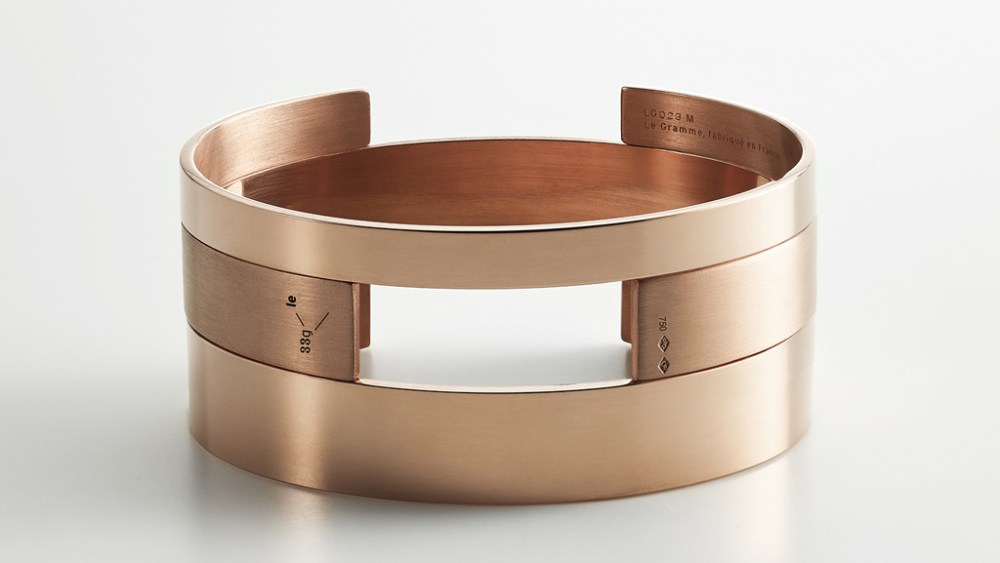
PARIS — When friends Adrien Messié, a former collaborator of French design maven Andrée Putman, and Erwan Le Louër, founder of ethical jewelry label JEM, stepped into the jewelry arena in 2012 with Le Gramme, they thought the market for men’s jewelry was “mature, but there was no selection,” explained Le Louër over a bottle of Evian in his pristine design office on Rue Beaubourg, just steps from the Centre Pompidou, Paris’ hub for modern and contemporary art.
“We launched the line just to see, did everything contrary to the market: We only had five references really — one design declined into different weights — and the fact is, it grew like crazy.”
Related Articles
In its first year, Le Gramme did twice as well as the founders predicted; in the second year, it tripled volume and now expects to triple again having sold approximately 5,000 pieces via its wholesale network, which currently spans 50 stores, including The Webster Miami, Selfridges and Bergdorf Goodman. Hip Parisian retailer Colette is said to be placing a reorder every two weeks.
You May Also Like
“Over the past couple of seasons, we have seen a notable increase in the demand for men’s jewelry at Mr Porter,” Toby Bateman, the online retailer’s buying director, told WWD. “We’ve seen this growth across all subcategories: from Tod’s’ woven leather wrap styles, Luis Morais’ beaded offerings and Miansai’s eclectic range, to brands like Le Gramme, with their understated cuffs in precious metals proving the most popular.
“We expect this trend to continue, and with this in mind we’ll be increasing our offering for the coming season,” Bateman added.
At Le Bon Marché, accessories are thriving, accounting for 40 percent of the men’s offer in terms of volume, and jewelry is a rapidly growing category within that segment.
“Sales are up 140 percent,” said Carole Falewee, buyer and product manager for Le Bon Marché’s men’s wear department, citing Le Gramme among the buzziest labels. “Men’s tastes have evolved from ostentatious rock-inspired pieces such as skulls and crosses to more refined, simpler items.”
Le Gramme, which at the moment has fewer than five minimalist bracelet collections employing either brushed or polished sterling silver, black silver, yellow or red gold, is manufactured in France.
Seven craftsmen work on one piece, which can weigh between 0.25 and 3.7 ounces and retail between $260 and $6,800. “It’s not like we invented anything new. The shape already existed,” explained Le Louër, “but we are freaks when it comes to details; we can spend up to a week working on one angle, and maybe men respect that. Also, the styles are so simple they fit many types — from the hipster to the lawyer.”
The trend is going strong on both sides of the pond. Case in point: Title of Work.
Jonathan Meizler, founder of the New York-based label, was running a successful accessories business built on ties and bow ties when he decided to launch a jewelry line three seasons ago, which “exploded immediately,” he said, despite a strong dollar.
“I had been doing primarily cuff links and tie bars for a bit and that was a nice niche, but as a designer I [was thinking about] what I could bring into the market that has not been explored yet. I saw a lot of people wearing layered bracelets and I thought, let’s do that in one piece.”
The multiwrap, a long bracelet made of multiple types of leather and chains in varying widths, which — when wrapped around the wrist, looks like a carefully curated assembly of classics — is now his bestseller.
“There’s a no-fuss factor in it,” said the designer, who has also started to integrate 18-karat rose gold and rough black diamonds, inching closer to the fine jewelry department, which is traditionally women’s territory. The pieces are still masculine thanks to their simple, clean lines and a darker edge, especially when mixed with waxed leather and oxidized silver for a rugged, used look.
Meizler says men are “experimenting more at this time. You see a guy with a whole wrist of chains, and it’s OK, it looks good and it’s sexy.”
Just don’t complicate things too much.
“Men have no patience to wear jewelry,” Catherine Zadeh is convinced — which perhaps explains why her parachute cord bracelet with a satin finish is a hit. “It’s waterproof. You can wear it in the shower or in the ocean. We always say our hash-tag is: never-take-it-off.”
With her namesake line, Zadeh aims for “the man who does not wear jewelry,” which, according to her, is 95 percent of men.
“We focus on a very simple and understated aesthetic, no Gothic or rock ’n’ roll, no big crosses or heavy pieces, but clean, elegant lines,” she noted, adding that sales of her line, which is handmade by New York artisans, jumped 250 percent in 2014 from the previous year.
Retailers have taken notice of the spike as well.
“The men’s business overall has been very strong the last few seasons, and chains, pendants, cuff links have become very popular. Everyone has a wrist full of collected pieces,” agreed Ken Downing, senior vice president and fashion director of Neiman Marcus, citing David Yurman, John Hardy and Stephen Webster among his top performers. “It’s all about the wrist for a gentleman, because it’s an easy way to translate fashion into the wardrobe.”
Downing has a hunch the jewels’ success story originated on the red carpet. “Male celebs often wear bracelets. They don’t have an open shirt, so the focus is on the wrist. And it’s not just the younger customer,” he noted. “Men of every age are embracing the idea of curated pieces for everyday use.”
Downing noted there was a time when men used to shop with women or just to find a gift; now they come “a lot” to the store to shop for themselves.
“It gives them a sense of confidence. Twenty years ago, there was an idea of international style. Now we are seeing an entirely new generation able to adapt to a trend much more quickly and pick it up. It’s the Internet that opened up the conversation of fashion,” he observed.
At Neiman’s, the category is experiencing a “nice growth,” according to Downing. “We are often looking for new collections to take in. It’s an underserved category — not as enormous an industry as women’s.”
“With guys, it’s tricky — you can’t go too crazy, because they won’t buy it,” said Michael Saiger, founder and head designer of Miami-based Miansai. “Designing for guys is like science.”
After six years in this still fairly novel business segment, Saiger attempts to keep the pieces modern with an industrial feel, which translates into square wires mixed with round screws, for instance. Besides his famous fishhooks, he is due to start working with more silver and brass, but said, “It just cannot feel like costume jewelry, it has to stay affordable and reach a wide demographic. Otherwise it doesn’t work.”
The opening price point at Miansai is $55, with the bulk of his business coming between $55 and $500, though Saiger says having opened his first store in New York last year exceeded his expectations. “People buy much more into the higher-priced segment now; they will come to the store for a watch and get a piece in solid gold for $5,000. It didn’t happen before, because there was nowhere to showcase those items. I feel like this has been the strongest season I’ve ever done.”
The company doubled its sales in 2014, and expects to keep up the pace of growth for 2015, having also hired a bigger sales team. Saiger said he aims to open five to 10 stores in the next five to seven years, with L.A., London and Paris among priorities, while he is keen to also expand the online business.
While simple styles have had a run, retailers cited an appetite for bolder designs as well.
Jo Harris, general merchandise manager of men’s wear at Harrods, said she noted that her “customers are influenced by statement iconic jewelry from the likes of Alexander McQueen and Versace. Generally, choice for men has widened.”
“We notice that men are increasingly discerning about their luxury purchases and are looking for unusual details that allow them to express their personal style in unique ways,” said designer David Yurman, who opened a flagship in New York last winter.
The space, which features a room dedicated to men, has performed well. “The percentage of men’s jewelry that we sell there is greater than most of our flagship markets. Currently, our men’s category accounts for 18 percent of our total retail business, and has emerged as one of our fastest-growing mainline product divisions,” Yurman explained.
The bulk of the label’s men’s business is generated in the $750-to-$1,000 price tier across the full assortment, “but we’re seeing that our male clients are increasingly willing to spend more on great design. Our most successful new launch in 2014 was a forged-carbon linked bracelet that was priced at $1,850,” said the designer.
Yurman plans to expand his range with new styles.
“When we design for men, we look for innovative materials, unusual techniques and design motifs steeped in history. Our clients have a tendency to accumulate and wear their jewelry like talismans to remind them of special places and times in their lives — ultimately layering pieces to create their own signature look,” he said, echoing retailers’ observations.
Yurman just launched his Faceted Metal collection, harkening back to high jewelry pieces with a new platinum that mimics the facets of a cut diamond. For spring, the brand will launch a collection called Heirloom in green and in black jade. “It’s the first time that we have used these stones in such distinctive cuts,” said Yurman.
Le Gramme, buoyed by the brand’s quick success, is expanding its range, too.
“We are branching out into leather goods and design very shortly,” Le Louër revealed, adding: “It’s going to be conceptual — a men’s lifestyle brand.”
On the other hand, following the launch of men’s watches one year ago, Miansai is targeting women with a watch line launched for spring. “Right now, women account for 20 percent of business. But that number is changing rapidly. By the end of this year, I expect it to be at around 40 percent,” Saiger predicted.