
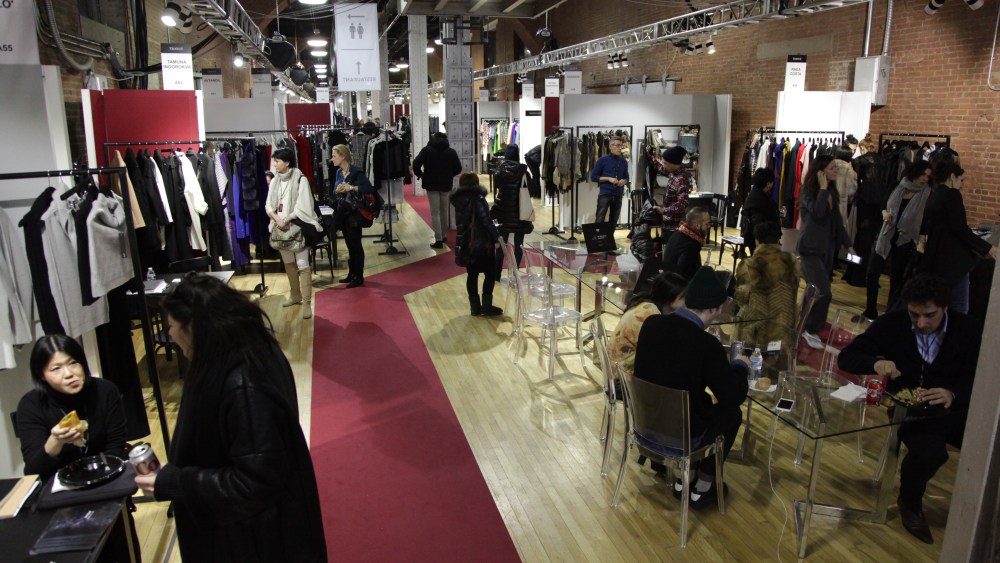
Tranoi, the long-running Paris trade show that means “between us” in Italian, last month held its first New York edition with 80 exhibitors. That’s a fraction of the 1,000 brands its Parisian older sister boasts, but Tranoi’s artistic director Armand Hadida isn’t worried, saying the New York show will grow organically.
Pointing to Tranoi’s long 20,000-square-foot space in the former Tunnel night club on 11th Avenue, Hadida said, “We need to keep this human size.”
“The purpose must remain elevated,” he said. “In Paris, we have a long waiting list. We’re very selective. The brands are very edgy.” As in Paris, Tranoi’s team in New York vets prospective exhibitors, taking into account a brand’s price point, distribution and image.
Related Articles
Tranoi’s development outside Paris was in part facilitated by a new investment in the company last summer.
You May Also Like
Hadida advises brands to stay away from displaying full collections, coaching them instead to “show a summary that’s more captivating. We propose that designers not bring all their goods. At Tranoi you don’t have to show 100 pieces. We are looking for new reflections to give to buyers because buyers today are a little lost.”
Tranoi was founded in 1993. When Hadida took the reins 12 years ago, the show was already a strong franchise with high-quality brands and exhibitions in high-profile Paris locations such as Palais de la Bourse and Carrousel du Louvre.
Hadida said he took over Tranoi “by accident. I had the opportunity to take this challenge. I loved it from the first moment and brought a new eye to this kind of exhibition.
“Retail is changing so fast,” said Hadida, who is also co-founder of L’Eclaireur, which has been a go-to resource for high fashion in Paris for 36 years with seven units throughout the city. “Department stores are demanding exclusives and breaking sales early. Consumers are asking for everything faster. The big companies are doing 20 collections per year. Our kids are doing four collections per year.”
Hadida said he’s looking for ways to help young designers succeed in the industry. He sees himself as an emissary of creativity. “In Paris at Tranoi, you won’t see jeans or sportswear. We can’t compete with Adidas. We’re here to coach people and help them be connected. We don’t have any pretense to come and change the rules and buying patterns in the U.S. The market here is so commercial. The only way for stores to survive is to bring in new things.
“I love the people bringing a new language and new creativity to fashion. That’s why we’re here,” said Hadida, who is bringing his ideas to L’Eclaireur as well. The Saint Ouen store, near the flea market, is actually a design gallery with well-appointed furniture and art but no clothing in sight. Scarves and fragrances are the only physical products available. Sales associates present fashion to customers on an iPhone, but only after engaging them in a conversation.
Tranoi’s designers had reasonable expectations, which were largely realized. Gavin Watson and Hamish Menzies’ Rocio is typical of the type of hand-made product that can be seen at Tranoi. The lacquered or painted acacia wood evening bags and clutches retail for $450. “We wanted to start building our sales in the U.S.,” Watson said, noting that the Scottish brand is sold at Le Bon Marché, L’Eclaireur and Harvey Nichols. “We want to replicate that in the U.S.” Rocio got a lot of interest during the show and took home a few orders. “Tranoi is a good platform in New York,” Watson said. “It will take time to gain traction.”
“I show with Tranoi in Paris and was curious to see the first New York edition,” said Francesca Zara, whose Barena collection for men and women is manufactured near Venice. Zara, who designs the women’s wear, said the company’s strength is its fabrics. Wholesale prices for blazers range from $200 to $350, and coats, $350 and up. “We’re happy with the show,” she said. “We got several orders from new customers.”
“My stuff is very European, so I wanted to participate with a European trade show,” said Dahui Li, of his self-named collection. The Columbus College of Art and Design graduate’s fall collection was inspired by the Sixties and Mary Quant. “Harvey Nichols stopped by,” he said. “Buyers showed interest.”