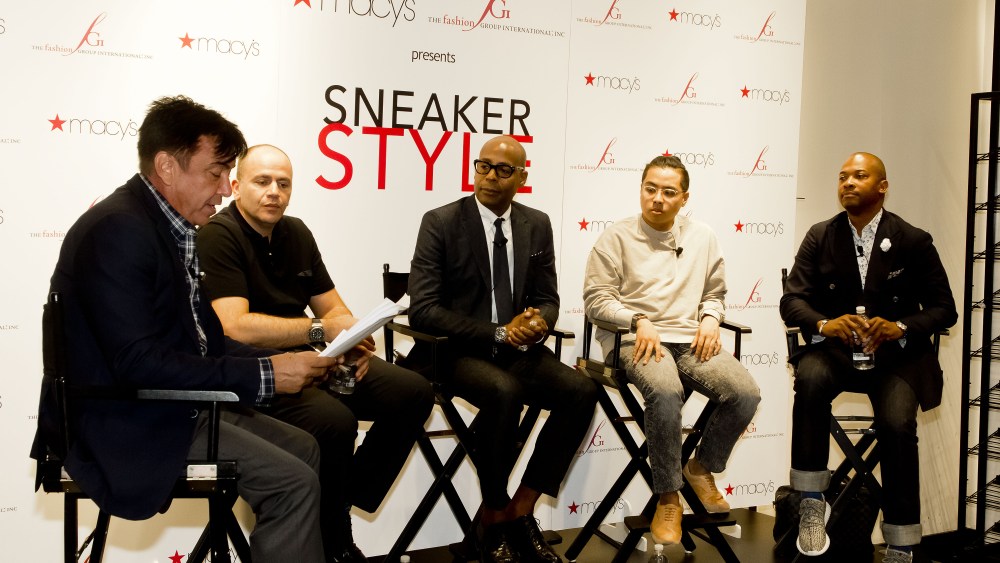
Sneaker culture has transitioned from a niche movement into a big business that’s impacting the mass market.
Macy’s, which hosted a panel on the subject with nonprofit organization Fashion Group International at its Herald Square flagship on Monday night, latched on to the trend early. In 2012 it partnered with sneaker chain Finish Line to bring 450 branded shops-in-shop within its department stores.
Since that deal, the customer’s affinity for sneakers has only increased according to Durand Guion, vice president, men’s fashion director at Macy’s.
“We have a generation of young men who have not grown up with this idea that this is the type of shoe you wear Monday through Friday and this shoe is only OK to wear Saturday through Sunday,” said Guion. “The titans of the industry are no longer the chairmen of Bank of America. It’s the leaders of Facebook or Snapchat and there is no way they are going to give up sneakers.”
Related Stories

Guion was joined by Ronnie Jefferson, executive vice president and merchandise manager for Finish Line, Macy’s; Jian DeLeon, deputy style editor at Complex Media; Udi Avshalomov, president and chief executive officer of footwear licensing firm The Cobbler’s Kitchen, and Joseph DeAcetis, the creative style director at Forbes Media who moderated the panel.
You May Also Like
DeLeon said the sneaker consumer has become savvier about the market and that interest in fashion has expanded beyond footwear and into the growing sportswear market.
“It started with the shoes, but now it’s about more than that. Now, shoes are just a starting point and it’s about how to complement the lifestyle the sneakers represent,” DeLeon said, adding that because this customer is more educated, it’s even more important for brands to offer an authentic message.
Jefferson agreed, stating that vendors must stick within their DNA when assessing new collaborations or brand extensions because the wrong pairing could have a negative impact. “For every Kanye West collection, there are about 80 collaborations that fail,” said Jefferson. “I think from the vendor standpoint, getting someone that’s an influencer prevents them from spending $30 billion on a television ad. Those brands are definitely looking to find those influencers that can propel the brand and emotionally connect with a consumer.”
Puma is taking this route with its Rihanna partnership. The pop star was brought on as creative director and designed an active collection for the brand; a black-and-white creep-soled version of the classic suede Puma was released last week. The panelists agreed that this celebrity and brand tie-up makes sense.
“Rihanna is a style icon that’s a force to be reckoned with,” said Guion.“If I was going to bet on anyone right now I would bet on Rihanna.”
When DeAcetis asked if sneakers that feature cutting-edge technology are important, Udi acknowledged that it’s a nice add-on but not something the customer is currently seeking.
“If you go back and look at the Reebok Pump, I don’t think any guy thought they would be a better tennis player if he sat down and pumped his shoes 10 times before he got on the court,” said Udi. “Guys bought the shoes because they felt like a toy.”
Udi did say he is utilizing 3-D printing technology in the development stage and creating prototypes on the spot instead of waiting for manufacturers in China to build the shoe. “It’s going to change the speed to market significantly,” said Udi.
In terms of what’s trending, Jefferson said that customers have moved away from the multicolored styles and on to monochromatic looks. For holiday, Durand predicted that boots or boot hybrids will see a resurgence. DeLeon cited rapper Drake’s OVO Air Jordan 8 sneaker and Kanye West’s Yeezy 950 duck boots as items that will be popular with customers for holiday.
The group didn’t foresee the sneaker market hitting its peak anytime soon.
“It’s going to grow a lot more before it becomes too overexposed,” said DeLeon. Guion felt the same way but added that there will eventually be a return to more formal attire within the men’s wear market. “We are at a point and time when there is an accessibility to the newness and fast nature of sneakers, but we will move back into a dress-up cycle and for a certain segment of guys, the sneaker will not be king.”