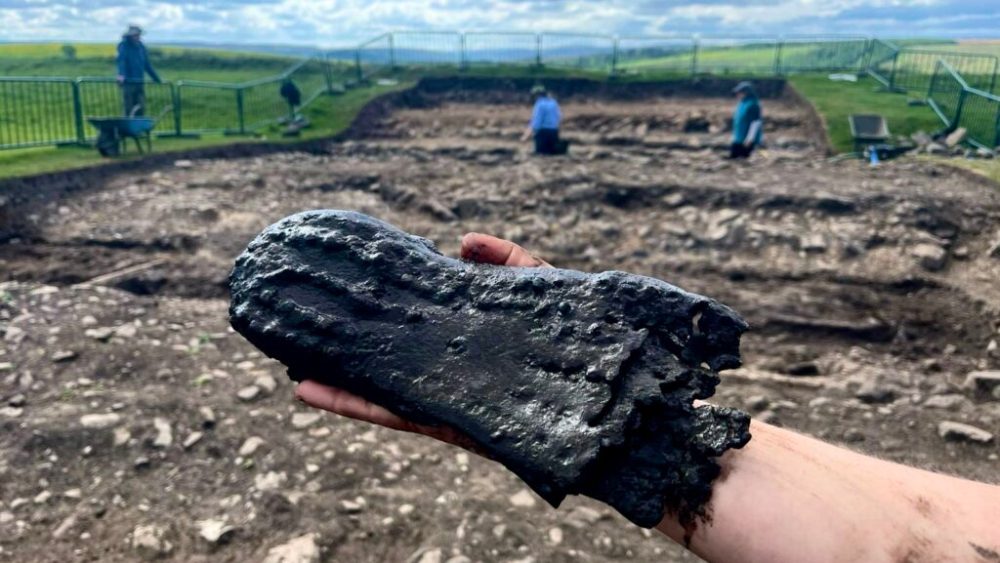
Three well-preserved leather shoes were discovered at Magna Fort this spring, offering a rare window into ancient Roman footwear — and one very big foot.
At the Magna Fort excavation site in Northumberland, archaeologists recently unearthed two unusually intact Roman leather shoes, including one so large it may be the biggest ever found along Hadrian’s Wall.
The shoes were recovered in mid-May from waterlogged soil layers at the base of the fort’s northern ditch, where oxygen-free, anaerobic conditions preserve organic materials, such as wood, leather and textiles. These deep, sealed layers have become a kind of archaeological time capsule, and the dig is delivering.
You May Also Like
Related Stories
The first shoe, found May 19, retained several key structural elements: “all of its sole layers intact, along with part of the heel area still attached and most of the hobnails in the outer sole,” according to the Magna Dig Diary. The design reveals typical Roman construction, with layered leather held together by thongs, stitching and metal hobnails used for a practical build for long-distance walking over rough terrain.

“It gives us a really good look at how Roman shoes were made,” the dig team wrote. And though the toe section was missing, archaeologists could still estimate the original length — likely a large men’s size in its complete form.
Then came the headline-grabber: a second and third shoe, found two days later, that were “intact from toe to heel and immediately drew impressed gasps from volunteers and staff alike.” Measuring in at 32 centimeters long — roughly a U.K. men’s size 12 to 14 — one shoe may be the largest leather footwear ever discovered in the Vindolanda Trust’s collection. “The sheer size of the shoe and guesses about who could have worn it dominated the conversation,” the team noted.
The shoes were uncovered in the base of a Roman military ditch that featured a notorious defensive structure: the “ankle breaker.” Senior archaeologist Rachel Frame explained in a dig update on YouTube, “Down at the bottom we have the ubiquitous ankle breaker — a common feature of Roman military ditches intended to snare any unfortunate victims.…They would put their foot down expecting solid ground and instead they would find a nice hole and just disappear into it as their body continued over the top and their ankles broke.” The trap, typically hidden beneath swampy floodwaters, was designed to stop any attacker from reaching the fort wall.
That same ditch is where the anaerobic finds have been emerging. “So far we have had three shoes along with various other pieces of scrap leather — most of which appear to be from shoes but will be identified more closely by our leather specialist,” Frame said. “The anaerobic preservation here has generally been pretty good, which is really promising for our future excavations.”
Jo, a volunteer on the excavation, described the thrill of unearthing such a personal artifact on the team’s dig diary: “It’s always exciting to find anything that hasn’t been touched for 2,000 years, but a shoe is such a personal item — it really puts you in touch with the people who used to live at the fort. Getting wet and muddy and digging in the wet is just a bonus!”
These finds not only offer a rare window into daily Roman life in the North but also reflect a throughline that stretches into today’s footwear culture. Roman military shoes like caligae were prized for durability and grip, but they were also quietly expressive — varying by rank, region and purpose.
And there may be more to come. Frame noted that multiple ditches beyond the fort are still to be explored — “we were expecting hopefully five” — with the potential for preserved timber buildings beneath later stone remains once excavations move inside the fort walls.