Alex Honnold left audiences in awe when he free-soloed Taipei 101, Taiwan’s tallest building, in January as part of a live Netflix special.
Honnold accomplished this feat wearing the TC Pro climbing shoes from La Sportiva, the outdoor brand he serves as an ambassador for and has worn for more than 20 years. (Notably, La Sportiva notes it wasn’t involved in the Taipei 101 climb, nor does it create shoes for such a climb.)
Honnold, of course, is a master climber with decades of experience under his belt. But where should people interested in trying out the sport for the first time start out? What paraphernalia is required?
You May Also Like
Related Stories
A good climbing shoe is imperative to the beginner’s journey, so FN asked Mike Genauer, La Sportiva’s director of product and planning, about navigating the brand’s products.

What shoes do you recommend for someone just getting into rock climbing?
“For your first pair of rock climbing shoes, comfort matters most,” Genauer said. “If you are uncomfortable, you are far less likely to enjoy the sport and stick with it. Your first shoe should feel snug, with your toes slightly curled, but it should not be painful. The goal in your first weeks and months is to have fun and learn good movement and technique, not to fight through foot pain.”
Genauer recommended La Sportiva’s Tarantula series for beginners, including velcro and lace styles, some of which sway toward gym climbing or bouldering. The expert also recommended the lace-up Finale style, which is particularly good for those wanting to switch between gym and outdoor rock. These styles are described as “comfortable and supportive,” and able to be worn for a full session while providing comfort throughout.
Genauer said, “When deciding between Velcro and lace, think about convenience versus adjustability. Velcro is quick and easy, especially in the gym when you are taking shoes on and off between climbs. Laces allow for a more customized fit and can feel more secure, particularly for longer sessions or outdoor routes.”
How might the footwear change as a rock climber advances in skill level?
Footwear will typically be more precise and aggressive as the climbers advance in skill level, FN learned from Genauer. Intermediate-level models at La Sportiva include the Kubo and the upcoming Skwama Lite, launching in April: “These shoes offer more sensitivity and a slightly more performance driven shape but still remain comfortable enough for longer sessions.”
The next level sees climbers moving to performance shoes, with the Skwama and the Solution being two such examples. Genauer explained how this type is unique: “These are more asymmetrical and downturned. That shape focuses power into the toes which helps on steep terrain and small footholds. They are built for precision and performance, not all-day comfort.”
What are the key differences between indoor and outdoor climbing shoes?
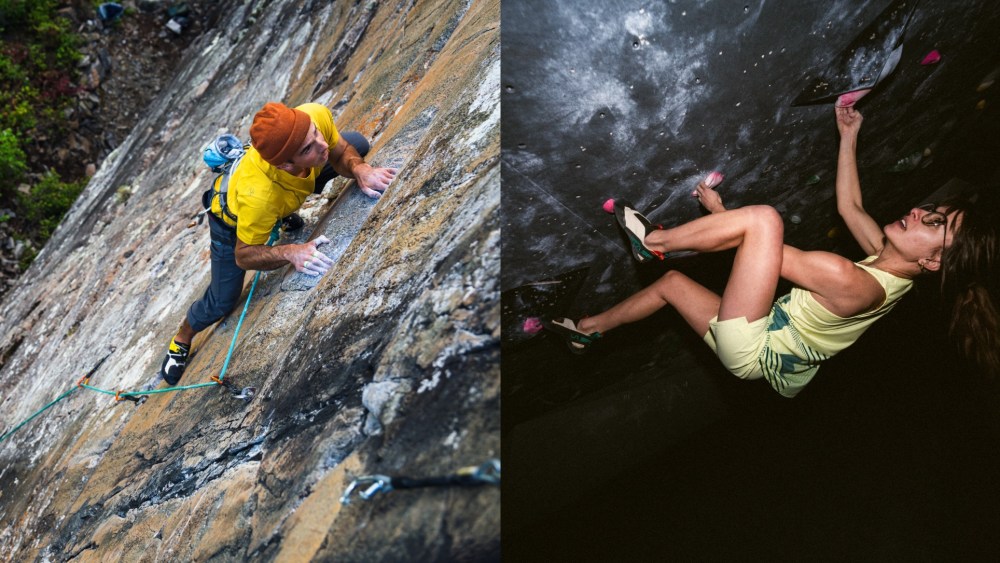
Genauer shared: “Indoor climbing often involves steeper terrain, large volumes, and in a lot of gyms today more dynamic movement. Softer, more sensitive shoes like the Theory, Skwama or Skwama Lite can feel great in the gym because they allow you to really feel the holds and grab features.”
When it comes to outdoor climbing, the type of rock in question plays a strong role. “On granite or limestone, edging power and support can matter more. Shoes like the Finale or Kubo work well outside because they offer structure and durability for longer routes.”
Genauer also explained that, particularly in the early stages, a lot of climbers use the same shoe for indoor and outdoor climbing. As they become more experienced and hone in on certain styles or goals, it’s common to pick one shoe style for gym training and another for outdoor endeavors.
What goes into developing a rock climbing shoe?
From concept to retail, the development of a climbing shoe can take two to three years, Genauer shared, with one shoe comprised of about 70 individual parts and pieces that have to unite in one system.
The director of product and planning explained, “It starts with defining who the shoe is for. A beginner shoe like the Tarantula is built around comfort, durability, and support. A performance shoe like the Solution is built for precision, power, and steep terrain.”
From designers building around the last to having the shoes “tensioned, stretched, molded,” on the manufacturing line to having them assessed in athlete and field testing, among other steps, climbing shoes go through a complex journey to make it to retail.