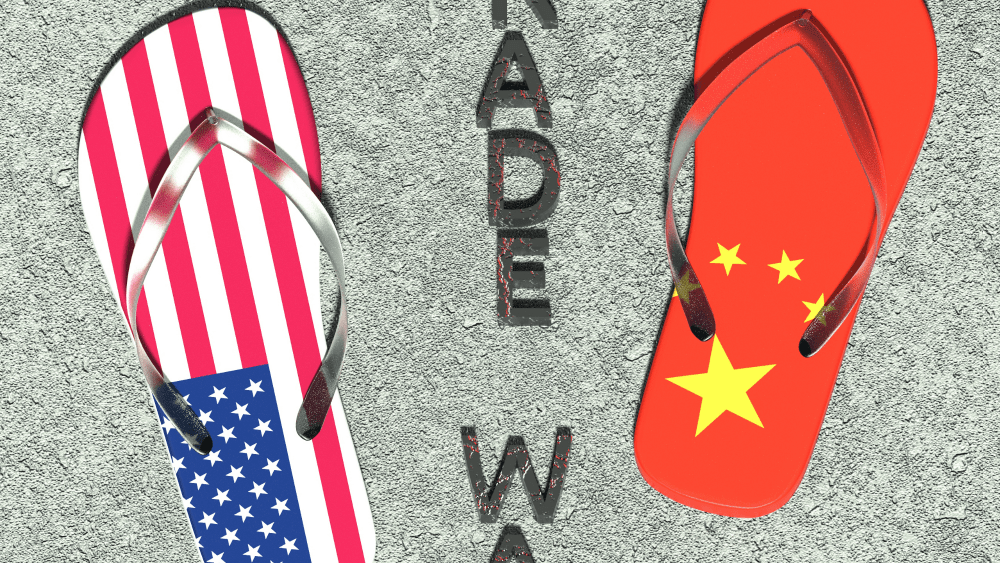
The footwear industry flailed its way through a tumultuous 2019, and will wash up on the shores of a new decade with a glimmer of hope as a life raft.
A phase one trade deal, agreed upon by President Trump and Chinese President Xi Jinping in December, allowed footwear brands and retailers to breathe a tentative sigh of relief at the avoidance of new and potentially devastating tariffs.
But while List 4B—which was set to go into effect on Dec. 15—has officially been put to rest for the moment, the industry still stands to feel the full weight of previously imposed sanctions on shoes and inputs made in China.
Heading into the holidays, footwear insiders who hoped for a bit of cheer are still feeling a blustery chill at their backs.
Related Stories

“The moniker for this year in the footwear industry has been ‘The Year of Drowning in Uncertainty,’” Nate Herman, senior vice president of supply chain at the American Apparel and Footwear Association, said.
You May Also Like
While things could technically have ended up worse this month, staring down the unknown in 2020 still feels like a herculean task. “We have contingencies upon contingencies in place, but things could change at a moment’s notice,” he added.
Despite the turmoil of 2019, many brands have yet to move out of China, and are still “highly exposed” in the region, said Herman.
Making strategic supply chain decisions within the pressure cooker of an ongoing trade war is counterproductive for brands looking to set themselves up for long-term success. Still, Herman knows that remaining in China while the battle rages on could open brands up to more risk.
“Even though we might have dodged a bullet with the Dec. 15 tariffs, there are three things to know,” he said.
“First, they were only suspended, and they could come back into play at any time. If that happens at the 15 percent level, we’re talking about $1 billion in additional tariffs for the year,” he noted.
Second, 53 percent of footwear coming into the U.S. is still subject to punitive tariffs at a rate of 15 percent—and since September, U.S. brands have paid about $370 million in additional duties, according to Herman. While the duty rate is supposed to be reduced to 7.5 percent under the new trade agreement, it’s unclear when the change will actually take effect.
The deal’s final, fatal flaw rests in the fact that “retaliatory tariffs that China put in place are still impacting the inputs that we use,” he said. Materials like leather hides (which are sourced in the U.S. but manufactured in China) were not included in tariff reductions.
Consumers are likely unaware of the effect that tariffs could have on their spending, Herman argued, because brands and retailers have shielded them from price increases. Most of the product on shelves today entered the country before the first round of duties took effect Sept 1.
“For the holiday season we’ve made every effort to try and hold the line by bringing in product early,” he said. Consumers will start to understand the trade war’s implications come spring of 2020.
“Because of efforts by companies, they’ve been largely spared the full impact,” he added.
While Herman could only conjecture that increases in price would have an adverse effect on shoppers’ purchasing patterns,anxieties surrounding the trade war would likely peak if American workers are drawn into the fray, he said.
“The footwear industry employs one million Americans, and we’re going to be hit,” Herman said. “When people start being affected—when benefits get cut and layoffs start happening—that’s going to play into this as well.”
Tussling with the Chinese
While voices throughout the industry have been calling for a concrete resolution, experts are tentative about voicing lofty expectations.
“It’s like the fire department came and put out part of the fire in your home while other parts are blazing,” said Matt Priest, president of the Footwear Distributors and Retailers of America, of the Trump administration’s phase one deal. “At the end of the day, they’re the ones who started the fires.”
“Tussling with the Chinese” will likely remain a political power play as long as the president remains in office, he said. “Depending on what happens next November, we could be doing this for years to come,” he added.
Priest does believe that the new deal signifies a definite step forward, however. “Any tweet can change the course of history, but this feels a lot different than where we’ve been before with some of these pronouncements.”
Priest’s hope was bolstered by provisions in the agreement laying out goals of enhancing rightsholders’ privileges in China, with the aim of combatting counterfeit products streaming into the U.S. Of the full text of the agreement, which spans nine chapters, Priest said, “It’s going to be more robust than what people are expecting.”
Despite confidence that negotiations are moving forward, a look back at recent seasons reveals lasting damage.
“It’s been a super, super disruptive year to say the least,” Priest said. “The relationship is forever changed—no one will ever be comfortable again sourcing from China without the memory of this, and it’s not even over yet.”
It’s tough to pinpoint the number of brands that have actually abandoned their Chinese suppliers over the past year due to tariff concerns, Priest said. Footwear companies have been diversifying their sourcing for a decade now, and the amount of product flowing in from China is at an all-time low.
In 2009, about 88 percent of U.S. footwear was manufactured in Chinese factories. Ten years later, that number has dwindled to 67 percent.
The FDRA is working to calculate the broader impact of the year’s conflict through a survey of brands that will be available in Q1, he said. Measuring the impact of the trade war will involve comparing the organization’s forecasted company departures from China (based on already existing trends) with what actually took place in 2019.
Tariffs aren’t the only volatile element causing brands to head for greener pastures. Other variables like rising labor, energy and raw material costs are also prompting companies to reevaluate their partnerships with Chinese suppliers. And the longer the conflict festers, the more businesses will adapt and evolve.
“Brands are constantly trying to figure out new ways to design and manufacture shoes,” Priest said. “That’s driven by duties, by a desire to be sustainable, and by fashion.”
Over the past year, brands began rethinking their designs and supply chain processes to avoid a need for Chinese manufacturing. That means shirking the status quo for different styles and materials altogether.
For footwear newcomers and direct-to-consumer startups, inventing new ways of doing things doesn’t feel so foreign. But across the industry at large, the effects of tariff uncertainty have stymied growth and innovation.
“I can’t overemphasize the dampening effect that tariffs have had,” Priest said, adding that many footwear executives have bemoaned the need to curtail investments because they don’t know what their duty bills will look like.
“They’re still trying to launch innovative product, but when you have to think about multiple millions of dollars going to tariffs that you weren’t expecting, that’s real money,” he added.
As the new deal helps to peel back some of the tariffs’ impact, though, Priest is crossing his fingers for strong economic growth in the industry—and a renewed focus on capital investments, employment and exciting new products.
It wasn’t just American footwear brands that took a hit in 2019. Chinese suppliers have been reading between the lines for years, and this year found themselves in the midst of a long-winded breakup speech.
A true reconciliation is unlikely, China Chamber of Commerce president Siva Yam said. But the process of separating will be “slow and long,” given the many steps that brands must take to explore other avenues for production, and put down roots in new markets.
“The constant shift in the direction of the trade dispute makes relocation risky,” Yam said. “As a result, most companies are not rushing, but moving cautiously.”
Still, it’s an undisputed fact that U.S. companies will continue to look elsewhere for sourcing, he said. China’s runner up in the fight for footwear is Vietnam, which Yam characterized as having “a relatively skilled labor force in athletic shoes.”
While the much smaller country has basically reached capacity for footwear manufacturing, others are actively working to develop the supply chain infrastructure and design capabilities needed to compete.
“Once the American importers find reliable sources, unless something dramatically changes, they are not going to reverse,” Yam said.
U.S. brands will need to adapt to the different cultures and unique talents represented in other markets, though. “It is very important for American designers to understand how to design a product for production,” Yam said, “taking into consideration the capabilities and social constraints of the manufacturers in specific countries.”
Few other nations have a workforce accustomed to working around the clock, seven days a week, he added.
Meanwhile, Chinese manufacturers will also work on broadening relationships in other markets, “particularly those that share their political philosophy,” he said.
No matter the impact of the phase one deal, the impact of 2019’s tariff saga will leave an indelible mark.
“We just need to accept and adjust,” Yam said. “The trade war has taken many turns, and the intensity will depend on the election, the progress and the result. It is very difficult to predict, but life will never be the same.”