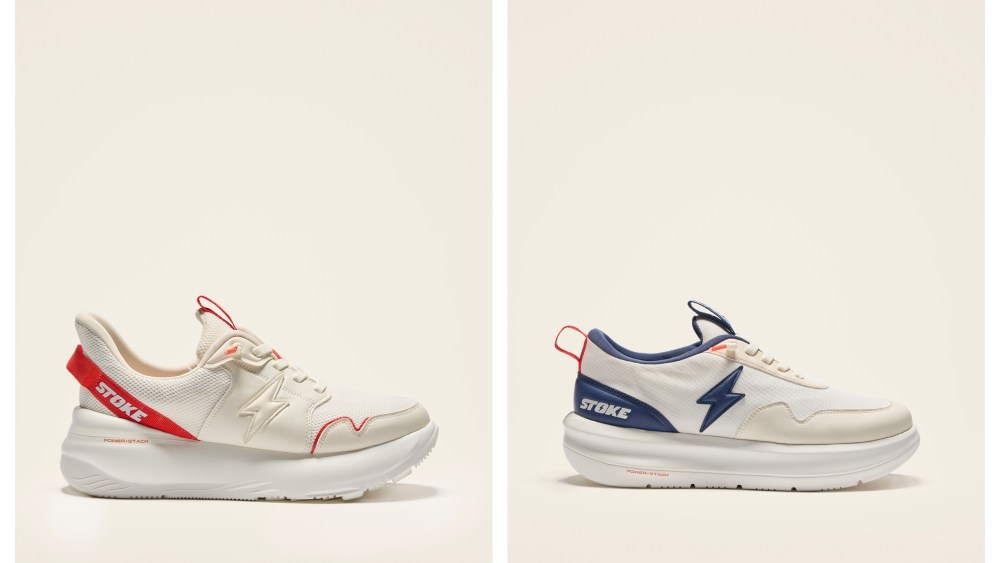
Stoke Shoes cofounders Rick Blackshaw and Ian Stewart are targeting an under-served consumer, the ordinary man on the street.
“Four out of five guys that buy a pair of running shoes don’t run in them,” Blackshaw told Footwear News of the insight his team learned, which led to them creating a “sport casual” sneaker for the average man. The Stoke shoe is for guys who don’t run, rely on walking as their primary form of exercise and want the same key running features for cushioning and comfort.
Related Stories
Blackshaw, whose shoe experience included executive stints at Sperry, Keds and HeyDude, and Stewart, the marketing expert who worked at Converse, Ugg and Toms, believe the average man represents a “large white space” with a long runway for growth opportunities. Billy Gorlesky, also a cofounder, is vice president of sales.
You May Also Like
Stoke believes the men’s footwear category is a market that has “65 million guys who’ve been completely forgotten by modern brands.” The brand is unveiling two sneaker styles for spring 2026, the FoMo and the Versa, at $85 and $80 a pair, respectively. Each style offers seven stock-keeping units.
The shoes will be in stores and online starting next February. According to the sneaker start-up, it already has commitments from national retail chains and independents that include Scheels, Rack Room, Academy and Shoe Sensation, as well as BootLegger’s, Red’s Shoe Barn and Austin’s Shoes. The bigger chains will help the brand “anchor” its positioning, with additional independents as part of its goal to reach 3,000 locations as the initial store target.
This is the strategy Blackshaw used when he was president at HeyDude that enabled that brand to hit $1 billion in sales in five years. The company is also in the early stages of mapping out its international strategy that Blackshaw calls Phase 2 of the brand’s expansion.
In addition, the company believes it can partner with other complementary brands. These include collaborations and storytelling in trucking, hunting, outdoor, and camping, as well as BBQ and food culture, motorbikes like Harley Davidson, and power tools — things that are part of day-to-day life. Stewart is also in the midst of planning marketing events that honors veterans on key holidays, offering discounts to military vets and first responders who buy on the company website, and donations to select charitable nonprofits.
So, who is this average guy?
According to Stoke’s customer profile, based on the National Institute of Health Statistics (NIHS), he’s between ages 25 and 54, 5 feet 9 inches tall, and weighs 200 pounds with a 41-inch waist. He’s also a large man with wide feet and lives in middle America. He’s not a runner, although he may take a jog from the living room to the kitchen for a snack.
Stoke also believes that the average male is a guy who loves to watch his favorite sports team on the television screen, and he’s not one to starve himself. In fact, Stoke’s marketing deck humorously notes that BBQ and beer are among his favorite things, and he listens to country music and local radio stations. Tongue-in-cheek humor aside, Stoke’s target consumer is proud to be an American, and is also a family man who values hard work and self-reliance.
“We think of him as the engine of the country,” Blackshaw said, noting that whether he’s in the military, a first responder or other position, he has a job where he’s on his feet all day. What this all-American guy needs is casual footwear that’s stylish and comfortable, whether for work or walking the dog as his form of exercise, the cofounder explained.
To meet the consumer’s footwear needs, Stoke designed a sneaker with lasts that are available in just two widths — wide (E) and wider (EE). The company said their data points indicate that 75 percent of men need a E+ width, but only 25 percent are finding it. The wider shoes allow for splaying of feet, instead of the “containment” found in the narrower shoes on the market. Crafted from stretch uppers that provide an adaptable fit featuring a “rugged build” and an easy-on design, as well as a high degree of underfoot cushioning, the design is aimed to curtail the formation of bunions, avoid constant foot and joint pain, and prevent instability and balance issues.
“We’ve got the most cushioning underfoot. The FoMo has 44 millimeters of injection-molded EVA at the heel, and 34 at the forefoot, and so it’s also insanely lightweight,” Blackshaw said, describing also the stretch upper as a “dynamic four-way stretch textile material.”
Early concept testing found a 70 percent positive sentiment among reviewers, with cushioning among the most positive takeaway, according to Stoke survey data. According to Blackshaw, the shoes are made in Vietnam. He’s not worried about the new tariff structure. “I think there’s a 9 percent duty, and now it’s at 20 [percent on top of the existing] 9. We’re okay with where that stands,” Blackshaw said. “At our price point, it’s still such a great price value. I think the tariff situation benefits us more than you know. If you were at $150-plus, that’s the sort of thing that starts to push people down into the lower price brands.”
For now, Stoke is focused on just the men’s market, although there’s potential growth in other segments too, including women’s.
