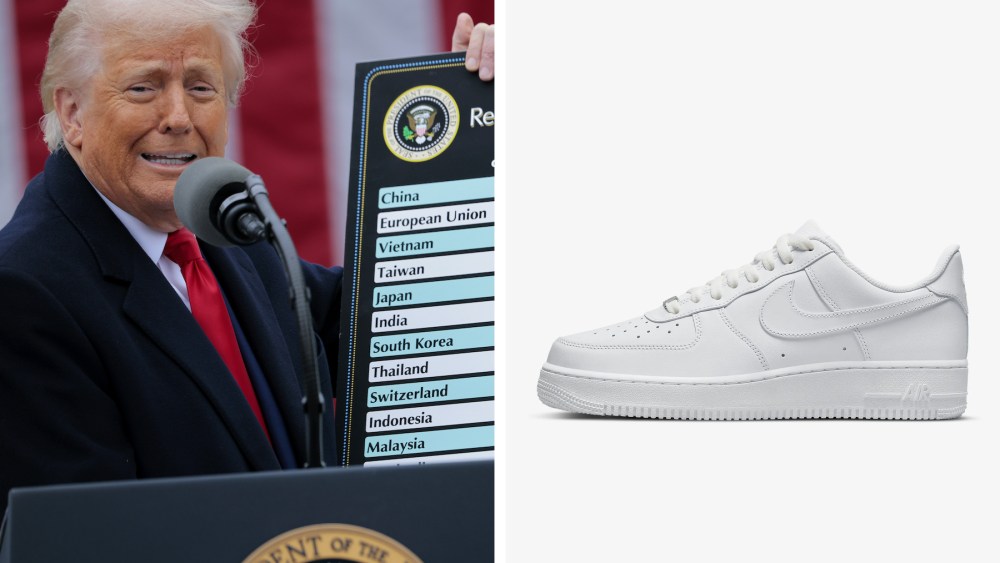
U.S. President Donald Trump’s announcement Wednesday of sweeping tariffs is likely to have sneakerheads thinking about international trade policy more than usual.
Vietnam, the largest producer of sneakers for Nike, would be one of the countries with the highest tariff rates should Trump’s policy go ahead as announced. The president said Vietnam will be subject to a 46 percent tariff for all products exported to the United States, and that cost would likely be passed onto consumers.
Related Stories

Roughly half of Nike‘s sneakers are produced in Vietnam, with China (which Trump slapped with an additional 34 percent tariff) and Indonesia (which got a 32 percent tariff) as the next biggest sources.
You May Also Like
So just how much would some of Nike’s most popular sneakers be under the new tariffs? Landing at a precise answer, of course, is complicated.
Nike will be asking the same question itself as it would be expected to work with its manufacturers and material suppliers to figure out how much each party would be willing to eat in its profit margins. It’s also not as simple as applying Vietnam’s 46 percent tariff to each product made there because parts of the sneaker could have been produced from other countries. And then there’s the matter of how much a sneaker actually costs for Nike to import versus what it costs at retail.
Because “we don’t know precisely” isn’t the most satisfying of answers, there are rough estimates that can be made. UBS analysts have predicted that consumers will see a 10 to 12 percent rise in costs for goods produced in Vietnam, according to Reuters.
Applying those figures to the existing prices of some of Nike’s most popular models, here’s how the new prices could look.
- The Nike Air Force 1 Low and Dunk Low, currently priced at $115, would cost $126.50 to $129
- The Nike Air Max 90, currently priced at $130, would cost $143 to $146
- The Nike Pegasus 41, currently priced at $140, would cost $154 to $157
- The Air Jordan 1 High and Nike Air Max 95, currently priced at $180, would cost $198 to $202
- The Nike Air Foamposite One, currently priced at $240, would cost $264 to $269
- The Nike Alphafly 3, currently priced at $285, would cost $313.50 to $319
Again, these prices are just estimates, as it’s hard to predict the precise fallout to Trump’s tariffs. It’s possible the tariffs are lowered after negotiations or the president simply reversing course as he’s done before. (It’s also unclear how companies will absorb the costs and how much of burden will be passed on to consumers.)
Nike could also make adjustments to where its sneakers are produced, though that would take time, and the products it already makes in China and Indonesia would be subject to different rates.