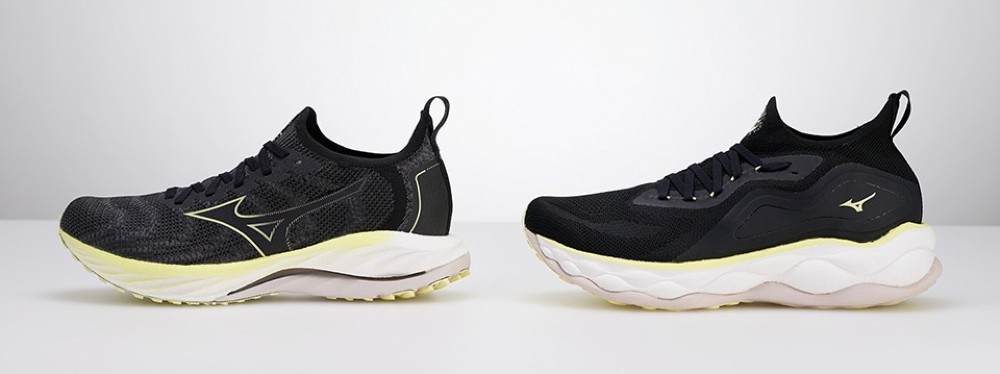
Japanese footwear company Mizuno has released its lowest-impact running sneakers to date, incorporating eco-conscious materials and offsetting production emissions.
The brand’s Wave Neo Wind and Wave Neo Ultra sneaker pack was developed with recycled polyester uppers, as well as Algix Bloom algae sock liners. Bloom’s bio-based EVA was mixed with Pebax Rnew, made from castor beans, to form the shoes’ midsole material. According to Mizuno, the upper for the black color way was made using a dope-dyeing process, wherein color is infused into the polyester in its liquid stage before it is extruded into fiber and made into yarn, negating the need for water-based dyeing.
Related Stories

Carbon impacts generated during the production process will be offset by reforestation efforts. Mizuno has teamed up with the U.S. National Forest Foundation to plant about 50,000 trees in Idaho’s Boise National Forest, noting that over their lifetime, the trees will absorb the amount of CO2 generated during the product lifecycle of the 20,000 pairs being manufactured.
You May Also Like
In addition to considering ecological impact, Mizuno said it aimed for designs that would serve long-distance runners, like those who compete in marathons. The Wave Neo Wind was engineered for both beginners and advanced runners who “prefer a propulsive feel for their run.” The shoe’s core technology, Mizuno Wave, provides cushioning and promotes stability, along with its highly resilient Mizuno Energy sole. The shoe’s G3 outsole offers lightweight traction. The Wave Neo collection is available in men’s sizes 7-14. The shoes retail for $250 on Mizuno’s e-commerce site as well as at select retailers.
The footwear release is the culmination of more than 30 years of study, Mizuno said in a statement. In 1991, the company launched an environmental conservation initiative called the Crew21 Project, aimed at mitigating carbon impact. In 2021, it committed to achieving carbon neutrality by 2050 through a focus on reducing waste, incorporating recycled plastics and plant-derived materials into its designs, prioritizing water efficiency and developing renewable energy sources for its production processes.