For Puma, the past nine months have been all about discounting. That is, there’s been way too much of it, the German sportswear brand’s executives argue.
They believe they should be selling more of their products at full price and to this end, the company has been reducing inventory around the world and will simplify its product portfolio going forward.
The range of products should decrease by a mid-double-digit percentage by spring 2028. Meanwhile by the end of this year, Puma inventory in U.S. mass market wholesale will have been reduced by as much as a mid-double-digit percentage — Puma executives wouldn’t be drawn on the exact numbers.
Related Stories

“The big cleanup was done primarily during quarters three and four [last year],” Puma chief executive officer Arthur Hoeld told journalists during an online press conference revealing first-quarter results for 2026 in Germany on Thursday morning. The takebacks have increased Puma’s own inventory but the company is now liquidating that excess stock by selling it through select wholesalers or its own direct-to-consumer channels.
You May Also Like
It should all be gone by the end of 2026, Hoeld noted, and so far the brand has seen better-than-expected results from its liquidation tactics. This was part of the reason why Puma’s results for the first quarter of this year were above expectations.
Over the first three months of 2026, sales at the German sportswear company fell 1 percent, in currency adjusted terms, to 1.86 billion euros. But analysts had expected a decline of closer to 3 percent and sales of only 1.82 billion euros.
Puma’s earnings before interests and taxes, or EBIT, rose 19.6 percent to 51.9 million euros. This resulted in a slightly improved EBIT margin of 2.8 percent.
Market analysts from the likes of Deutsche Bank, Jefferies and the Royal Bank of Canada all praised the results because Puma had outdone forecasts. However, as several pointed out, inventory reduction and liquidation are one thing, regaining market relevance and releasing new products quite another.
“Our Q1 results for 2026 are in line with our expectations and I would say they are a very solid start to what we call our transition year,” Hoeld explained. “This is despite the macroeconomic and geopolitical uncertainties.”
Hoeld, who took on the top job last July, previously unveiled a three-year plan to bring Puma back into the black. By 2027 the brand will return to growth, he repeated on Thursday.
Besides taking back products, Puma has also restructured its European operations and reduced its workforce. The company previously said 1,400 corporate roles would be cut. By this quarter, only around 280 positions are still to be actioned.
There have also been a number of changes in Puma’s leadership roles. On Thursday, Puma said that Mark Langer, the former chief financial officer and then CEO of German fashion company Hugo Boss, would start as Puma’s CFO from May 1. There have also been new appointments made in the creative department with Puma employing James Carnes as senior vice president of creative direction and Laurent Fricker as vice president of sportstyle. Both are Adidas alums, which is where Hoeld worked in senior management for over 25 years, until late 2024.
Puma saw mixed results in its sales territories.
In Puma’s home market of Europe, the Middle East and Africa, or EMEA, sales fell 10.4 percent in currency adjusted terms. This was due to weaker consumer demand as well as reduced wholesale as Puma cleared inventories.
It was also because of “lower sales in the Middle East amid ongoing conflict in the region,” Puma said in a statement. The Middle East makes up less than 2 percent of the brand’s total sales.
Revenues in the Americas increased by 6.1 percent. There, North American consumers bought 2.3 percent more Puma products while in Latin America, they purchased 10.5 percent more.
In the Asia-Pacific region, sales grew by 7.9 percent, currency adjusted, with Greater China contributing a 9 percent increase and the rest of the sales territory bringing in 7.4 percent more.
In terms of product categories, Puma footwear sales — the company’s largest category — fell by 2.3 percent. Apparel and accessory sales rose 0.9 percent and 0.3 percent respectively.
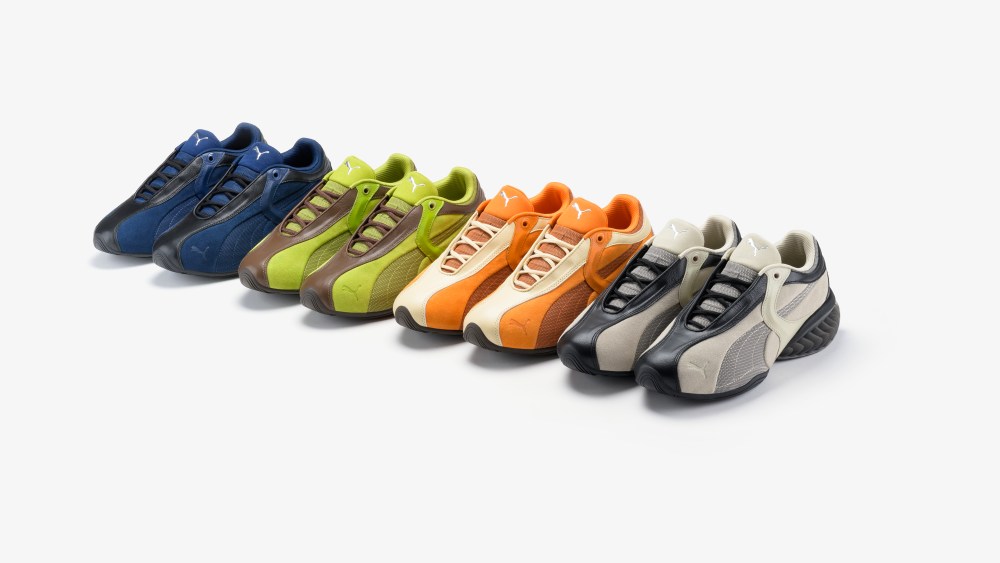
The takebacks of Puma stock also included some low-profile looks, Hoeld said, the flatter sneakers out of martial arts and motor racing that Puma had previously pinned its hopes on as the next big thing after the Adidas terrace trend.
Hoeld told WWD that they were still seeing plenty of demand for low-profile styles, though, especially in Asia, and that they believed the trend would carry on into 2027.
“The takeback activities and reduction of inventories allowed us to better manage the life cycle of low profile,” he explained. “In certain areas where we felt we had an overexposure we took them back.” In some cases, that was with a view to selling at higher or full price later.
For example, Hoeld said, he had just received pictures from JD Sports in Asia of consumers lining up at their doors. Puma relaunched a product there but it had been out of stock for a couple of weeks, he noted. “Now consumers are queuing up for the Speedcat ballet,” Hoeld continued, referring to the trendy ballet-slipper style version of Puma’s motoring shoe, the Speedcat.
The company has also been pushing its classic Suede sneakers and has had success with performance running and training shoes out of the Nitro range. These have sold out on their own platforms, some new models going within 24 hours.
Like other sports brands specializing in football, Hoeld confirmed that Puma is also hoping for increased sales thanks to the World Cup, which will be held at venues in Mexico, the U.S. and Canada between June 11 and July 19. “We’re very much on track with our plans [for the World Cup],” Hoeld told journalists but declined to specify by how much the tournament might boost Puma’s coffers.
Hoeld did divulge that Puma expected second-quarter sales to be weaker than in the first and that the second half of the year would be better than the first.
“We are going to build on the momentum of what we are calling a very solid start to the year,” Hoeld concluded.
The company reiterated guidance for the year, while cautioning that it couldn’t account for geopolitical uncertainties and the future of U.S. tariffs. Puma expects sales to continue to decline in the low to midsingle digits over the whole year as the reset continues.
The company’s EBIT is forecast to come in somewhere between minus 50 million and 150 million euros and this number will include “one-time effects related to the implemented cost efficiency program.”