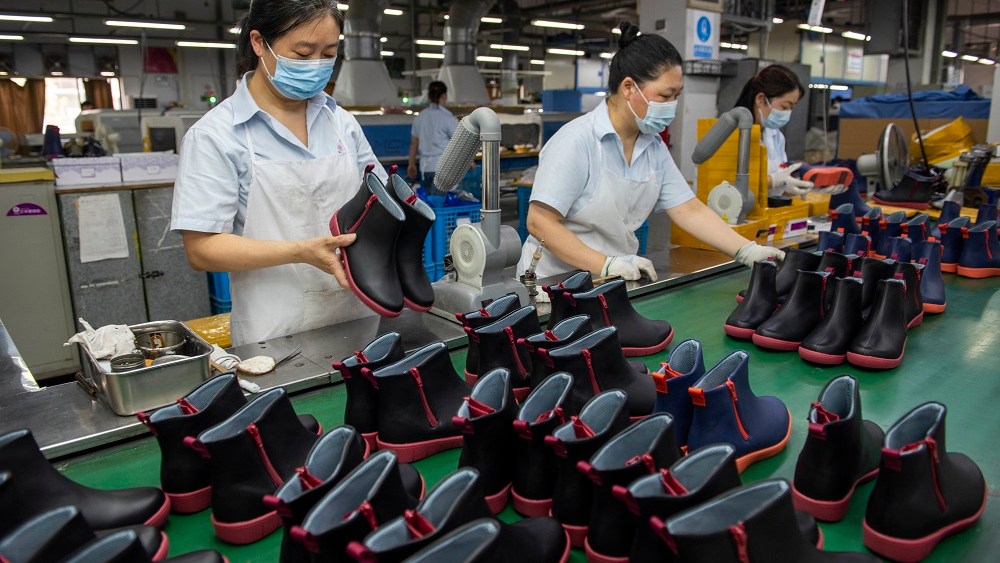
Misconceptions abound when it comes to the carbon impact of making shoes. Chief among them is a notion that the footwear industry—which has been fingered as a master polluter within the fashion sector—hasn’t made significant strides when it comes to shrinking its footprint (no puns intended).
That’s according to a recent study released by the Footwear Innovation Foundation, the brainchild of Andy Polk, who serves as senior vice president of the Footwear Distributors and Retailers Association (FDRA). According to Polk’s research into the subject over the past year and a half, existing literature on the subject is both out-of-date and flawed, as it doesn’t take into account advancements in manufacturing technology, materials and energy efficiency, as well as more recent trends in sourcing diversification.
Related Stories

According to the FIF lead, modern research on the subject is scant. There was a sneaker Lifecycle Assessment (LCA) study conducted by MIT professors on a shoe manufactured in 2010, a report from Quantis in 2018 on footwear production emissions, and data released by Global Fashion Agenda and McKinsey in 2020. “I refer to it as faded green data—it’s not really modern, high-depth or clear about where we are today. It’s more analog; where we were, both in terms of the data and how we operate,” Polk told Sourcing Journal.
You May Also Like
Plus, “shoes are not shirts,” he said—meaning that apparel and footwear have disparate supply chains, inputs and production processes, leading to different environmental impacts, though they’re often grouped together in research. “We could have 60 different materials going into an average shoe, and a lot of those materials you will never find in apparel. Footwear has been put in these textile categories for so long when it comes to standards or policy,” he said, but in reality, less than 20 percent of the makeup of an average shoe is textile-based.
The group has attempted to paint a fuller picture of the footwear sector’s waste and emissions impact based on current, primary source data from Tier 1 producers in Asia, where most of the world’s shoes are produced. Using global shoe trade data including production volume, type, weight and marketplace, along with input from industry insiders, the group came up with a prototype for the typical women’s performance athletic shoe’s emissions impact. The globally typical shoe sells for about $30 at large retail stores, and features a synthetic upper made from polyurethane and polyester, a high-density foam insole, a PU foam lining, a low-density EVA midsole and a TPR outsole.
With that profile as a baseline, FIF utilized the Footwear Impact Calculator, a footwear specific LCA-like tool created by Eurofins, to calculate its impact. The tool showed that the typical shoe emits 6.7 kg CO2-eq throughout its entire life “from cradle to grave,” with manufacturing representing 1.5 kg of that total—just under one quarter of the total impact. According to FIF, this flies in the face of the “prevailing narrative that the overwhelming majority of a shoe’s carbon emissions comes from manufacturing.”
The research revealed that the global footwear sector contributes about 0.45 percent of total international carbon emissions—a figure that is much lower than previously thought. There are a few reasons for this. For one, footwear manufacturing has upped its energy efficiency, all but nixing coal as a direct energy source for factories and switching over to green and renewable energy sources. In looking at 54 million pairs of shoes, the average amount of electricity used to produce one pair is just 1.17 kWh. According to carbon management software tool Carbonfact, it takes about 10 kWh to produce a T-shirt.
Basic injection-molded silhouettes are the most energy-efficient, utilizing on average 0.5 kWh per pair, while boots require more than 5 kWh per pair. Unlike apparel factories, footwear factories may use 200 or more manufacturing processes, from molding to adhesive application and high-temperature assembly, so optimizing those activities to use less energy, and cleaner energy, is important, Polk said.
While the 15-year-old MIT LCA referenced coal as a problematic source of energy for many factories in Asia, Polk said that’s not the reality of the modern footwear manufacturing landscape. He pointed to Vietnam as an example, as it has seen the most growth in footwear production in recent years and is now the leading producer of athletic shoes for the American market. Vietnamese footwear factories rely on a diverse energy mix that goes beyond the main electric grid, with many installing solar panels on their own roofs to power factory operations.
“As an industry, either through regulatory impact by governments or just by doing things better, we’ve eliminated [coal] as a source of emissions, which makes a huge difference,” he said. “Making shoes with less energy costs less money, but optimizing the factories also had a huge impact” on ecological output. And as footwear manufacturing expands further into markets like India, Cambodia and Bangladesh, new factories are being built with an eye toward energy efficiency and renewables.
Then, there are the changes in inputs and materials, which represent the biggest opportunity for slashing eco-impacts in FIF’s estimation, given that a single pair of shoes can contain 60 components. “We’re so much better on the material side than we used to be even five years ago—light years ahead of where we were,” Polk added, pointing to next-generation options that are fast replacing or displacing some of the fossil-fuel-derived content that make up many athletic shoes.
More earth-conscious material choices, from recycled polyester or renewable natural fibers for uppers to bio-based inputs, like algae, that are replacing some of the plastic in foam midsoles and outsoles, “represent the greatest opportunity for reducing carbon emissions per pair,” the report said.
“If there’s a way to displace your midsole with 15 or 20 percent bio, or incorporate some recycled content, that’s where you can really start to make an impact at the at the product level,” Polk said. For some companies, these innovations are still cost-prohibitive, but he believes more aggressive adoption will bring down prices from today’s premiums and allow eco-inputs to scale.
If there’s one thing he believes could stand in the way of progress, or at least slow its momentum, it’s cost pressure. And in an era where tariffs are dominating headlines, decision-makers are laser-focused on margins.
“There’s a large portion of the industry who have basically paused any effort around sustainability in their products right now because of cost,” Polk said. “So if they think it’s adding extra costs that they can’t pass along, or that their consumer won’t swallow, they’re basically halting” efforts surrounding green materials.
“Some companies really believe in what they’re doing as part of their strategy, and brand equity, so it just depends, but it does feel like the tariffs strip out so much capital from the growth of innovation that we can have,” he added. “It’s punitive to the companies,” which are contending with a consumer base that is currently extremely price conscious in light of heightened costs and inflation.
However, Polk said he doesn’t believe trade policy will “slow down capital movement for moving sourcing, because that has to happen; we have to have more diversification.” Shoe companies were already broadening their portfolios to reduce reliance on China before Trump began his second term in January.
FIF data from 2023 showed that China produced just over 56 percent of the world’s footwear that year, and 60.2 percent of shoe imports to the U.S. market. That’s a marked difference from 2007, when China’s share of the U.S. footwear market peaked at 87 percent. The same data set showed India accounted for 8.7 percent of global footwear production, while Vietnam captured 5.8 percent, supplying 23.2 percent of the shoes imported into the U.S.
While his tariff regime is wide-ranging, President Donald Trump’s real beef is with China, and the duties will continue to drive investment into other sourcing locales—even those that are currently being threatened with double-digit duties, Polk said. “Even if India is also being targeted, there’s less of a competition between the U.S. and India, and more of an alliance that can solve some of those tariff issues,” he added. “China is just a different ball game. Trump wants to negotiate with China completely differently than everybody else.”
With those markets already siphoning off some of China’s manufacturing market share, their increasingly bullish investments into clean energy, water stewardship, energy efficiency and the like will also see advancement in the coming years, further contributing to a more ecologically healthy footwear sector, he believes. “I think [tariffs are] a blip on the radar when it comes to most countries, like Vietnam or India.”