PARIS — With visitor numbers declining, the Paris edition of Texworld sought to provide solutions for an industry “undergoing significant transformation.”
“The market is tough,” said Julien Schmoll, marketing and communication director at organizer Messe Frankfurt France. “Every day we hear about mid-range companies experiencing difficulties. This show is a place to find solutions.”
While not reporting precise figures, organizers said footfall at the fair, which ran from Feb. 2 to 4 at the Paris-Le Bourget exhibition center, was stable compared to the September 2025 edition, when 7,000 fashion professionals attended. That represents an almost 18 percent decline from the 8,500 visitors registered in February 2025.
Related Articles
Visitors came mostly from France, then the U.K., Italy, Spain, the Netherlands and Germany. Schmoll emphasised the return of representatives of major brands who hadn’t attended for some time.
You May Also Like
“With tariffs, increasing transportation costs, they need to keep their margins, and they know they have good value and quality here at Texworld,” he said.
Amid U.S. tariffs, this edition welcomed another wave of new exhibitors from China.
“We came here to find new customers in Europe,” said Alex Tian, manager of Zhongyi Wool Plush, exhibiting at a European trade show for the first time in the Zhangjiagang-based factory’s 25-year history.
A supplier to Uniqlo and The North Face, Zhongyi’s collection of certified recycled polyester jacquards plus recycled wool blends had gained 30 new prospects by the second day.
With some U.S. customers shifting manufacturing to Bangladesh, Vietnam and Egypt, Suzhou, China-based Oracle Textile Technology, which specializes in technical fabrics for premium down jackets, expanded its activities to Indonesia two years ago.
Because China has the edge in polyester fabrics, it’s harder for brands to source elsewhere, explained sales manager Leo Gao. “But for more natural fabrics, they can leave China, so we opened a dyeing factory in Indonesia for our natural fabrics,” he explained.
Show discussions included the European Union free trade agreement with India. “We hope to increase our work in the E.U., customers know prices are going to go down,” said Varish Seth, director of Veekay International, a maker of embroidered fabrics and laces in West Bengal.

European manufacturers braced for potential competition. “People will go, ‘Oh India, it’s so cheap, let’s buy here,’ but it’s not the same thing,” argued Soames Rudowski, chief executive officer of Portuguese knitwear manufacturer FashionTeam.
“It’s special to produce in Portugal: people have social security, holidays. We should be recognized for that,” he added, pointing out that his factories also run on renewable energy.
Rudowski said his mostly niche customers are more cautious this season. “We’re living a moment in the world situation where no one knows what’s going to happen,” he said.
“We’re going backwards,” said Louis Gérin of fashion design and consulting agency 2G2L, as he outlined a trend forecast for spring 2027 rooted in the reality of “multiplying conflicts” and “widening inequalities” in a world “where 1 percent of the population possesses 50 percent of its wealth.”
That translated into creative themes such as “Digital Lordship” and “Nuclear Sorcellery,” while colors took on names like “radioactive pink,” “feudal shell” or “demonic glow.”
“More than a Middle Age, we are living a middling age,” Gérin told his audience. “Mediocre answers to immense challenges. AI cannot think for us,” he added.
“AI is the equivalent of having an Oxbridge third-year PhD student with you. You’re still training the AI and the AI is training you,” said Gifi Fields, founder of Scarlett & Jo, who’s managing the U.K. plus-size label’s sales plus building marketing strategies using Chinese models.
“They’re better than ChatGPT, and they’re not using 5 percent of the energy. The frightening thing is the lack of regulation. The technology is progressing faster than legislation,” he said.
Fields lauded the show’s layout overall. “What Texworld’s done is make it as simple as it can be for us visitors. And that makes it more productive,” he said.
In a tough market, designers said fabric suppliers are increasingly adaptable, open to initial orders of a few meters and then bulk four months on.
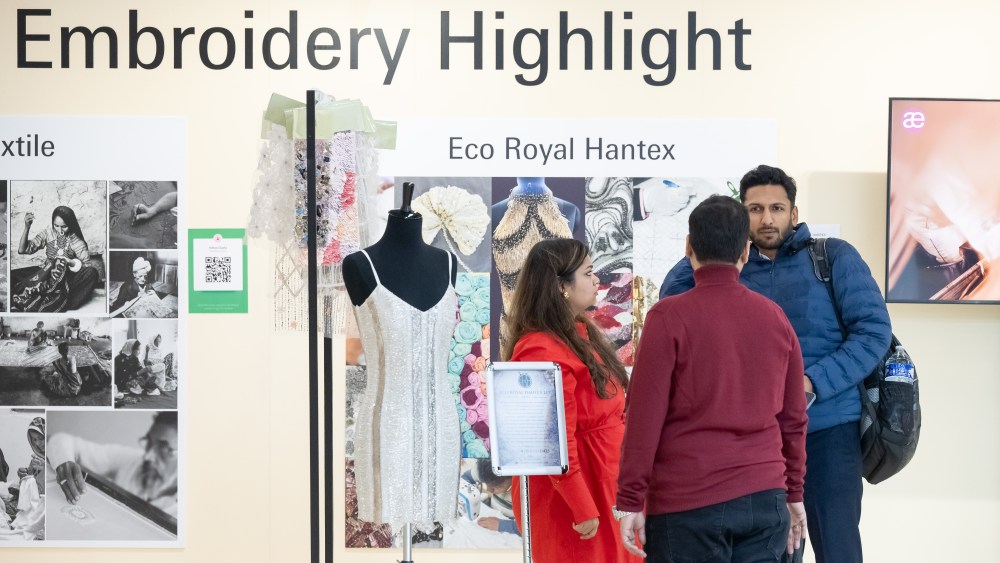
“There’s less focus on huge quantities, but more on collaborating season after season,” said Paris designer Christophe Guillarme, who found Texworld’s trends forum “super inspiring, especially the embroidery and beading sections.”
Top of mind for sourcing teams was climate change. “Everyone is playing it safe with global warming, we’re not investing in heavy items, just balanced layering,” said Sanjay Chugani, chief executive officer for Morocco-based ready-to-wear company Krisna. “We’re not taking any risks.”
Anticipating a spring where the customer still needs something warm through April, “the garments have to work harder,” echoed Holly Thomson, partner and designer for menswear at John Lewis. “No one was really buying any coats until November, so we needed layering pieces in earlier. It’s been a learn for us.”
Reordering at China’s Jannocks Textile plus “nice denims and hemp blends” at Dongyi Group for the U.K. department store’s own label, Thomson praised “interesting linens, plus double-faced, lightweight bonding fabrics. The hand-feel, the washes are generally more impressive than the base fabrics.”
Seeking “traditional woollens with innovation” for expansion into outerwear for Vancouver-based performance denim brand Duer, director of product Elizabeth Davey praised the increased availability of natural wool blends in fleeces.
“We’ve seen five mills, very affordable price points, with a 50 percent wool content,” she said. Further highlights included “soft hand feel, beautiful sherpas” and “interesting jacquards” at Zhongyi Wool Plush. Sustainability certifications are decisive. “If the mill is certified, then we’re good,” she said.
While praising “environmentally sourced yarns,” fast fashion’s need for margins hampers full sustainability adoption, said Emma Eastoe, senior designer for Bettex Fashion Ltd, a China-based manufacturer for chains like Primark and Sainsbury’s.
“The supermarkets and the high street are hot on it. We go fully in, with all recycled, trims and everything, and then when it gets to a certain price, companies can’t afford it. So they have to start taking bits out,” she said.
“Being in this industry, sometimes I’m conflicted,” said Analy Mejia, on her first Texworld sourcing trip for Orsay International, a midrange label that just relocated from Germany to the Czech Republic. “So many brands, so much excess.” Among her highlights, “synthetics that felt like natural fibers, even though they were a poly blend.”
Among European start-up labels, such as a Norwegian influencer brand by Liva Ingebrigtsen, or We are Fonda, a Brussels-based recycled nylon bag line now expanding into apparel, sustainability was a dealbreaker.
“Why would I sell something if it’s not doing good?” asked Esmaa Kithro, a human resources manager launching a modest wear label in the U.K.
“I could say, ‘It’s not the right time to create a brand,’ but it would never be a good time,” said Bénédicte de Torquat, a retail consultant self-financing a new line of inclusive wear, Aequidem, featuring easily undone Velcro Ts, for patients undergoing invasive treatments.
Texworld’s September edition will spotlight technologies for sustainable fashion with its Avantex Paris section, while in 2027, the show is set to celebrate its 30th anniversary.