
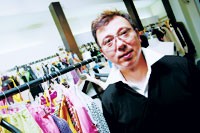
BEIJING — When Chinese fashion designer Xie Feng got his start in the industry two decades ago, there was hardly any fashion to design.
At the time, China was still a land of simple clothes and sturdy fabrics. The country had little interaction with the outside world, which meant no fashion magazines, no designer labels and certainly no events like China Fashion Week. “When I was in college in the early Eighties, you couldn’t even major in fashion,” said Xie. “It wasn’t part of the culture at all.”
What a difference 20 years can make. China has gone from a fashion black hole to an industry hub, quickly becoming the center of multibillion-dollar manufacturing and international retail activity. Lingering in the shadows of such massive movement is the field of Chinese fashion design, which was celebrated last week at the seventh annual China Fashion Week in Beijing. The event is barely a blip on the international radar, but not for long: As the industry’s focus on China sharpens, local designers like Xie could become the future of fashion. All they need to do is wait; after all, the market is coming to them.
It’s a terrific position to be in for the small number of established Chinese designers, many of whom have been in business for less than 10 years and are hardly household names, even in China. A study by Merrill Lynch released early last month predicts that by 2014, Chinese customers will account for 30 percent of the world’s luxury market, up from 11 percent now. That will place them on par with today’s core Japanese consumer and well ahead of those in the U.S., whose share is expected to drop to 17 percent from 26 percent in the next 10 years. Like everyone else, Chinese designers are looking to their homeland to find retail success. “Of course, I’d like to be able to sell internationally, but it’s not a priority,” said Chinese women’s wear designer Luo Zheng, who launched her Shenzhen-based women’s wear line, Omnialo, in 1996. “Right now, my focus is on developing and selling in China.”
The obvious advantage for locals like Luo is that they don’t have to travel far to tap the world’s potentially biggest market, a fact that hasn’t gone unnoticed by foreign investors who are suddenly making Chinese designers a hot commodity. In hopes of getting an edge on the ever-crowded Chinese retail scene, more outside companies are starting to invest in or partner with Chinese designers who could help them rule the retail boom. There are success stories already, like the formerly bankrupt Canadian luxury brand Ports International, which localized its design team and retail activity in China and boasts soaring sales and a bigger presence here than such brands as Gucci or Chanel, according to market research.
Related Articles
You May Also Like
Foreign interest in Chinese designers has helped Xie — often called by his adopted English name, Frankie — who started his own line, Jefen by Frankie Xie, in a partnership with an Italian company four years ago. Today, Jefen’s 20 boutiques across China have annual revenues of more than $7 million, making it one of the top local brands. “The most successful fashion lines in China right now all have foreign partners,” Xie said. “There hasn’t been enough time for Chinese designers to learn the business from the start. The partnerships help us keep up and move forward.”
This kind of arrangement might make Xie the perfect prototype of the modern Chinese designer. He seems ready to step into the role: Two days before his fashion week show — which featured colorful satin blouses, tight jersey dresses and sleek belted jackets — Xie was huddled in his smoky office in the financial district of downtown Beijing, selecting runway hair and makeup (wild curls, pink lips) and screening the music for the show (energetic techno). His short black hair was newly highlighted with golden streaks in the front; his signature sunglasses, worn even in Beijing’s pollution-clouded daylight, were a constant accessory.
Xie’s experiences give him a worldly perspective: He spent years studying design and working in Japan — and often refers to it as the kind of mature Asian market that China could be — and also worked for Japanese designer Kenzo in Paris, as detailed in his new book, “The Way to Fashion.” Xie seems to understand the potential of increasing his name recognition: He’s working on producing a TV show based loosely on his life as a designer. In an office overlooking a row of run-down neighborhood noodle shops, he reviewed the bright styles from his upcoming spring line, many of which would be featured at the Jefen show.
The collection was a rainbow of hot pinks, lilac purples and buttery yellows, a silky mix that appealed to Jefen’s clientele of professional women who are just starting to enjoy fashion, while also meeting their daily need for officewear. Because he’s watched fashion grow in China, Xie understands the style necessities of women in a country that is still very cautious when it comes to dress.
He — and presumably his Italian backers — thought it gave him an advantage as a designer in the Chinese market. “Foreign luxury brands will always appeal to the people who only want the top labels,” he said. “But where Chinese designers really have their strength is in the everyday clothes that the majority of people will wear. If you look at Japan, there are both successful foreign luxury brands and high-end and mid-priced clothes from Japanese brands. The Japanese designers understand the culture and lifestyle better than any designer from an outside country. In the future, China could be the same way.”
Adds Wang Qing, president of the China Fashion Association: “Foreign brands competing in the market have better operations and brand images than those from China right now. But Chinese designers have their own advantages. While foreign designers tend to view China as a whole, Chinese designers recognize the differences in markets around the country. The cultures and needs are very different as you go from north to south. Foreign companies entering China can spend three to five years localizing their brands, but Chinese designers are already there.”
Right now, the biggest hurdle for Chinese designers may be overcoming the stigma from the country’s stylish elite who find Chinese design too unsophisticated and underdeveloped for their high-fashion, brand-focused tastes. Nowhere is that rift more apparent than at the fashion week events: Unlike other cities, where the front rows of shows are crammed with well-dressed celebrities and socialites, the superstylish shy away from China Fashion Week, which is held twice a year in Beijing (where it focuses on domestic brands) and Shanghai (where it focuses on promoting international labels and caters to a more elite crowd).
At last week’s fashion week events in Beijing, the audiences were primarily filled not with style-setters but with government suits, members of the media, and young fashion students. The small but growing group of glamorous Chinese stayed home.
“The fashion industry isn’t meeting the needs of the modern Chinese woman,” explains Su Mang, executive publisher and editor in chief of the Chinese edition of Harper’s Bazaar, who’s been a fashion editor for 10 years. “They love fashion, they want style, and they’re only finding it in foreign designs right now. Women here don’t want to wear the Chinese brands — they’re just not sophisticated enough.”
Even Xie acknowledged the divide: “My wife,” he said, “prefers Prada.”
Although there is some evidence of a lack of sophistication — to start, no Chinese runway show seems complete without a generous amount of sequins — it may not really matter that Chinese design isn’t as advanced as its foreign competition. While there are certainly high-profile consumers in China who covet trendsetting styles, the typical customer is someone who is just starting to appreciate fashion and requires something affordable. Luo’s brand Omnialo, for instance, is aimed at an average professional consumer who makes about $400 per month. That’s not enough income to cover necessities and a label like Louis Vuitton, but it is enough for a regular splurge from Luo’s line.
Last week’s fashion shows also demonstrated an increasing creativity that organizers hope will lure more local customers to Chinese design. Luo’s feminine show was a standout, offering modern yet delicate twists on classic Chinese designs. And there was Shenzhen-based designer Liang Zi’s nature-inspired show for her brand Tangy, which opened with a model draped, monk-like, in folds of natural-fiber fabric. Liang’s organic designs were quickly heralded by critics and organizers as one of the week’s best and earned her top women’s wear designer honors along with Luo at the closing awards ceremony.
“I don’t think Chinese design is far behind the foreign brands,” claimed Liang, her arms full of floral bouquets amid a flood of camera flashbulbs after the awards. “We just need to start thinking more about business opportunities to grow our brands. Foreign companies have recognized the importance of building brand extensions in areas like makeup, bags and shoes. Chinese designers need to look beyond clothes and start doing the same.”
It could be that the biggest problem for the local fashion industry is itself and its propensity to produce knockoffs. No matter how innovative and well-financed the designers can become, they will still be plagued by competing brands that can easily copy the styles and sell them as their own. Even a central event like China Fashion Week has become marred by the threat of copying. “There are so many fashion companies here who don’t even employ designers,” said CFA president Wang. “They simply copy the design of the best-selling clothes and produce them under their own brand name. It’s a big problem for events like fashion week, where fashions are shown months before they’re seen in stores. Many of the designers who show here run a very large risk of having their styles copied before they even put them out.”
Still, judging by the response to the recent fashion week, the future remains bright. The investors are coming, along with a slow stream of accolades and awards. The potential for success — less than two decades after the industry’s start, no less — is large. “The Chinese fashion world is constantly growing,” said Wang. “It’s only a matter of time before it starts receiving international attention.”