
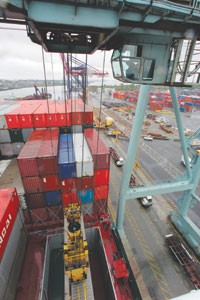
NEW YORK — When the APL New York sailed into New York harbor on May 20, completing its 22-day maiden voyage from China, APL officials stressed the ship was not just the newest vessel in its fleet but the solution to a growing problem — reliance on West Coast ports.
“This ship is to provide alternatives for L.A. port strikes,” said Robert Sappio, an APL senior vice president and head of trans-Pacific trade services, at an event celebrating the ship’s arrival.
The desire of importers to avoid the seemingly constant threat of strikes and congestion at West Coast ports already has begun to show itself in rising traffic of 20-foot equivalent units — the standard maritime industry measurement used to count cargo containers — at East Coast ports.
The Port of New York & New Jersey, the third-largest in the nation, reported a 10.1 percent increase in cargo traffic to 4.5 million TEUs in 2004, according to data from the American Association of Port Authorities. Charleston, S.C., the fifth-largest North American port, reported a 10.2 percent rise to 1.9 million TEUs. Savannah, Ga., reported a 9.3 percent gain to 1.7 million TEUs. In comparison, Long Beach, Calif., saw a 24.1 percent increase to 5.8 million TEUs and was second only to the port of Los Angeles in TEU traffic.
The frenzied pace of growth on the West Coast has caused significant disruptions over the last five years. A strike shut down 29 major ports along the West Coast for 11 days in 2002 and was estimated to have cost billions. Another strike at the twin ports of Los Angeles and Long Beach was narrowly avoided in July 2004 when the dockworkers union and major shipping lines reached an agreement to hire an additional 2,000 nonunion workers to handle the rising traffic.
More recently, a strike by 1,000 independent truckers shut down the port of Vancouver for more than a month beginning in late June. The strike stalled $615 million worth of goods in Vancouver, including huge shipments of imported clothing from Asia, and cost the Canadian economy an estimated $310 million in lost business, according to the Retail Council of Canada.
For APL, the world’s seventh-largest container ship operator with 156 years of history behind it, the introduction of the New York and its sister ship, the APL Virginia, which completed its maiden voyage in July, could not have come at a better time. Inbound cargo container traffic is expected to be flat over the next six months at Los Angeles and Long Beach, according to a survey conducted by the National Retail Federation released on Aug. 9. However, the ports of New York and New Jersey; Hampton Roads, Va.; Charleston, S.C., and Savannah, Ga., will have sharper increases in container volume than West Coast ports because of increased use of “all water” Asian container services through the Panama and Suez canals.
Related Articles
You May Also Like
A tour of the New York gives a sense of how far shipping companies such as APL are going to claim a piece of this growing market. The ship is 20 stories tall, 965 feet long and capable of carrying more than 5,000 TEUs. The new ship took about five months to build, with an additional month of testing built in following final construction.
According to APL officials, it’s one of the largest ships to regularly pass through the Panama Canal, squeezing through the system of locks with just one yard of clearance on either side of the ship. The ship’s commander, Master Andrzej Gomulski, said the trip through the locks on a ship of this size is always tricky. As the ship enters a lock, it is attached to eight locomotives, four pulling on each side to build just enough momentum to propel the ship the length of the lock. Once in motion, the locomotives cannot halt the ship. An emergency mechanism allows the locomotives to cut the lines from the ship in order to avoid being dragged from the tracks and out into the open ocean. According to Gomulski, the locomotives had to cut the lines on the ship’s first trip through the locks.
The trip from Shanghai, south to Hong Kong and on to New York takes 23 days.
“To be on time, I need to make 22 knots,” said Gomulski, who has captained 11 other ships since 1997. “I will be always on schedule and I can easily increase speed.”
Cargo includes electronics, computers, cigarettes, textiles and toys, said Gomulski.
On the ship’s bridge, even Gomulski seemed impressed by having the latest technology at his fingertips. “Some of these things have never been in any other ship,” he said.
The ship’s radar system, for example, allows Gomulski to identify all other ships in the harbor. At the radar’s monitor, Gomulski shows a view of New York harbor, a blur of red dots representing the hundreds of boats in the area. By zooming in and clicking on one of these dots, the ship’s name, type, length, current latitude and longitude and speed are displayed. The computer stores more than 30,000 navigational charts, as well.
Even the pristine engine room had that new-ship smell. According to an APL official explaining the inner workings of the ship, automation has reduced the average crew size to 20 from 40. Twenty-four-hour shifts are also no longer necessary. Engineers manning the engine room work a standard eight-hour day, then flip switches and allow the computers to take over. Those working on the bridge work on a rotation of four hours on and eight hours off. If it doesn’t sound like much, consider that most crews are on the ship for three voyages, or potentially 70 days, and get one voyage off.
The 35-foot-tall, nine-cylinder engine system accounts for about 25 percent of the ship’s weight. The engine burns 170 to 180 metric tons, or some 60,000 gallons, of fuel oil a day. The ship carries 7,500 metric tons of fuel, which can get the ship from New York to the Far East and back to New York. The fuel is highly viscous, requiring it to be heated to 135 degrees Celcius before being pumped into the engine, a problem when refueling in New York Harbor in the dead of winter.
BY THE NUMBERS: APL NEW YORK
- Maiden voyage: April 27.
- Height: Approximately 20 stories.
- Length: 965 feet (more than three football fields).
- Container Capacity: 5,039 TEUs.
- Weight (including cargo): 66,565 metric tons, or 146.7 million pounds.
- Range: 22,500 nautical miles.
- Maximum speed: 25 knots (28.8 miles an hour).
- Crew: 21.
- Hong Kong to New York Travel Time: 23 days.