
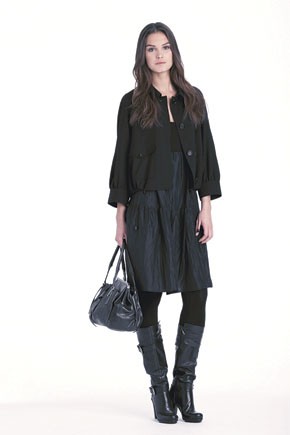
NEW YORK — DKNY has been on a roll recently.
In addition to having a few strong seasons at retail under its belt, parent Donna Karan International has been working to update and improve its network of licenses, and to make an aggressive push into markets like Asia and the Middle East.
The activity is serving as a platform for the next step Karan and DKI chairman and chief executive officer Mark Weber and their team plan to embark on: the launch of the better-priced DKNYC label, which is being handled by a newly hired team overseen by DKNY president Mary Wang and executive vice president of DKNY Design Jane Chung.
When Weber joined the company in 2006, he instantly realized DKNY’s potential, saying its brand recognition was larger than the actual business on hand. Weber pointed to the past 12 months, where the business has seen “impressive” results, growing “dramatically” at stores such as Bloomingdale’s and Saks Fifth Avenue.
Related Articles
With its contemporary styling, the brand appears to be benefitting from the challenges faced by some of its competitors in the bridge sector. Ellen Tracy, for instance, finds itself in a state of flux as owner Fashionology Group LLC maps out a new strategy for the storied bridge brand, while Dana Buchman is exiting the bridge department to sell at mass retailer Kohl’s.
You May Also Like
Retailers agreed DKNY has been a strong performer.
“We’re having a fantastic season with DKNY, driven by the fashion,” said Frank Doroff, vice chairman of Bloomingdale’s. “This is coming off of a very good fall and I think they’re gaining traction in our modern New View zone.”
Ron Klein, chairman and ceo, Macy’s East, concurred, calling the DKNY business “very healthy and getting better.”
Averyl Oates, buying director at Harvey Nichols in London, noted that DKNY was one of the store’s key core businesses, saying the line has shown continued growth of over 20 percent over a strong last year. “One gets a strong sense that the design team has refocused and gone back to designing what is essentially a lifestyle brand, one that still manages to channel fresh energy and urban modernity season on season,” Oates said. “For us in the U.K., the collection has enjoyed such success because it offers great item pieces that are always on trend and contemporary, without alienating the consumer with unworkable shapes.”
In addition to growing the business locally, DKNY has pushed into markets such as Asia, the Middle East and Europe. According to Weber, DKNY’s international business has grown by 75 percent over the past two years. For instance, DKNY is expected to have 20 freestanding stores in China at some point this year.
The company has also been in the process of updating its licensing network, terminating less successful agreements and inking deals with new partners.
As reported, DKI just signed a global licensing agreement with Maidenform Inc. for intimate apparel, and with The Komar Co. for sleepwear, robes and loungewear bearing the DKNY and Donna Karan labels.
In addition, it signed a golf license with Jamie Sadock, a golf apparel company. The DKNY Golf label is slated to be unveiled softly for fall 2008 and launched fully at the 2009 PGA Golf Show in Florida next January. It is expected to include a full range of women’s golf apparel as well as accessories such as visors, caps and golf gloves. DKI also entered a licensing deal with Parigi Group Ltd. to develop a children’s wear collection for the U.S. market this fall.
The most significant launch, perhaps, will come this July with DKNYC, a line that will bring Karan’s fashionable, urban spin to women’s better apparel, handbags and footwear.
This isn’t the first time DKNY has dipped its toes into the better zone. The company launched the City DKNY label in a licensing agreement with Liz Claiborne in 2001, and quickly expanded it to more than 600 doors. But with designer lines flooding the market at the time, City DKNY was challenged on the floor. DKI did not renew the license at the end of 2005. DKNYC is being manufactured and distributed in-house.
Karan said the relaunch into the better zone has always been an ambition of hers. She said DKNY, in its original concept, targeted a wider approach but over the years has evolved into a more fashion-oriented, exclusive collection.
“DKNY, in its original concept, was able to touch many people,” she said. “That’s what New York City is — complicated, multidimensional.” Putting her own spin on the new concept, she offered, “As I see it, the C stands for circa. It’s Circa DKNY, from its original core concept, when it was really intended for a much wider level. The current success of DKNY opened up the doors to be able to expand.”
Unlike many offshoots, DKNYC does not take its cues from DKNY, and DKI executives were keen to stress that it was not a watered-down version of DKNY looks. Instead, DKNYC offers cool urban looks but with a slightly more casual, almost throwaway spin than its bigger sibling.
“When we decided to do DKNYC, we said, ‘where DKNY Jeans leaves off, DKNYC would begin,'” Weber said. “It would be a complement to what is being done at DKNY Jeans at similar price points.”
Karan added that fashion now permeates all retail tiers, a point she hopes to drive home with DKNYC.
“No matter what their demographics are or their financial status, people are looking for fashion, and that’s where we used to be with DKNY,” Karan said. “When DKNY bridge started out, it had a much wider distribution base. We started out as a jeans-based company, and when you talk about jeans, you talk about a mass distribution base. We took that aspect of it out of the company and scaled up the design of DKNY, which became a lot more fashion oriented and luxurious in terms of fabrics and manufacturing.”
Wholesale prices for DKNYC range from $100 to $150 for outerwear; $70 to $100 for jackets; $40 to $55 for pants, skirts or shirts; $40 to $80 for sweaters, and $25 to $45 for T-shirts.
DKNY is simultaneously entering the men’s better business with a new Gray Label sportswear collection, which is licensed to Liz Claiborne.
DKNY’S Wang said, “It’s being more accessible to a much broader audience. The bridge can only thrive in a set number of doors, whereas the world of better is far more distributed than we would ever hope to be in bridge.”
The collection, which will launch in 200 to 250 doors of such stores as Macy’s, Bloomingdale’s, Lord & Taylor and Dillard’s this July, will also offer handbags and shoes.
Bloomingdale’s will initially offer DKNYC in about 13 doors. “I think DKNYC will add a lot of fashion into the better zone…which is sorely needed,” said Doroff.
Klein at Macy’s East agreed. “Donna Karan’s unique perspective on the contemporary fashion customer is special,” he said. “It brings Donna’s sensibility to our broad customer base in a way that has not been done before.”
Weber, who declined to give sales projections for DKNYC, said that while the better line will be an important element in the company’s future, it won’t be the only engine to fuel the brand’s growth.
“The future for us and for the luxury market is very much a combination of the U.S. and the rest of the world, and the rest of the world is not in the better business, it is about bridge and up,” Weber said.
Karan, for her part, draws a strict line between DKNYC and DKNY.
“It caters to a different market,” the designer said. “There may be an overlap, but interestingly, I find the Collection and the DKNY customer morphing into one sometimes. I don’t think that’s as much the case for DKNYC.”