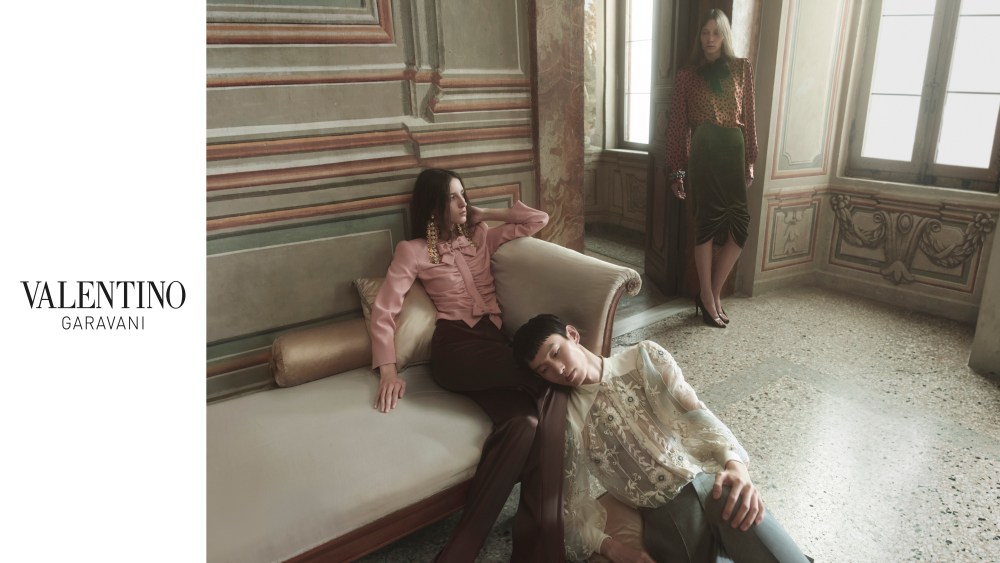
STANDING TOGETHER: There’s always a thought-out narrative behind any campaign conceived by Alessandro Michele and Valentino‘s spring 2026 ad communication is no different — it’s actually enhanced by an extensive letter penned by the brand’s creative director.
Michele said in October that the collection presented in Paris for spring was inspired by a letter written by Pier Paolo Pasolini during World War II, in which he described the joy of seeing fireflies. But the designer explained in his letter that the seasonal campaign is more focused on the theme of dependency and the support of a community, dismissing self sufficiency.
Related Articles
In a video accompanying the images by Willy Vanderperre, models Emese Nyiro, Peris Adolwi, Malena Tafel, Chloe Oh, Valery Sergeeva, Amos Laermans, Siddartha, Saliou Gueye and Lv Yifan are seen moving slowly through the beautiful salons of the 17th-century Villa Parisi in Frascati, near Rome, and gently supporting each other to avoid a fall.
You May Also Like
“Every body knows falling. Not as an accident, but as original condition. Balance, in fact, is not the natural state of being, but only a fragile interval within the becoming of things. Falling happens when the world no longer holds us in the forms we once knew. It takes but a moment: a yielding, a loss, a force that exceeds our capacity for containment,” wrote Michele.

The designer underscored “the awareness of the provisional nature of verticality, constantly negotiated through the physical, symbolic and relational supports that sustain our existence. In this frame, falling reveals the structural dependency that defines us, becoming a political vector capable of shattering the myth of self-sufficiency.”
The models, wearing the collection’s pencil skirts, richly embroidered blouses, ruched dresses and dramatic sequined gowns, are captured posing near a marble fireplace, antique wooden doors with intricate gold decorations or lounging on a sofa — beautiful frescoed walls as a backdrop.
“We can’t resist stumbling by individual will alone; we need the grace, the care and the concern of those who try to hold us. In this posture, the presence of the other becomes a concrete practice that embraces vulnerability without denying it,” Michele continued. “Caring does not mean preventing the fall, it means making it inhabitable. It’s holding on to each other when balance breaks, sharing the weight rather than removing it, being there in the time of instability without forcing a solution.”
Michele believes that “the most radical form of elegance does not lie in solidity, rather in the willingness to become support. Fashion, in this sense, does not stage strength. It displays the responsibility of the weight we bear: of the burdens, of what must be shared and of what cannot be left to fall elsewhere.”
He underscored that he was not aiming at “aestheticizing fragility, but acknowledging it as a structural condition of existence: a starting point for imagining different forms of coexistence, responsibility and relation. Falling, then, is not the end of movement, but the opening of a different posture, where every claim to self-sufficiency is exposed for what it is: a cultural fiction.”