
NEW YORK — Van Cleef & Arpels turned 100 this year, but according to Emmanuel Perrin, who took over in July as the firm’s president and chief executive officer in North America, the French fine jewelry house is still maturing.
“In a recent study we looked at, the brand has awareness of slightly below 20 percent in the U.S. in comparison to other fine jewelry houses,” Perrin said. “When you see that figure, you can view it as much as a liability as an asset. I myself see it as an asset, because it means there’s that much more potential for growth.”
Perrin helped build Van Cleef in Asia as its ceo there and has been with Compagnie Financière Richemont SA, which owns Van Cleef, since 1992 in various roles. He succeeded Nathalie Guedj, who held the posts in North America for six years before departing in April to become managing director of Spanish jewelry firm Carrera y Carrera.
Seated in the library on the second floor of Van Cleef’s remodeled flagship at 57th Street and Fifth Avenue here, Perrin said his goal as he begins his new role at the firm is to concentrate on product development and image to significantly boost the brand’s profile among U.S. consumers and to ensure the brand’s momentum as it enters its next century in business.
Achieving his goal won’t come without challenge.
“Van Cleef is a very erudite brand, and it is at the top of its world alongside jewelers like Harry Winston,” said Andrew Jassin, managing director of the Jassin O’Rourke Group consulting firm here. “But what it faces now is that it doesn’t have the recognition it could have in the general affluent market. The question is, can it create that product that allows it to remain special while reaching out to that general affluent consumer who is looking to buy fine jewelry?”
Perrin believes as the firm prepares to unveil two of the three final centennial celebration collections over the next few months, it just might have achieved the balance necessary to confront that challenge.
The first collection, Trésor Révélés, comprises 11 one-of-a-kind pieces based on drawings created for Van Cleef from the Twenties through the Sixties that were stored in its archives and never produced because of a lack of technological know-how. The pieces, including an Art Deco sautoir called the Fox Trot (see separate story) that was handcrafted in Van Cleef’s New York atelier, will make their debut at a private dinner here in December. They are expected to retail from $185,000 to $3.5 million.
Related Articles
You May Also Like
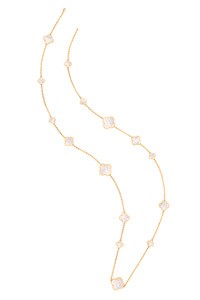
The second assortment, the Centennial Alhambra Collection, will retail for $1,300 to $11,900 beginning this October. It will be Van Cleef’s most accessibly priced line. Taking inspiration from the vintage Alhambra collection, which introduced the signature clover motif some 30 years ago, the new collection features butterflies and flowers as well as clovers, in semiprecious materials such as mother-of-pearl, coral, turquoise and tigereye dangling from 18-karat yellow gold necklaces, earrings and bracelets.
“The collection is young and playful and very iconic,” said Perrin, who added that Van Cleef will launch a print advertising campaign in Vanity Fair, In Style, House & Garden and Interview to promote it.
“It shows that we can have fun with the jewelry and increase the accessibility of Van Cleef while still creating the quality that we are known for,” he said. “With it, the range that Van Cleef can offer is very much in place. The challenge will be to remain careful in our approach to our growth because the brand is a gem of its own, and we want it to remain selective.”
The same holds true for retail and wholesale expansion, two other goals Perrin sees as crucial to raising Van Cleef’s profile in the U.S. While Perrin said he is looking to increase Van Cleef’s retail doors by one to two stores annually over the next three to five years, as well as widen its wholesale network, he said the firm plans to take one step at a time and give priority to cities such as Las Vegas, Dallas and Atlanta, where it has little presence.
Van Cleef has six stores in the U.S., including units in Beverly Hills, Bal Harbour, Fla., and Chicago, as well as in-store shops in 12 doors, including London Jewelers in Manhasset, N.Y., and Dorfman Jewelers in Boston. Three more stores are expected to open by the end of the year, although locations were not disclosed.
“Jewelry is the only fashion category right now where branded houses own only 10 percent of the market,” said Stanislas de Quercize, Van Cleef’s international president and ceo, who oversaw 30 percent increases in sales for the firm last year.
Industry analysts estimate Van Cleef’s sales at $200 million annually, although Perrin said that was on the low side.
“Right now, 90 percent of jewelry purchased is unbranded, but that is changing,” de Quercize added. “The U.S. has always been a priority for Van Cleef, but we think because of that change in consumer behavior, the potential is still quite considerable. Perrin’s mission will be to help people understand and appreciate the Van Cleef brand even more. We want people to realize that the brand is iconic and also has enduring value.”
Christie’s plans two centennial Van Cleef tribute auctions to be held in conjunction with its Magnificent Jewels sale this fall. The Christie’s Van Cleef auctions, on Oct. 11 here and on Nov. 16 in Geneva, will each showcase 50 pieces, including 49 existing creations and one specially made for the event. Among the highlights of the Geneva sale will be the Millennium Brooch, featuring Van Cleef’s signature Mystery Setting among its two flowers designed from 817 Burmese rubies and 666 diamonds. A spokeswoman at Christie’s said the sales are expected to bring in $7 million to $9 million.