
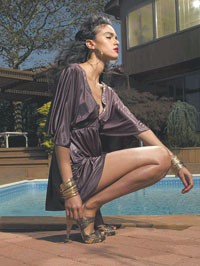
A shakeout is looming in the celebrity designer world.
A few years ago, the fashion industry saw an explosion of music and Hollywood stars who suddenly decided to become designers. Jennifer Lopez, Beyoncé Knowles and Gwen Stefani were among the first few, but in no time, everyone from A- to Z-listers were turning themselves into clothing and beauty brands. Today, Mary-Kate and Ashley Olsen have everything from sportswear to area rugs; Mandy Moore has T-shirts; Hilary Duff has sportswear and accessories; Jaime Pressly recently introduced a contemporary sportswear collection, and Pamela Anderson, naturally, is pushing her lingerie label. Even Nikki Sixx from metal band Mötley Crüe and Travis Barker from Blink 182 have clothing lines.
Now the winners and losers are starting to emerge. The current leaders are clearly Stefani’s L.A.M.B., Kimora Lee Simmons’ Baby Phat and Rocawear, according to retailers, while high-profile brands such as JLO by Jennifer Lopez, Nicky Hilton and Jessica Simpson are struggling.
Meanwhile, the jury remains out on such labels as House of Deréon by Knowles, Justin Timberlake’s William Rast, Duff and Sean John, which flirted with the women’s contemporary market, pulled out and now plans to reenter ready-to-wear with a junior line.
One thing is clear, however: the market isn’t what it once was. Rob Smith, executive vice president and general merchandise manager for Macy’s East, said overall, celebrity fashion lines have slowed down at retail.
“JLO has softened a lot,” he said. “I’m not sure it’s because of the product or the fact that Jennifer just isn’t out there as much as she used to be, but the line isn’t performing like it used to. I think the idea of the celebrity is still huge, it’s just that when it comes to fashion, no one has done it well.”
Smith said he has yet to see Deréon, Knowles’ junior line that just launched in about 500 specialty doors for holiday, but he did try Chick by Nicky Hilton, which didn’t perform well.
“It just didn’t work, we no longer carry it,” he said.
Smith said that, on the flip side, Baby Phat by Kimora Lee Simmons is doing exceptionally well for Macy’s and, as a result, the brand’s floor space has greatly expanded. In the chain’s New York flagship, Baby Phat has taken over prime real estate in the former XOXO space, which has moved to another spot in the rear of the junior department.
Related Articles
You May Also Like
“Baby Phat has bridged from an urban brand to a fashion brand that offers really good product and great fashion pieces that appeal to many customers,” he said. “It’s a terrific brand for us.”
Part of the problem is that celebrity lines continue to proliferate at a time when consumers appear bored with the entire concept. They rabidly follow celebrities’ personal lives more than ever; they just don’t want to wear a Hollywood star’s name on their backs.
“The mind-set used to be that a musician was a musician, but when they decided to launch a clothing line, that was big news,” explained Michael Wood, vice president and director of syndicated research at Teenage Research Unlimited, a Northbrook, Ill.-based research firm. “Now the novelty has worn off, and it’s just not news anymore.”
That said, Wood believes the idea of the celebrity is still alive and well, but perhaps not their fashion brands. He said that, while consumers are still interested in reading about stars’ personal lives and what they are wearing, that doesn’t mean they want to buy a label with a celebrity’s name on it. Part of the predicament is that celebrities have no problem putting their names on clothing or accessories; they just don’t want to wear it themselves.
“Young people want to wear what the celebrities wear, not the label they have their names on,” he said. “Today, there are so many ways for fans to connect with their favorite celebrities, they can log on to their MySpace pages online, for example, they no longer have to buy their fashion brands to be close to them.”
Wendy Red, fashion director at Up Against the Wall, a 25-store junior and young contemporary specialty chain based in Washington, said she carries a few celebrity lines, including House of Deréon and Deréon, William Rast (but only for men) and Stars & Straps, a line backed by Blink 182’s Barker.
“When House of Deréon launched, I did very well with it,” Red said. “The jeans sold out so fast, I couldn’t get them in the store fast enough. Since then, they’ve raised their prices from a $98 jean to a $148 jean, so I think that’s part of the reason why the line has cooled off a bit. But now with Deréon, which I just got in the stores — that is really blowing out.”
Red said there is one hoodie in particular from the Deréon line that is selling really well.
“Beyoncé wore it in her video,” she said. “I put it on the floor on Friday [Dec. 1] and today [Dec. 4], I only have two left.”
Red said she also does well with Stars & Straps and Harajuko Lovers, Stefani’s lower-priced line.
“These lines do very well; they are really popular with our customers,” she said. “I think that if the celebrity is cool and their line is edgy, there is no reason why it wouldn’t do well. With Jessica Simpson’s line, for example, it’s just not the kind of thing you would put in a cool specialty store.”
On the contemporary side, Abbey Samet, contemporary market analyst for the Doneger Group, a New York-based buying office, said some brands perform well, while others are not living up to the hype.
“I’ve heard that Beyoncé’s line [House of Deréon] is not doing well at all, but L.A.M.B. by Gwen Stefani is doing very well,” she said. “The thing about it is that nearly all celebrities have stylists that make them look the way they do. It’s very hard to translate that look into a product line, which is really what the customer is buying into.”
Although fashion lines have seen their ups and downs for celebrities, the beauty business, particularly in fragrances, has not seen the same effect. Rapper/actress Eve Jeffers is the latest example. As she works on her fourth album, Jeffers said she is also on the lookout for a fragrance deal, while her Fetish clothing line, launched a few years ago, went out of business.
The beauty world today is full of celebrities. Coty is arguably the most entrenched, with Gwen Stefani, Jennifer Lopez, Sarah Jessica Parker, Kimora Lee Simmons, David and Victoria Beckham, Mary-Kate and Ashley Olsen, Shania Twain and “Desperate Housewives” in its stable — with, as reported, perhaps Kate Moss due to sign any day.
Elizabeth Arden’s deal with Britney Spears, signed in March 2004, has yielded two top-five hits: Curious Britney Spears and Fantasy Britney Spears. Arden has had teen queen Duff under contract for beauty products since September, and it signed Catherine Zeta-Jones in February 2002 to be the face of its core Elizabeth Arden brand. In addition, NASCAR star Jeff Gordon has been the face of its Halston Z-14 brand since May 2004, and the original celebrity fragrance maven, Elizabeth Taylor, is also part of the company’s constellation.
Knowles, too, has dabbled in the fragrance world, as the face of Tommy Hilfiger’s True Star fragrance. While her House of Deréon label is still new on the market, some may say that one issue they have with it is fit.
In September, Knowles attended an in-store event at Macy’s in Chicago to celebrate the launch of the line and the large shop-in-shop for the collection at the store. When a CBS reporter asked the entertainer if there was indeed a problem with the line’s fit, she and her mother and agent, Tina Knowles, cut the interview short, walking away from the reporter.
Chip Rosen, president and general manager at Beyond Productions LLC, the parent company for the Knowles’ brands, said it was a misunderstanding and that the fit of the collection is working well.
Samet said she thinks that the denim-based line William Rast, which just launched last year, looks good and has potential to grow.
“I really like the way William Rast looks and I think there certainly is room for it,” Samet said. “The denim market can use some freshness, so they have a real opportunity.”
Samet said her overall feeling is that the focus of the celebrity-as-designer has shifted to the designer-as-celebrity, which is sparking more interest at retail.
“The newest emerging celebrity is the designer, there was Viktor & Rolf for H&M, Behnaz Sarafpour for Target — these things are what customers like to hear about,” she said. “The customer has wised up a lot and, in turn, it’s become more challenging for a celebrity to be a designer.”
Madonna has a deal with H&M this holiday season called M by Madonna, which she’s just renewed for a second season. That line will be in stores in March.
Stefani seems to be the true exception, as retailers and analysts agree her L.A.M.B. brand has continued its strength.
“Gwen has always had that style about her that gives her line that credibility,” Wood said. “She wears her own clothes and she really creates what her customers are looking for in a clothing line.”
Retailers selling the L.A.M.B. line seem to agree. Nordstrom has recently opened L.A.M.B. shops within its stores.
“L.A.M.B. is one of our strongest vendors in our Savvy department, largely because of our partnership with Ken Erman, the president of SkaGirl [L.A.M.B.’s apparel license],” Ana Swaab, corporate merchandise manager for women’s contemporary at Nordstrom, told WWD in September. “L.A.M.B. has selective distribution, and we are proud to be the largest fashion retailer carrying the collection.
“The allure and styling of the fall 2006 line is making it one of the most popular and loved collections with our customers. Customers love the design of the collection, including the vibrant graphic prints, as well as classic and feminine shapes done with a Fifties vintage feel — all reflecting Gwen’s own personal style.”
While many celebrities are their own marketing machines, being able to wear their own labels and having their photos taken wherever they turn, this business also has given some a fair share of drama. Now, Knowles is facing allegations that she violated a contract related to the founding of her House of Deréon label.
Greg Walker, a businessman based in New York, filed a lawsuit in the Supreme Court in New York this summer alleging that the pop star and actress neglected to pay him money he was owed for helping her find a licensing contract and is asking for $1.5 million in damages. The lawsuit was filed against Knowles and Wear Me Apparel, which does business as Kids Headquarters.
According to court documents, Walker alleged that he and Beyoncé and Tina Knowles entered into an agreement in August 2003 that Walker would help them find a licensing opportunity similar to the Sean John line established by Sean Combs. Walker’s obligation under the contract was to obtain proposals and bring them to Beyoncé Knowles. According to court documents, Walker facilitated a relationship between Knowles and Wear Me Apparel. Walker received $25,000 from Knowles in July 2004 and an additional $85,000 from Wear Me Apparel between January and June 2004 as part of that contract, according to the lawsuit.
The lawsuit asks for $500,000 in damages against Knowles and $1 million against Wear Me Apparel.
Executives for Knowles did not comment on the suit, which is still pending.
Knowles isn’t the only music star to land in court over a licensed apparel brand this year. Simpson faced allegations that she failed to promote her Princy and JS by Jessica Simpson lines. Tarrant Apparel Group sued Simpson and master license holder Vincent Camuto for $100 million in April. Camuto later filed a countersuit against Tarrant for $100 million. Those suits are also still pending.
But it seems that brands such as these continue on a growth track. Camuto, chief executive officer of the Camuto Group, the master license for the Jessica Simpson brands, said he is working to build a lasting brand. He said that, while Simpson’s popularity helps, it’s not just about that.
“We are hearing that the product is right on,” he said. “Our retailers are very happy with it.”
The company just launched a collection of outerwear for holiday selling, will have eyewear in the spring and, in 2007, will look for more licensing opportunities in categories like lingerie, swimwear and even stationery.
At JLO by Jennifer Lopez, executives are confident that one slow season isn’t going to break their growth plans.
“Our JLO business has been a little soft this season,” admitted Andrea Scoli, president of Sweetface Fashion Co., the parent company for the JLO by Jennifer Lopez junior brand and Sweetface contemporary label. “But I think that, overall, the junior business has softened.”
In 2001, Lopez entered the fashion business with partner Andy Hilfiger and established Sweetface Fashion Co., which now has annual sales of $200 million and includes JLO by Jennifer Lopez junior sportswear, outerwear, lingerie, footwear, watches and jewelry, as well as the Sweetface contemporary collection and four fragrances.
Scoli said that, despite the fall in business, the company is poised for growth next year. For the JLO by Jennifer Lopez brand alone, the company will bring in $250 million in sales by the end of this year, she said, and expects 2007 to be even better. Scoli said a great deal of the growth is sure to come from the contemporary brand, Sweetface, which is sold at better specialty stores such as Madison in Los Angeles and Intermix in New York.
“In contemporary, it’s cooler to be more select with the distribution,” she said. “Jennifer is such a fashion icon. When she’s in the press, it’s really for her fashion, which is great for the Sweetface brand, since she does wear it.”
Scoli said the company also is focused on international expansion, as she plans to pursue more licensing opportunities abroad in the next year.
For Sean John, which closed its Sean by Sean Combs women’s contemporary brand earlier this year, Bob Wichser, ceo, said the women’s business will be back on track next year. The company has signed a deal with G-III Apparel Group to design and merchandise a Sean John young contemporary line, for a fall launch.
“With Sean by Sean Combs, we just realized that the timing wasn’t right and made the decision to exit the market,” Wichser said. “But that doesn’t mean it won’t be back in the future.”
The deal with G-III, he said, is different. Sean Combs for women will be set at a lower price point than the contemporary line was, and will be targeted to select specialty and department stores. To test the label, Wichser said select stores are selling a test line of outerwear now, which is selling well.
“We are very happy with the way the outwear is selling,” he said. “We thought there was tremendous potential in this market for our brand. We really see it doing very well.”
Wichser said that, by the end of this year, the Sean John brand will bring in $450 million in retail sales. Moving into next year, he expects that number to grow by around 15 percent.
Rocawear, the brand backed by Jay-Z, is also on a roll. After the company opened a temporary store in New York last September, the success of it has led it to think more seriously about retail. Now, Jameel Spencer, chief marketing officer at the $800 million company, said it is planning for a retail rollout in 2008.
“Our men’s business has always been solid, but the women’s is way up this year,” Spencer said. “Our department store business is up by 50 percent.”
Spencer said that, for fall, the company will launch Bella Roc, a contemporary brand for women. “Jay has wanted a line like this for a while,” he said. “Without him, it would not exist.”
The Knowleses also are planning for their growing fashion empire, which includes the House of Deréon and Deréon brands. Deréon just launched at retail for holiday selling and, according to Beyond Productions’ Rosen, it is performing very well so far.
“Beyoncé’s fans have been asking for a line that’s at a more approachable price point,” Rosen said. “It’s more of what they were asking for, so it’s doing well.”
At the time of the launch of the company earlier this year, executives projected making somewhere between $30 million and $50 million in first-year wholesale volume. By the end of next year, Rosen said he projects the brand to reach $100 million in wholesale volume. He said this growth will be because of the increase in product for both lines, with a House of Deréon swimwear line launching in February and new licensing opportunities coming up for the Deréon brand.
“It’s growing fast, but not too fast,” he said. “It’s not about how fast or how big we can make this. It’s about building a brand that will last.”