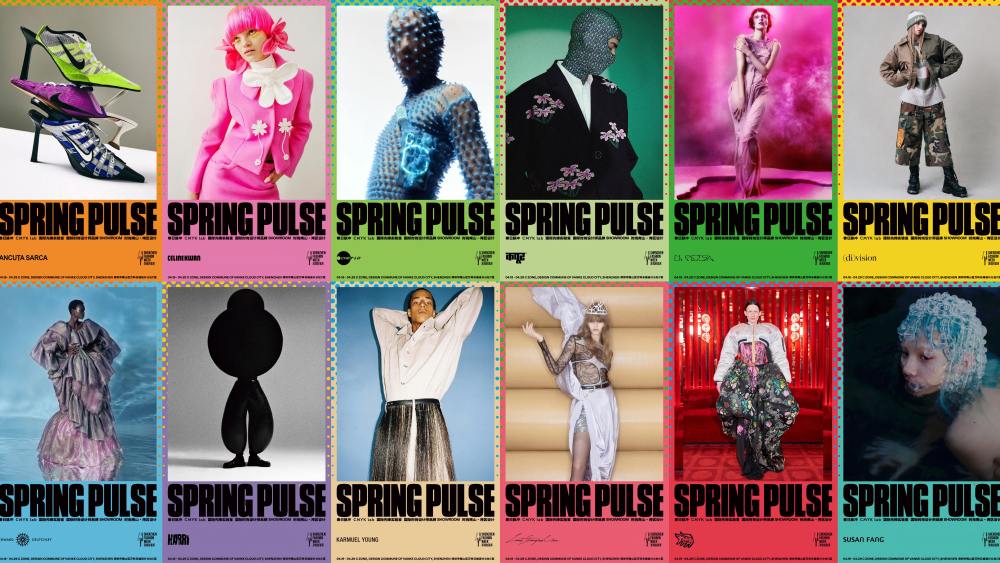
LONDON — Shenzhen Fashion Week, a government-led initiative that aims to polish the tech hub’s fashion credentials and differentiate itself from runway events in Beijing and Shanghai, is hosting a cohort of international emerging brands with its fall 2023 edition.
Matty Bovan, Harri, Chet Lo, Edward Crutchley, Dhruv Kapoor, Di Petsa, (Di)vision and Ancuta Sarca will be making their China debut with CMYK Lab, a showroom operated by the Shenzhen Garment Industry Association, in Shenzhen, the neighboring city of Hong Kong.
Related Articles
Participants of the project, which runs from April 19 to 29, also include Susan Fang, Celine Kwan, Karmuel Young and Louis Shengtao Chen, a semifinalist in this year’s LVMH Prize for Young Talents. The brand lineup is curated by fashion consultant Declan Chan.
You May Also Like
The CMYK Lab aims to serve as a conversation starter for the city to engage with the global fashion community. The main show venue of Shenzhen Fashion Week, which runs from last Friday to Saturday, mainly features local brands that are largely unknown in the West.
International brands that show on the main venue include the Italian fashion brand Tela, Belgian tailor Scabal, as well as and the German fashion label Laurèl, now owned by the Shenzhen-based clothing company Ellassay, which also holds the China operating rights of Self-Portrait, Ed Hardy, Iro, Jean Paul Knott and Vivienne Tam.
“We aim to build an international pioneering creative lab that brings together fashion, art, design and culture,” said Pan Ming, chair of the Shenzhen Garment Industry Association since December 2019.
“We also hope that through the platform of CMYK Lab, we can combine creativity with global partners in fashion [and] design and experiment together, explore new consumption patterns and business formats and help Shenzhen become an international capital of fashion and therefore create more new possibilities,” Pan added.

While not many of the international participating talents will be in Shenzhen physically, they candidly expressed their ambition for China with this project.
Bovan, who has shown in London and Milan, said he is “thrilled to be invited and present my work to a wider audience, who will appreciate the hard-working and craft that goes into each piece of my collections and truly one-off aspect. I’m looking forward to the feedback.”
Crutchley, who has been referencing elements of Chinese culture in previous collections, said he is “excited to have the chance to explore the different markets China has to offer.”
Lo, who was born in the U.S. to parents from Hong Kong, wants to take this opportunity to open up his brand to the fast-recovering local fashion market, which has shown a great appetite for designer brands thanks to a boom in concept stores in recent years.
The Chongqing-based fashion boutique SND, for example, expanded into Shenzhen in 2020, at a time when moneyed mainland Chinese, deterred by political protests and COVID-19 from crossing into Hong Kong, looked to spend their money closer to home. Shenzhen is home to some of the nation’s biggest tech giants, from Tencent to Huawei to DJI, which has created incredible wealth.
“I opened my brand during COVID-19, so it was really difficult to expose my brand to the East due to restrictions both physically and digitally. I’m so excited to join the Shenzhen Fashion Week Showroom not with great expectations but just to be able to show my work. Being Chinese, I just hope my family is able to visit the showroom,” Lo added.
Harikrishnan Keezhathil Surendran Pillai, founder of Harri, a brand that recently dressed singer Sam Smith in a custom-made latex outfit to the Brit Awards, said this would be the “perfect experience” to be part of.
“When I was in Paris for my fall 2023 showroom in January this year, I had a lot of interest from Asian buyers, and during my spring 2023 presentation, some of the video clips went viral in China. They showed great enthusiasm, support and curiosity about the story of our pieces,” he added.
The Hong Kong-based Karmuel Young, who launched his namesake label in 2014, believes that while “Shanghai and Beijing are well-established in fashion, Shenzhen has a great opportunity to rise and develop the fashion market in southern China.”
Young noted that Shenzhen has its unique advantages. To begin with, the city is located in the wealthy Guangdong Province and is known as one of China’s major fashion manufacturing bases. Shenzhen has a huge resource in the apparel supply chain, like fabrication sourcing, garment manufacturing and a well-developed logistic system.
“At the same time, Shenzhen has been promoting innovation and entrepreneurship, which led to the development of various fashion incubators and the emergence of young designers. In addition, Shenzhen is located in the Greater Bay area, its close proximity to Hong Kong and its strategic location makes it an important gateway to the global fashion market,” Young added.
For Fang, who splits her time between London, Shanghai and Vancouver, Shenzhen represents where China will go in the future.
“China has been very open to futuristic ideas and with Shenzhen being the pioneer of technology, there is excitement for new fashion technology developments that are unique and accelerated in the location of Shenzhen,” said Fang, who staged mesmerizing fashion shows in London and Shanghai for her fall 2023 collection, which saw the introduction of kidswear line, and Insta-viral misting dresses.
“I heard in recent years many international graduates in the creative field consider either moving to Shanghai or Shenzhen because of their local supportive regulations for young people. The city already saw many fashion events booming pre-pandemic. Now that COVID-19 is finishing, the fashion sector is growing again. It seems very exciting that Shenzhen may become another key fashion week in China,” she added.
CMYK Lab is also dipping its toes in virtual fashion with a collective showcase of DressX, as well as digital fashion creators such as Roubit Meatbit, Fake Art Inc. and FrankNitty3000. The experience is looking to bring a new AR fitting experience and 3D digital fashion vision to the local public.
Once a quiet fishing village, Shenzhen became a role model of China’s economic reforms introduced by Deng Xiaoping. It was set up as one of the first Special Economic Zones in 1979, giving the city a favorable investment environment.
After decades of rapid development, the city with a population of 18 million has become China’s third wealthiest city after Shanghai and Beijing, and a global center in technology, manufacturing, finance and transportation with the Port of Shenzhen being the world’s fourth busiest container port.