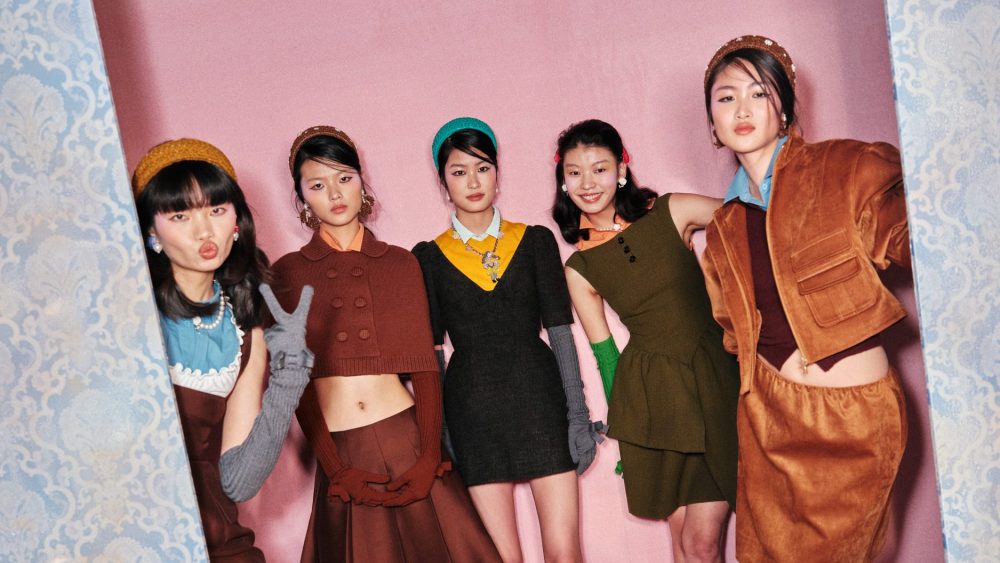
SHANGHAI — The fall 2025 edition of Shanghai Fashion Week wrapped Monday night on a high note, with Shushu/Tong presenting a well-rounded collection capturing the zeitgeist of Asian femininity in front of a room filled with guests hailing from around the world.
Over the past decade, the brand has built a global presence without ever doing a show outside of Shanghai. Shushu/Tong is now stocked in some of the best retailers and has dressed numerous Hollywood and K-pop stars.
In a recent development, its store in JC Plaza on the bustling Nanjing Road has become a destination for the influx of wealthy, fashion savvy South Korean visitors.
You May Also Like
Related Articles
Facing a growing and increasingly diverse audience, the brand’s design duo Yutong Jiang and Liushu Lei drew inspiration from American photographer Diane Arbus’ work “Identical Twins,” in which two identical girls gave different facial expressions.

“We wanted to create the images of two different girls. They are friends from the very beginning, and they have been referencing each other. They have similar details but with different colors and materials, they give completely different vibe,” Lei said backstage.
On the runway that meant assembling different female archetypes with the same wardrobe. The looks were put together via a wide range of Shushu/Tong-coded classics, such as pleated skirts, knitted cardigans, suit blazers, puffy minidresses, embellished hairbands and bold, decorative jewelry by Yvmin.
All the models carried an XL size, boxy bow bag stuffed with flowers and baguettes, which, according to Lei, aimed at bringing the Shushu/Tong girls from social media moments to the everyday.
The duo said fall 2025 is the brand’s most colorful offering to date — green, blue, red, pink, brown, orange, teal and gray cohesively appearing in one look — and that mix-and-match, carefree process was meant to showcase the themes of self-awareness and identity construct in Arbus’ work, and serves as a metaphor for female empowerment.
With just as much heightened drama, Mark Gong’s Hollywood divas could have been the Shushu/Tong girl gone bad.
Celebrity pop culture never dies, and they thrive on parody, an idea conveyed succinctly by the Parsons-educated designer on the runway and in the broadsheets of “M Daily News,” which carpeted the concrete floor of the Labelhood show space by the Bund.
The designer, fresh out of his Oscars red carpet debut courtesy of Lisa of Blackpink, evolved his tamed housewife archetype into a movie star vixen strutting across the hot mess that is tabloid news in power shoulders, a repurposed fur shawl, swishy lace pencil skirt or tassel-legged suit pants.
“I hate the word Y2K so much but I’m obsessed with the way they dressed in Hollywood at that time,” Gong said. “It’s the bad girl effect, they are real, they look flawless, that really was the look of the generation.” Gong also dislikes merchandise, but a quick street-style search got him under the Paris Hilton spell, which inspired the logo T-shirt design “I Love Mark Gong, Money & Boys.”
Gong’s treatment of flamboyancy and street-smart glamour was exemplified by the excessive use of fur that highlighted the otherwise all-black ensembles. Floor-grazing tassels that adorned handbags and became leg holes adds feisty allure to the otherwise sharp silhouettes. His signature cargo pants, which came with large pockets, and cinched-waist fur coats and beaded florals, were some of the singular Gong pieces that could easily become a daily uniform for reckless Gong girls.
Taking over a century-old garden house hidden within Shanghai’s storied alleys, Samuel Gui Yang softly partitioned the space, seducing the audience yet making every one of them a clandestine voyeur. The models strolled by in measured strides, seemingly unaware of the ‘trespassers’ who were gazing over from the other side of the slanted shade.
Freewheeling in nature and with a knack for mixing eclectic cultures, Yang proposed a thoughtful collection with an irreverent edge, one consistently framed by Yang’s lineup of Asian female protagonists.
“It’s about frames of a window, the framing of who you are, a frame of mind,” Yang said of the literal reference, pointing to female icons such as Eileen Chang, Song Meiling and Patti Smith.
In search of renewed energy, the show’s styling subverted viewers’ expectations with kitschy details such as the denim dress suit styled with a G Dragon-like hat and scarf combo and an asymmetrical opera gown that had a pair of wool joggers poking out from the side.
Jacques Wei offered the destination show of the season, bringing guests to the crown-like top floor of the Shanghai landmark Bund Center, with a sprawling view of the city skyline, for a collection that infused old-school Parisian glam with new-age surrealism.
The designer said he wanted to build a wardrobe for ”a beast under the lace,“ a dangerous liaison sort of scenario.
In true ’80s fashion, he played with sheer lace, feathers, faux fur, sequins and animal prints and repurposed Irish artist Ted Pim’s painting “Echoes Echoed,” reinforcing the collection’s fantastical escapism amid China‘s economic downturn.
Wei said he first stumbled upon Pim’s work at Almine Rech two years ago and later acquired a piece of his work, “Nightflyers Meeting,” at the Shanghai art fair Art021.
The designer said he was blown away by the artist’s Old Masters approach to depicting giant beasts and birds. “It felt intense, erotic and powerful. At the same time, the symmetricity of his work, I think, is very modern,” he added.
As China’s 37-year-old womenswear label, EP Yaying has always stuck to its guns, which means designing for the ethereal matriarch and the glamorous business powerhouse. Like all high-end Chinese apparel brands with manufacturing backgrounds, EP Yaying possessed a certain nerdy penchant for poetic fabrication, which also became the star of the show during its Shanghai Fashion Week debut.
The collection launched into action with vignettes of Chinese cultural artistry, both ancient and new — including a Kunqu vocal juxtaposed against guitar jabs, an AI-generated artwork by the Beijing Olympics-approved digital artist Yuxi Cao, fused with modern ballet — all unfolding under the supernova-like red peonies created by the avant-garde florist Fei Xu.
Peonies, the brand’s botanical signature, bloomed on pleated silks, resembling calligraphy strokes; Guizhou tribal totems offered “primal energy” via intricate embroideries, and jade-inspired brocades captured the brand’s essence: formal and conventional beauty that makes the wear feel statuesque.
Model-turned-designer Lu Yan dreamed of a breezy retreat for her brand Comme Moi’s latest collection. Following a jazzy trumpet performance, she showed sleek, urban numbers in mud dyed linen and silk. Some came with bold prints inspired by artwork by French textile sculptor, Simone Pheulpin and German artist Joana Schneider.
Other standouts included maxidresses with tiger prints, gradient knits and several more dressy, elegant pieces with sea creatures embroidered around the body.
Having finished the launch of a new candle brand, Xuzhi Chen returned to the runway this season with a collection that juxtaposed his signature fringes and an urban, romanticized take on the nomadic lifestyle.
Chen said the collection united the geometric principles of modernist master Eileen Gray with the chromatic aesthetics of Colombian textile artist Olga de Amaral and looked at inspirations that have shaped our creative journey, from tributes to the 1920s — an era of artistic renaissance and Hollywood glamour — to muses like Jane Birkin of the ‘70s, and Patti Smith and Robert Mapplethorpe of the ‘80s.
He hit a balance between originality and commercial viability. It was, overall, an elevated collection that those who still shop around regardless of challenging market conditions would appreciate.
The Central Saint Martins-trained designer also unveiled a collaboration with the French beer brand 1664, featuring jackets, tops and silk scarves in an Art Nouveau style print.
Qiu Hao‘s small atelier along the Bund made all 200 of his guests feel right at home.
As the unofficial grandmaster of Shanghai fashion design, Qiu Hao’s runway show was an intimate affair. It was the brand’s 20th anniversary celebration, a full-circle moment succinctly animated in 31 exits.
Soundtracked by the ambience of torrential rain, a play on the Noachian flood that last for 40 days, Qiu’s 40th collection was a meditation on renewal and rebirth. His nymph-like creatures glided down the runway in sculptural yet cocooning shapes that were styled with skintight leather stockings and tabi heels.
Exploring the circular form, which was cut in half and made into two dimentional patterns, Qiu’s take on wardrobe staples gave the otherwise common crisp white button downs and wool sweaters an unexpected drape and an ultra-relaxed fit that the wearer could relish and enjoy in secrecy — just like the brand itself, which has always appealed to a certain set of local stylish elites.
Poetic moments abounded, such as a column dress with exposed horizontal seams and tied just below the shoulder blades, or an austere high-collar sack dress, which were broken up with easier looks such as the pleated miniskirt and biker jacket ensemble, or sporty motorcycle jackets that extended into thigh-high boots. ”Our clients love to move from ultra-femininity to ultra-androgynous in a heartbeat,” Qiu explained.
For fall 2025, Oude Waag designer Jingwei Yin fixated on the concept of symbiosis between thorns and soft cotton. Presented between columns equipped with needle-like installations, the designer showed sultry, body-hugging looks with prickly prints and comfy, padded pieces.
It probably was the designer’s most accessible collection to date. Not a single look was pure showpiece. Even the ultra sexy, see-through fine knit dress would work in an everyday setting when paired with Yin’s cropped leather jackets or floor-length statement coats.
Private Policy, a brand that’s been showing in New York for years, decided to present its latest collection in Shanghai since its cofounder Haoran Li is stuck in China due to a longer-than-expected U.S. green card application process.
The fall collection subverted the high and low class dress codes, as Li and the New York-based cofounder Siying Qu alternated between expensive fabrics on classy silhouettes with distressed denim and plastic sequins made from recycled polyester. The show also included custom Nike sneakers that resembled clown shoes.
The rebellious attitude came through — as seen on h-line dresses reimagined with utilitywear fabric and pockets — as well as the brand’s pursuit of sustainable practices. The show space was covered with dried leaves Li collected from the mountain by himself, and he will return the leaves to where they were sourced after the show.
Jarel Zhang got philosophical for his fall 2025 show, with thick smoke permeating the room and fireworks during the finale. The designer said he wanted to illustrate the beauty found in uncertainty and the ever-changing rhythms of existence. He toyed with three-dimensional fabrics, layered silhouettes and asymmetric cuts to evoke a sense of movement and transformation.
Le Ngok’s designer Carla Zhang said the fall 2025 collection stemmed from her journey to Shanghai at the end of last year to establish the brand. She wanted to reflect the uncertainties and open-ended possibilities of the new chapter with a free-form, irregular weaving technique. The varying elasticity of different fabrics and the tension applied during sewing lead to the curved lines seen in her bright and playful creations.
Zita Tan, a Central Saint Martins alum, presented her new collection in a postively absurd format. The designer said she aimed to showcase the surreal within the ordinary with a presentation titled “One Day of Everyday.” She turned the seemingly mundane rhythms of daily life — walking the dog, attending a party, and drawing — into an abstract, immersive experience.
She incorporated surreal body performances into the fashion presentation. Models moved through three zones, depicting cycles of consumption, perception and response in daily life. Toward the end, their movements evolved into expressive gestures, symbolizing emotional transcendence and the fluidity of human connection.
Shuting Qiu, known for wild yet exquisite print clashing, hosted an intimate gathering at the Consulate General of Belgium. Qiu based the collection on graphic elements discovered during a recent trip to Indonesia, also incorporating florals from her hometown of Hangzhou, then topped it all off with embroidery from Hami in Xinjiang.
Building a tapestry of florals, Qiu said she was interested in how different cultures used similar floral motifs in various proportions, which she played up in layered cocktail dresses that came with mesh opera gloves and zany leggings.
Ao Yes is in the mood for forbidden love this season, delivering a collection that borrowed ideas from classic fashion films. “We were crazy about ‘In the Mood for Love,'” said Austin Wang, one-half of the designer duo behind Ao Yes, which he founded with partner Yansong Liu two years ago.
Embodying Uma Thurman’s character in “Gattaca,” Ao Yes reimagined Thurman’s folded-collar power suit into delicate pinafore dresses adorned with cascading bow ties. With a slight protrusion at the waist, which was created by shoulder pad placements, Wang said the look was meant to better frame and sculpt the female shape.
References to modern China have always been present in the duo’s design; this time, they found a kitten-adorned object from the 1980s, which the designers discovered at Beijing’s Panjiayuan antique market. The graphic image was recreated as necklaces or appeared as figurines on sweaters via the needle punching technique, giving the looks a streetwear bent.
Similar to EP Yaying, Chinese homewear heritage brand Threegun used the show to celebrate its 88th anniversary and tease what comes next. It started with a short film in the local dialect, highlighting the brand’s essential role in domestic life over the years in Shanghai. Then it presented several archetypes of the brand’s customers in a nostalgic fashion before revealing a more fashion-forward runway range.
According to the brand’s general manager Jiaorong Chen, the show aimed to convey the brand’s determination to reinvent itself from a bodywear specialist into a full-fledged fashion brand.
“We want to break the boundaries of traditional underwear to attract young consumers who pay attention to both comfort and fashion, and let them see that a Chinese household brand can also offer a modern and stylish wardrobe range,” added Chen.