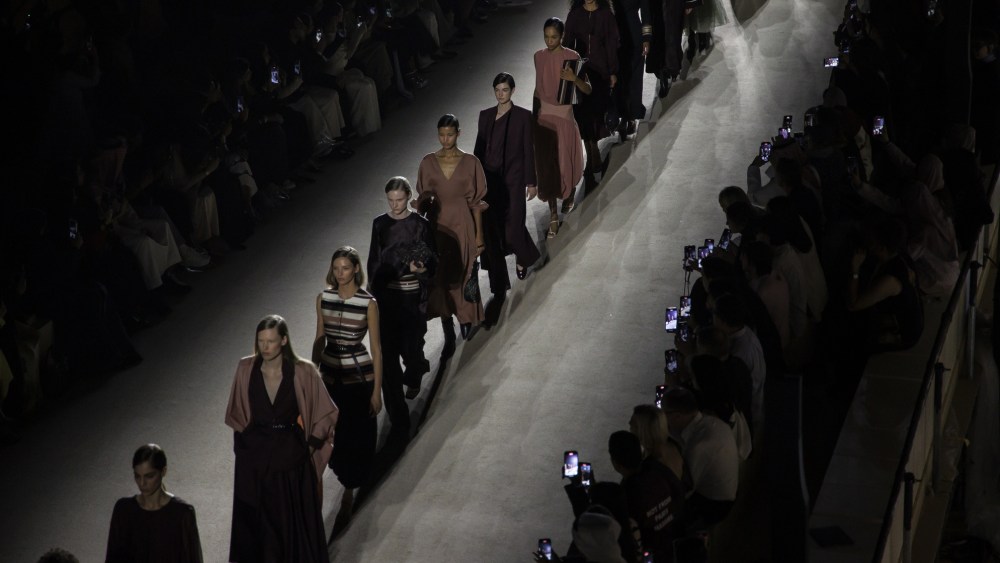
The third edition of Riyadh Fashion Week marked a step change for the fledgling showcase, attracting international labels, retailers and editors to transporting, open-air runway venues and showcasing the appeal of its homegrown modest fashions — and spectacular special-occasion wear.
“Honestly, I didn’t expect that much, and it’s been fantastic,” said Manel Aboudaoud, owner and designer of Manel, a Dubai-based eveningwear-focused brand and one of five international names participating in fashion week for the first time. “Eight stores want to work with me.…I will be all over the GCC [Gulf Cooperation Council countries].”
Related Articles
Aboudaoud staged an intimate salon show on Oct. 19 and also displayed her designs in a commercial showroom set up within the golden sphere atop the Norman Foster-designed Al-Faisaliah Tower, the first skyscraper to be built in Saudi Arabia in 2000, kicking off its urbanization drive. The offering ranged from fun slogan T-shirts and loose linen separates to lavish evening gowns and jewelry.
You May Also Like
The schedule stretched over six days, with 45 brands staging runway shows or presentations. There were up to six back-to-back shows at remote venues that often ran as much as 90 minutes late, testing the patience and stamina of editors from various international Vogues, NSS Magazine, Les Echos and Dazed Korea — in addition to a wide swathe of regional press.

Participants ranged from local couture stalwarts Ashwaq Almarshad, Tima Abid and Adnan Akbar to Leem, a contemporary womenswear label which is fast growing in Saudia Arabia and abroad in the modestwear segment. Popular mall-based brands like Femi9, which gifted straw hats with lace chin straps to front-row guests, dovetailing with its Victorian-inspired collection, were also present.
There were two days devoted to casual and streetwear brands in Riyadh’s warehouse district, with several models in the RBA show on Sunday accessorized with hooded falcons, which didn’t seem to mind the pounding dance music.
The up-for-it crowd at those shows clamored for seats and photo ops at the step-and-repeat walls, wearing an array of looks stretching from abayas to board shorts and sneakers.
Demure fit-and-flare silhouettes predominated on the runways and presentations, with fringe and crystal among the popular embellishments.
While the kingdom has relaxed dress codes in recent years — bare arms, shoulders and backs were seen on front-row guests and on runways — fashion week organizers must still clear all provided images from the shows with the Ministry of Culture, which funds the Saudi Fashion Commission, organizer of the Riyadh showcase.
Organizers are hip to the burgeoning interest in Asian stars, hence, there were paparazzi frenzies over Thai actors Faye Peraya and Win Metawin, along with international notables like Georgina Rodríguez, Cristiano Ronaldo’s fiancée, who turned up at Mona Alshebil’s show in a trenchcoat with broderie anglaise detailing.
On the sidelines of the runway shows were launch events including a late-night dinner at Carbone that eyewear retailer Eyewa hosted to launch its collaboration with eL Seed, a French Tunisian calligraphy artist and muralist.
The fashion week offered an opportunity to exalt Saudi hospitality — coffee, dates, canapés and juices were proffered at every turn — and the city’s myriad facets, from its luscious groves of date palms to imposing skyscrapers like the Kingdom Centre Tower, which lights up with advertising at night.
Demand for Saudi brands in the kingdom is surging, as wearing a Saudi label is increasingly becoming a point of pride.
“I’ll be wearing a dress from a Saudi designer in Paris, and people ask me about it. I feel so proud,” said Nouf Alnamlah, Farfetch’s first senior stylist in Saudi Arabia, who now works with high-profile clients. “People really love a good Saudi brand — something from our own that represents us in a way that understands our needs.”
According to designer Reem Alkanhal, “Saudi women have always been naturally stylish. I witnessed this growing up with my grandmother, mother and their friends. That’s where I largely draw my inspiration.”
That said, style has evolved organically among younger generations.
“What is unique is how they’re living the now, but still loving our traditional abaya,” Alkanhal said. “They combine and embrace the modern with the traditional, play around more and experiment with styles and colors. It’s vibrant, joyous and fun. It’s not something new to Saudi women, it’s just new to the world.”
Alkanhal’s last collection featured cropped jackets with detachable sleeves, giving women the option to use pieces with versatility.
“You can have a sleeveless look or a peekaboo affect if you prefer to cover your arms.” This, she noted, isn’t just for Saudi women, but resonates everywhere. “Many women all over the world don’t prefer to show arms, so they have the option to [offer a peekaboo of] some skin without feeling insecure.”
Multiple showgoers were seen wearing T-shirts declaring “Saudi Arabia Is the Future,” a design that went viral after appearing on the catwalk in Hindamme’s show last year.
Many streetwear brands emblazoned their designs with optimistic slogans like “12 new chapters, 365 new chances” writ across an anorak by Cargo, or “Mercy,” spelled out in English and Arabic on a T-shirt from House of Cenmar.
Saudi heritage and national pride figured across many collections, with geometric rooflines a graphic detail on the loose men’s alterna-suiting from Noble & Fresh, and odes to various regions spelled out in spirals of Arabic characters on Hindamme’s second-skin dresses.
Most participants showed fall 2025 collections on the runway as a see now, buy now effort, while taking orders for spring 2026 collections in the commercial showroom, operated by White Milano.
Italian streetwear brand Ih Nom Uh Nit, participating in Riyadh for the first time, said it expanded its wholesale client roster in the region and noticed an immediate surge in sales fanned by social media posts in the wake of its runway show. “Our e-commerce went crazy,” sales manager Carlotta Tassi said.
The Saudi fashion industry is expected to reach $42 billion by 2028, with fashion contributing 2.5 percent to the kingdom’s gross domestic product.
And the Saudi Fashion Commission was working overtime to give local brands a leg up, hosting 70 buyers, most of them international.
Among major retailers in attendance was Judd Crane, executive director of buying and brand at Selfridges, which hosted a clutch of Saudi brands at its London flagship over the summer for what he said was a “very successful” pop-up.
Mona Alshebil was “the top-performing brand” at the event and will be back in the department store’s womenswear edit in 2026. Also joining will be Abadia, whose “strong show this week reaffirmed our interest in the designer from last year’s short list,” Crane said.
There were some new finds as well for the retail executive. “Mirai was a top new discovery of the week,” Crane shared. “The humorous Not Boring ‘bodega-inspired’ merch shop was another highlight, with T-shirts cleverly boxed with games and stickers alongside baskets of baseball caps.” Crane said Selfridges is “keen” to plan activations with both designers in 2026.
“We felt energized after a few days at Riyadh Fashion Week. We continue to be interested in sharing a global perspective through our fashion offer, in a way that is meaningful both for a global and local Selfridges customer,” he said.
“What’s happening here is incredible — the energy, the engagement of the designers,” agreed Brenda Bellei, chief executive officer of White Milano as she escorted Uberta Zambeletti, founder of Milanese store Wait and See, around the three-level showroom.
Bellei trumpeted a strong rapport between price and quality among the Saudi collections on display. “Buyers are no longer looking for something expensive,” she stressed.
For example, Manel’s Aboudaoud said her average selling price for an evening gown is about $750 despite her use of top fabrics, a tactic to help her six-year-old label grow.
The showcase had a notable Italian accent, with Italian brand Amen parading its latest collection on the runway, and Italian jewelers L’Eight Studio and Coppola e Toppo showcasing their wares in the showroom, the latter securing a sizable order from an Italian retailer attending the week.
For first-time visitors to Riyadh, it was an introduction to its lively local fashion scene, where dressing-to-the-nines is the norm, and female-led and designed brands rule, especially in the couture space.
“It’s been something that many women in this country aspired to, it was an open space,” said Burak Cakmak, CEO of the Saudi Fashion Commission. “They were able to build their businesses and directly sell to their audiences here — other women in the country. It made it even more intimate and easier in private settings, because they didn’t even have retail spaces.”
Cakmak sees that as a “big opportunity” given that Saudi female designers understand comfort, the body and “what women want to look like.” In addition, they understand the lifestyle of Saudi women when at home and traveling.
“As a result, they’re able to introduce products at the right time for the right occasions, which any international designer, man or woman, might struggle to understand,” he said.
Meanwhile, a new crop of ready-to-wear brands is emerging like Abadia, which “understands the mindset around how women from this region want to dress, which is very much translatable to the rest of the world,” according to Cakmak. “Anyone, anywhere in the world, at any age can feel comfortable in it.”
When Abadia did a pop-up at Galeries Lafayette in Paris, it attracted attention and purchases from American and European women “just because it’s a new brand they’re discovering, without knowing that it was even Saudi brand,” Cakmak said.
Meanwhile, young men dominate the burgeoning streetwear scene as traditionally, few Saudi women designed clothes for men.
“But even then, in the streetwear space, we have several brands that are female-owned, and they are aligned with global trends, designing for both men and women, as many brands are now moving into both gender in all their products,” Cakmak said.
Fahad Al Jomiah, CEO of a streetwear brand 1886, called its participation a milestone moment.
“We wanted to showcase how far Saudi fashion has come and how it can proudly stand on a global stage,” he said. “The response was beyond expectations, both locally and internationally. For us, it wasn’t just about presenting clothes; it was about presenting confidence proving that Saudi design today is ambitious, relevant, and ready to compete globally.”