
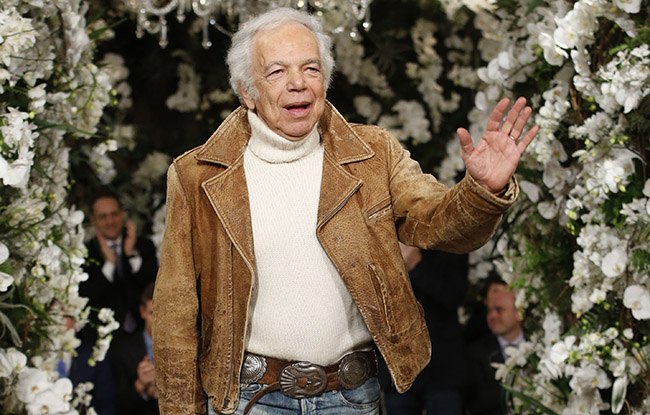
Ralph Lauren stood on a sisal-covered floor this afternoon, the surrounded walls covered with densely packed orchids. He extended his arms to reference the setting, before settling in on one of the generously pillowed white damask sofas that surround the perimeter of the room. “An experience,” he said.
Lauren was in the second-floor collection selling space of his Madison Avenue women’s flagship, closed for three days in preparation for his New York Fashion Week spring showing tonight. The idea of the decor is to capture a spirit evocative of a show designed under the working title “Nomad.” “I don’t want to do predictable,” Lauren said. “It’s a little bit exotic.” A preview offered glimpses of fluid shapes in liquid golden fabrics and mesmerizing prints. [For a review of Lauren’s show, see WWD.com and Friday’s Digital Daily.]
Related Articles
The two first floors of the Lauren store have been transformed into a chic floral wonderland, every inch of wall space covered with orchids — 100,000 or so — intertwined with vines and moss throughout which paper butterflies perch. In the background, a soundtrack of tweeting birds heralds the coming of spring. (Full disclosure: a quick feel in a small corridor leading to a private, non-show space revealed that a few plastic blooms mingle among nature’s own.)
You May Also Like
“This is for customers as well as for the press,” Lauren said.
That’s more than marketing jargon. Lauren staged two shows tonight, each with 200 guests. At the first, 60 seats were reserved for VIP clients. Beginning Thursday morning, those clients and others can shop within the installation, which will remain intact through Monday. (One assumes most of the seating will be removed to make room for the clothes.) It’s hard to imagine that shoppers won’t be blown away, on two levels. They’ll love the window to the insider show experience, and that the designer and brand cared enough to share it in a way more personal manner than that which social can afford.
This experience, of course, focuses on shopping for spring. In just one season, the buy-now element of NYFW has changed dramatically, as the two other majors who embraced the concept for fall made other plans this time around. Tommy Hilfiger skipped town for Venice Beach, and Tom Ford, in the throes of his “Nocturnal Animals” activity and the only luxury-space designer to have done see-now-buy-now in New York, opted out of a show this season. Lauren said those moves didn’t cause him a moment’s concern. He observed that last season he wasn’t really aware of what anyone else was doing, and that the traditional gap between fashion’s showing and selling seasons has always bothered him. He views instant fashion as an extension of his long-held lifestyle approach to the business.
“I’ve always believed in the experience,” Lauren said. “I’ve done it a long time, with my first store across the street — we had home furnishings, a women’s floor, children. The world, the lifestyle, it’s always what I’ve believed in. We want people to have an experience.”
Lauren expects clients to find taking in the installation “pleasurable,” whether or not they’re among the lucky ones attending the show. “This is the way of putting you in the middle of it, to have an intimate experience,” he said. “It has to be a pleasure. Now, the question is, are the clothes a pleasure? Luxury has to have specialness.”
Yet Lauren acknowledged different kinds of luxury. He indicated his very weathered leather jacket — vintage, and his cowboy boots — 30 years old: “They’re luxury because you can’t buy them now.”
Ever the gentleman, Lauren didn’t flinch when the conversation turned in a direction he preferred not to take. What happened in the relationship with Stefan Larsson? “I like him very much. He’s very smart,” Lauren said. “The truth is, we had a difference of opinion about the business.”
Lauren said Larsson, who hasn’t yet left the company, took great strides in “speeding the production cycle. And he brought some good people into the company.”
Lauren did not say, but inferred, that Larsson may have wanted to move too quickly in certain areas. “This company is 50 years old,” he noted, alluding to the big upcoming anniversary. “You can’t be 50 years old in fashion and not have changed and moved and led the times. I believe in that. I don’t believe in revolution.”
He turned his attention to the several models, in variations of the nomadic chic he was preparing to show. “I feel like they’re coming from somewhere else,” he said. “You look, and you’re not quite sure where.”