
BERLIN — Porsche Design is shifting gears to position the designer sportswear and accessories brand closer to its automotive namesake from the standpoint of design, technical savvy — and even mobility.
Despite the iconic car’s legendary speed, though, Porsche Design’s new chief executive officer Christian Kurtzke isn’t in a rush. When it comes to expansion, he is even prepared to step on the brakes, be it in own retail or the brand’s fledging women’s wear business.
Having served as ceo since last June, Kurtzke views Porsche Design as a primarily male, designer sportswear brand targeted at the business traveler. “The internal mission,” he told WWD, “is that we intensively drive the fusion between sportswear, fashion and technology by inventing new innovations.” This translates into a host of plane-to-business meeting items, like the leather accented, wrinkle-resistant travel blazer or the hybrid blazer with its detachable, zip front, quilted vest.
Related Articles
Porsche Design founder “Professor Ferdinand Alexander Porsche said we want honest design, driven by function and fair pricing, which serves us well in these times,” the executive noted.
You May Also Like
The brand’s premium price positioning — with blazers retailing from 500 to 750 euros, or $560 to $840; non-leather outerwear up to 1,250 euros, or $1,400, and leather outerwear from 1,450 to 3,000 euros, or $1,625 to $3,360 at current exchange — “resonates well these days,” Kurtzke said. “The next generation has a different approach to luxury or the upper market segment. Fair pricing is important. They’re not willing to just overspend for brand names.”
In recent years, Porsche Design had worked to both expand and spotlight its women’s fashion offerings, staging runway shows during New York Fashion Week and launching handbags. “Women’s is growing on a small base, but if [women’s] hadn’t been started, it could have waited five years,” the ceo said. “I believe we have the potential to double the company by first focusing on men,” he added, though he declined to talk numbers.
The company’s financial results are part of the Porsche AG annual report, but Porsche AG no longer breaks out Porsche Design Group figures. The last released figures, for 2013, placed group sales at 128 million euros, or $170 million at an average exchange rate for the period.
Kurtzke has also distanced himself from past management’s ambitions to run in the high-fashion league, arguing, “We are not in the fashion business, but in designer sportswear. And for us, designer sportswear involves performance.”
The more active Porsche Design Sport range, currently a collaboration between Adidas and Porsche Design, will be brought in house as of 2018. It’s just one move to make Porsche Design more coherent, which given the company’s complicated construct is no easy task. Though the Porsche Design brand goes back to the Seventies, the Porsche Design Group, or PLH (Porsche Lizenz-und Handelsgesellschaft), was founded in 2003 to consolidate Porsche’s non-automotive design activities. The Ludwigsburg-based group, a subsidiary of Porsche AG, has three divisions. Porsche Design offers a product range spanning city and active sportswear, shoes small leather goods, bags and luggage, watches, pens and writing supplies, smartphones, sound and data storage, eyewear, fragrance, tea sets, candles and even an ultrasleek Shisha (water pipe).
Then there is Porsche Driver’s Selection, with products sold via Porsche auto dealerships. The third is the legendary Porsche Design Studio in Zell am See in Austria, which spawned many signature Porsche Design products including the brand’s ever-popular aviator glasses. Something of a design think tank, the studio also designs for other companies in a variety of fields, including medicine.
There was little effort in the past to integrate the vision of the group, Kurtzke said, nor the various categories under the Porsche Design brand. To help ensure a consistent design signature, Pierre Costin was named Porsche Design’s creative director earlier this year.
Costin, in turn, has banned trend services in the design studio, arguing it’s crucial for the brand to find its own direction and identity. “Plus we don’t really need to look farther than across the hall, so to speak,” he remarked. Every so often, the Porsche Design creative team meets with the Porsche car tech team to gain insight into new automotive materials, technology and inspiration, he explained.
Some cases in point: the way Porsche melds and/or fuses the windshield of its sports cars could be utilized in the brand’s eyewear. Or new treatments used to improve the wear and tear of Porsche car seats could do the same for Porsche Design’s small leather goods. There’s a more concerted effort, Costin said, to connect the leather colors of the cars with the collection’s leather palette, or to incorporate the cars’ metallic shades with the apparel’s fabric range.
“You can’t turn a coat into a sports car,” he continued, “but like the car, we want the customer to find our clothing to be collectible and prized for its details and quality. Before, there had been a design direction to move away from the car, but now we try to infuse the clothes with the mood and lifestyle people associate with the car.”
Moreover, “we push ourselves to innovate and develop signatures with the make and details of our garments. We use advance seam sealing and bonding techniques in our clothing manufacture, and apply unique and identifiable branding details such as braided rubber patches in a pattern we call Tec-Flex,” already known outside the world of racing in Porsche Design’s popular stainless steel braided TecFlex pens.
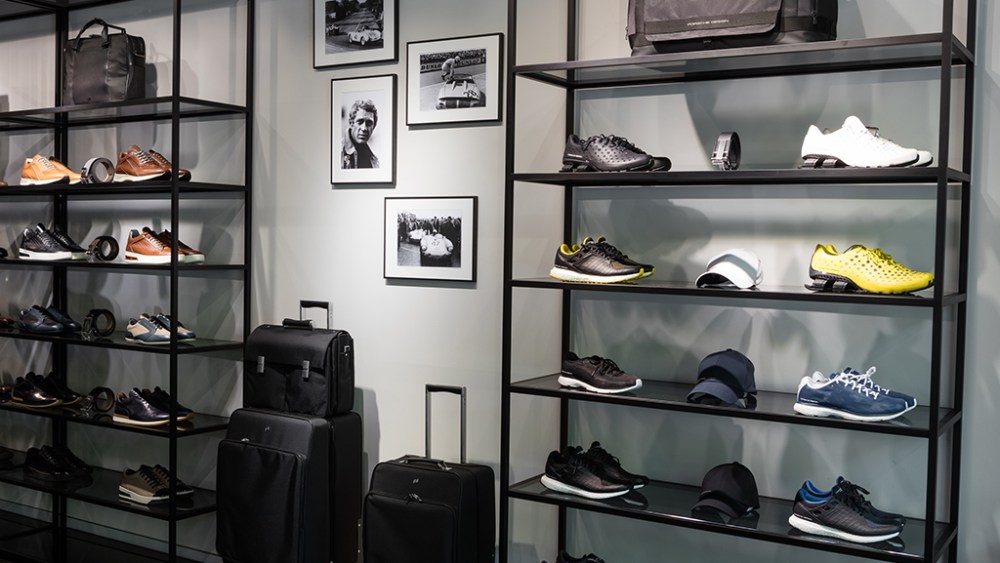
Vintage photos of the most coveted Porsches and racing highlights now line the walls of Porsche Design stores, such as the Berlin flagship on Kurfürstendamm. “We’re changing the paradigm of the company, not loudly but fundamentally,” Kurtzke said. “Rather than just rushing into the future, we are connecting with the past to build depth. It’s about showing our heritage, and even reflects how we launch new products,” such as the new 1919 Eternity watch, which premiered at Baselworld earlier this year. The timepiece’s design not only evokes the legendary Porsche 356, but the promotional materials clearly connect the watch and the sports coupe.
Kurtzke does want to push forward when it comes to retail, though he’s not necessarily envisioning more Porsche Design doors. At least not as we know it. In the present global market environment, with many premium and luxury brands having to scale back extensive own-store networks, he contends Porsche Design “is lucky, because we were late.” The brand now has more than 130 franchise partners, a wholesale business which needs to be redeveloped, and 30 company-owned boutiques, which are under review. “We need to readjust, perhaps closing some doors or reopening in other locations. I mean, do we really need three stores in Berlin?” he pondered. “But with just 30 own stores, this is relatively easy.”
In his view, the key task is no less than “reinventing retail. That means looking at it digitally, with fixed points of sale or mobile,” and he’s not talking apps.
“The shopping experience has to go where the customer is. It’s like a jeweler — how much business actually gets done in store? Which is why my store should be mobile and that’s what we’re working on with a new project called Urbanharbor.” Situated in a former industrial complex in Ludwigsburg, Urbanharbor involves repurposed factory halls, surrounded by containers which are customized for their tenants — and can be moved as the need arises.
“Everyone is always talking online, online, but we need a mix. A hybrid, combining online, offline, and…mobile in some way, rather than concentrating on stationary shops,” Kurtzke declared. “Nobody, whether producer or wholesaler, is capable of financing inventory anymore. It’s a question of how to provide a minimum of infrastructure for movable touch points where we’ll be able to sell our whole product world to customers. “
Envisioned is a Porsche Design container or containers in the signature Porsche Design retail design, which can travel, for example, to a Porsche golf tournament and tap Porsche enthusiasts there, as well as implementation with a few select partners.