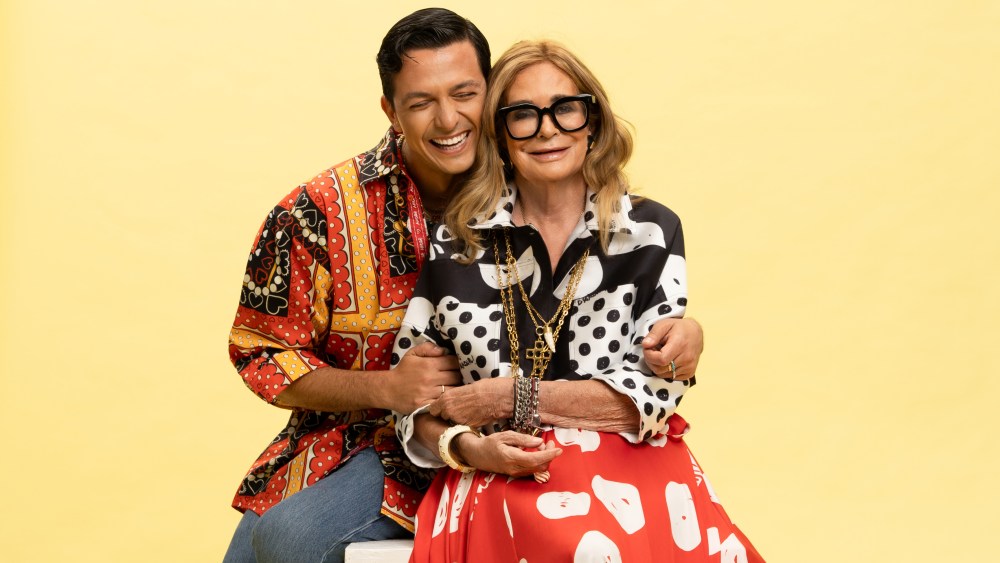
MILAN — “Which woman doesn’t have polka dots in her closet?”
When it comes to Rossella Jardini, the question can only be rhetorical. The designer spent 11 years working with the late Franco Moschino, becoming his right-hand person and keeping his legacy alive in the aftermath of his untimely death in 1994. She remained at the creative helm of the Italian house until 2013, becoming the embodiment of the Moschino codes — polka dots included.
This Milan Fashion Week, Jardini is making a comeback, invited by Sicilian designer Alessandro Enriquez to contribute — and inject a generous dose of the pattern — to his namesake line’s spring 2026 collection that will be unveiled on Wednesday.
You May Also Like
Related Articles

The partnership is the result of a natural affinity between the two, both on an aesthetic and personal level. Like Jardini, Enriquez is known for his bubbly personality and has a passion for everything Italian, translated in the joyful vibe of his collections, bold in their color palette and rich in prints like floral and heart-shaped motifs.
Launched in 2013 as “An Italian Theory” and rebranded under his own name in 2017, Enriquez’s label spans fashion, home decor and lifestyle. It was this multidisciplinary approach that sparked the connection with Jardini.
In a preview with WWD, the two designers recalled their first meeting in 2011. At the time, Enriquez was working on his book “10×10 An Italian Theory,” creating a conversation between fashion and food at a time when this combination wasn’t as widespread. Each of the 10 chapters featured an interview and the table and mise en place of a prominent personality. Convinced by a mutual friend, Jardini opened the doors of her home to Enriquez for the project, and the two clicked.
After more than a decade, food triggered their collaboration again. As he started to work on his spring 2026 line, Enriquez was inspired by the story of Francesco Procopio dei Coltelli, a fellow Sicilian billed as the inventor of gelato, who left the island to open Le Procope in Paris in 1686 and export a taste of Italy. As he wanted his collection to metaphorically cover many flavors while staying true to his brand’s ironic DNA, Enriquez invited Jardini to bring her expertise to the project.
The final range is a blend of Enriquez’s playfulness and Jardini’s lighthearted sophistication, expressed via bold patterns, flashy prints and vibrant colors.
Polka dots were turned pop, scaled down or up in their size, rendered in white, red or black, or overlaid on summery, Italian Riviera-nodding stripes.
“Polka dots for me are a universal print. They hold the same value of a solid colored piece, they are a passe-partout with which you can do everything,” Jardini said.
The motif was also integrated into new prints in combination with other Jardini signatures, such as strings of pearls or the fun motif of a hen, including a special version of the animal wearing black optical frames just like the designer’s own.
In a less literal approach, Jardini’s handwriting was present through nods to her personal archive of clothes and accessories. Enriquez marveled about the many vintage pieces from different brands she collected through the years, headlined by Jardini’s favorites — a selection of Hermès looks by Martin Margiela and those she designed with Moschino’s founder, of course.
References to her work with the late designer can be retraced in this collection. These include T-shirts and a striped jacquard dress bearing the word “niente,” or “nothing” in English, that winked to archival Moschino pieces. Jardini recalled that at the time the concept was the result of a conversation she had with Moschino, in which she didn’t want to print anything on a chic silk blouse so the late designer took her input literally by printing the word on the garment. In the new iterations bowing this week, the term is repeated three times, as is customary with Enriquez’s fashion.
Jardini’s influence will also be seen in the profusion of chemisier and ladylike duchesse dresses, fitted blazer jackets, as well as an ‘80s-inspired denim jacket punctuated with an array of gold buttons and buckle details, which made for a new addition to Enriquez’s lexicon.
“She gave us many precious tips and she passed down to us the know-how and rigor that come from her experience and her other stints, too,” Enriquez said. For one, Jardini worked at Bottega Veneta, which she left to join Moschino in 1983, then in its early stages of development. After her exit from the Aeffe SpA-owned brand, where she was succeeded by Jeremy Scott, she moved to Aspesi.
“From that experience, she shared with us the importance to play with different weights in the collection and not just the summery ones,” said Enriquez, referencing the introduction of pieces such as quilted outerwear overprinted with a daisy motif.
Jardini also suggested the introduction of a leopard theme to boost the commercial viability of the collection. “But when I envisioned the initial theme, I wasn’t thinking of any wild twist, so we reinterpreted the animalier pattern as little mouths and kisses,” Enriquez said.
Elsewhere, colorful allover prints of strawberries, ice cream and Popsicles, as well as postcard-like vignettes, further indicate Enriquez’s own vision and round out the playful collection.
To fully grasp the spirit of the line, the designers also tapped Pierpaolo Ferrari — who cofounded Toilet Paper with artist Maurizio Cattelan — to photograph the look book images. These will be showcased along with the collection at the brand’s presentation at the Circolo Filologico Milanese venue.
“It’s been such an experience overall. What I’ve learned in these months is [to embrace] that lightness and lightheartedness that fashion should have and that often this industry doesn’t [have],” Enriquez said.
“But that doesn’t mean she [Jardini] wasn’t razor sharp in telling us what she liked or not,” he quickly added.
These extended the scope of the collection per se, as Jardini expressed her disappointment for “what Moschino has turned out to be today,” luxury brands’ surge in prices, up to commenting on style trends. An example? “A woman who wears sneakers is not a woman,” she said bluntly.
Yet Enriquez overlooked that viewpoint. For spring, he tied up with Casadei to develop a sneaker design, in addition to slingback pumps and flats, for a capsule collection that will be unveiled at the footwear brand’s presentation on Thursday.