LONDON — “I felt like Uber all of a sudden. It was so weird, as a pajama brand, to be in this space that everyone was talking about in terms of big opportunities,” said designer Olivia von Halle on Zoom, while sitting in her chic pink-hued living room, dressed in one of her luxe silk pajama designs. “If anyone is allowed to wear pajamas to meetings, it’s me,” she joked.
Since the outbreak of the pandemic, her namesake business saw sales skyrocket, along with celebrity and media attention. Sales doubled in 2020; high-profile celebrities like Angelina Jolie attended Zoom movie premieres, while lying in bed in the brand’s signature silk sets, and new customers used the savings from canceled holidays and social occasions to treat themselves to a pair of the luxe pj’s.
Related Articles
“We’ve always been a totally ignored category that’s stuffed off in a lingerie department somewhere. We don’t show at fashion week, we’re usually a small private part in people’s lives and all of a sudden we were shoved onto the world stage,” she added.
You May Also Like
But even as the world opens up, the momentum is still going strong and the company has already outperformed last year’s sales. She is plotting new product categories and physical store openings.
“This time last year, the world was going back into lockdown and our sales were booming. But we are outselling what we were doing in 2020. I can’t speak for the rest of the nightwear category but for us, [the pandemic] fanned the fire and we managed to keep doing well and continue the growth,” said von Halle, who fully owns her company and has never taken on investors.

“People are taking a while to get back to dressing up, a shift has happened. We are dressing in a much more casual way, but there are brands like Olivia von Halle that elevate that kind of experience: there’s a big difference between our tracksuits and an average tracksuit,” she added.
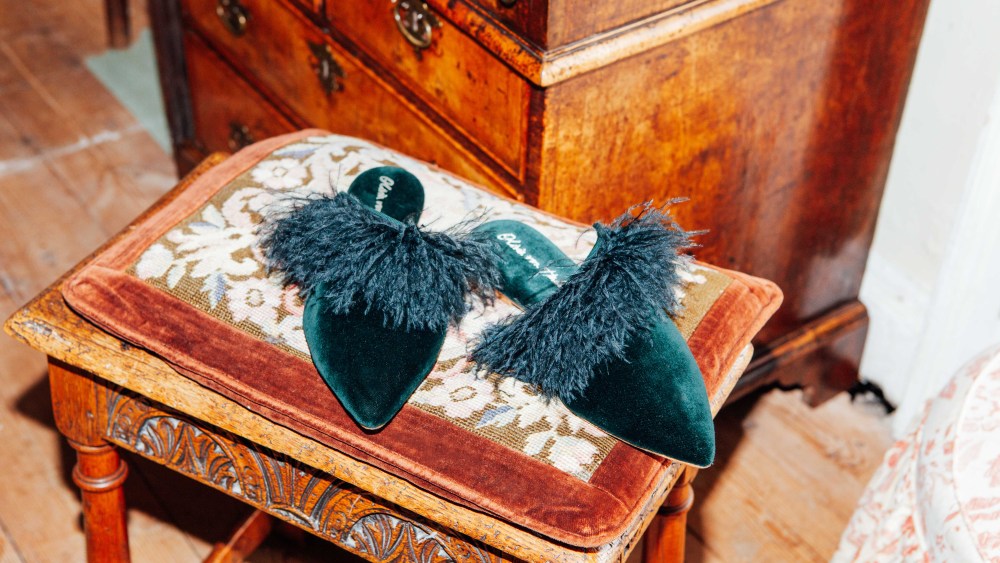
The brand has also just unveiled a line of slippers and a Black Label capsule featuring some the brand’s most decadent, embroidered designs.
“We’re lucky to have that customer for whom price is no issue: they just want the most beautiful, the most ridiculous pajamas, so we get the opportunity to just go completely wild with the Black Label range and not think about cost. You do sometimes think ‘Who on earth is going to buy this?’ but it all sells,” said von Halle, adding that the range features sumptuous velvets and delicate embroideries, done by hand by women in the coastal British town of Brighton. “When you see the work that goes into those products, it’s kind of moving.”
Prices range from 485 pounds for a set of velvet pajamas to 2,500 pounds for an embroidered velvet robe.
The slipper styles were also designed to be the most “environmentally aware shoe” it could be, with vegetable-tanned soles; leather that’s a byproduct of the meat industry, and recycled OrthoLite, a material used in sneakers to ensure cushion-like comfort.
“It was great to approach a new category without having to worry about existing supplies,” said von Halle, who maintains a very pragmatic attitude toward sustainability in fashion. “The most sustainable thing you can do is to buy less clothes, but that’s a tricky thing to say as a brand. We lay out our challenges, which is helpful for other businesses, too, and try to have a transparent approach. Trying to pretend you’re super green makes me mad, especially if your brand is driving sales all the time — that’s a problem.”
The brand has also replaced its labels from polyester to silk and uses mother-of-pearl buttons, to ensure that its signature pajamas are made of 100 percent natural fibers and fully biodegrade. It’s also in the process of measuring its environmental footprint and partnered with carbon offsetting provider Highland Carbon to offset emissions relating to premises, manufacturing, shipping and travel.
Next the label plans to expand its physical retail footprint, to keep customers engaged in the post-lockdown world. Von Halle’s aim is to explore opening stores in affluent London neighborhoods like Notting Hill, engage customers in a localized manner and bring the same concept across the pond to cities like New York and Los Angeles, as the U.S. is “by far” the brand’s biggest market.
“E-commerce had this massive boom, but there’s also some backlash in terms of the packaging. People might not be going to Oxford Street but they are now shopping in a much more neighborhood way, so that could be a really interesting strategy for us to explore,” she added.