
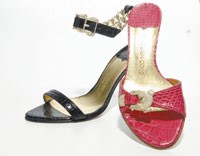
NEW YORK — If Kieselstein-Cord has its way, it will soon be snapping up a larger audience.
The brand favored among luxury consumers for its high-end jewelry and accessories, such as belt buckles, handbags and eyewear that sometimes feature a signature crocodile, is exploring growth opportunities to build annual sales from about $50 million to $300 million in the next five years.
The brand push is already under way:
Related Articles
- Next week, Kieselstein-Cord will add Boston’s reopened Shreve, Crump & Low to its retail distribution, and begin construction on an in-store shop in Hirshleifer’s in Manhasset, N.Y., which is expected to be open for the holiday shopping season.
- In January, the brand will begin renovations at its year-and-a-half-old, 1,000-square-foot SoHo boutique on Prince Street here that is expected to boost selling space 50 percent. The brand also is completing updates in its eight-year-old Palm Beach, Fla., boutique on Worth Avenue, and shopping around for a bigger uptown flagship after moving out of a year-old boutique on Madison Avenue in Manhattan.
- In the spring, Kieselstein-Cord will introduce three new categories: Crocodile Hall, a 20-piece selection of more affordable weekend-ready totes, handbags and unisex carryalls designed from a colorful logo-patterned leather; Kieselstein-Cord footwear, featuring alligator skins and gold-plated signature hardware that will retail from $350 to $1,700, and AKC by Kieselstein-Cord, an apparel grouping made in arrangement with the American Kennel Club that will showcase whimsical canine prints on innerwear and outerwear.
More could be in the works, too. Founder, creative director and president Barry Kieselstein-Cord said the brand, whose logo was inspired by a former pet crocodile named Herbert, is interviewing potential investors for the first time in its 30-year history.
“We confined our distribution to achieve true luxury status and it worked,” Kieselstein-Cord said. “We are now a known entity to the cognescenti who really understand high-end luxury product. But in the last five years, we have been chafing at the bit to unconfine ourselves. We are prepared to spread our wings.”
Kieselstein-Cord, who worked in film and importing Art Deco antiques, got his start in the business by happenstance.
You May Also Like
“I was living with a gal who decided to take a jewelry course, and not wanting her out of my sight, I decided to take the course, too,” he recalled. “I loved what I was doing, so I decided to take an advance course. The teacher told me I had absolutely no talent and there was no way I should continue.”
Today, Kieselstein-Cord counts two Coty American Fashion Critics Awards and a Council of Fashion Designers of America award among his credits. His designs are also in the Metropolitan Museum of Art in New York and the Louvre in Paris.
“The Kieselstein-Cord customer is a very independent woman who is confident, worldly and well-to-do,” said Robert Burke, senior vice president of fashion for Bergdorf Goodman, which houses Kieselstein-Cord’s flagship in-store shop. “The brand has a very loyal following and continues to add new customers with its new collections.”
Burke cited Kieselstein-Cord’s new diamond-enhanced jewelry assortment that began retailing two years ago, but Kieselstein-Cord said he also has enjoyed success with the recent addition of the lower-priced sterling silver Vero collection based on the macabre icons of Mexico’s Day of the Dead.
“People have a tendency to think of my work as bold, but they are finally getting acquainted with my entire dialogue,” Kieselstein-Cord said. “And my customer has expanded. I used to be able to say it’s 40 and above, but now it’s 18 and above. I have reached out to a young market and a broader segment of the population because I think that’s another form of expression for the brand.”
Kieselstein-Cord said he has experimented successfully with other categories, like cashmere and men’s ties, in the past.
“When I went into handbags, I was asked, why handbags,” he explained. “The prevailing thinking was, what do jewelry designers know about handbags. But it became a multimillion-dollar business for me. I’m betting someone is going to say, why are you doing footwear. But why not footwear, or even perfume and outerwear?”
Kieselstein-Cord said new ideas are always arising.
“There is nothing in my everyday life that isn’t inspiring,” he said. “It can be everything, from an incredible painting and sculpture to the bumper of an automobile to a leftover piece of iron in the scrap heap. It could even be the arrangement of food on a plate. I’m very visually oriented and everything presents itself as an opportunity.”