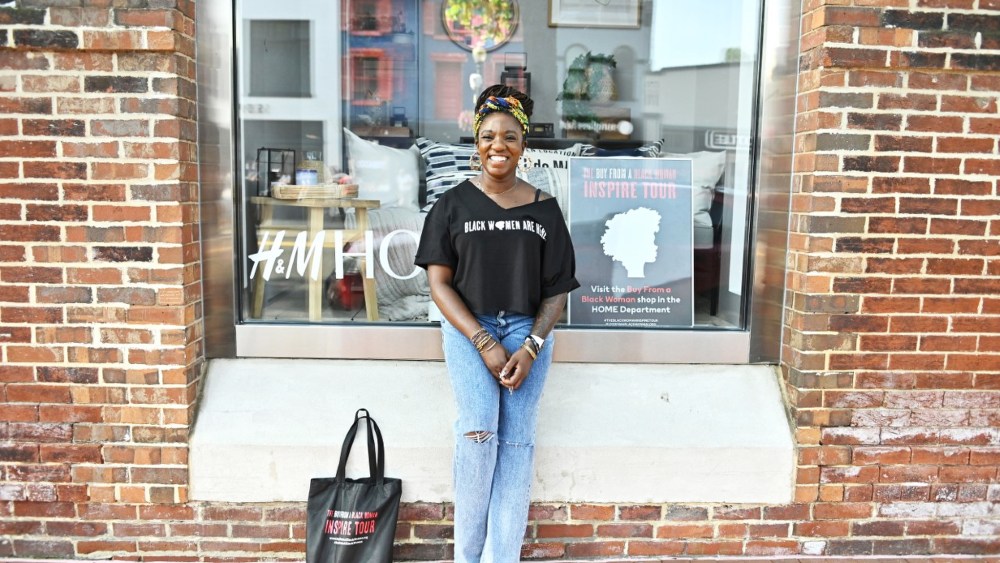
The partnership between the nonprofit Buy From a Black Woman and H&M has wrapped up.
Started in 2016, BFABW offers educational programs, an online directory of hundreds of female-owned Black businesses and funding to help Black women business owners succeed. As the social justice movement was gaining momentum in the U.S. four years ago, H&M and the organization teamed up to showcase Black-owned businesses through special events, a grant program, a business accelerator, activities and donations that supported such things as a docu-series that highlighted the personal stories of 25 female Black entrepreneurs.
Related Articles
In an interview, the organization’s founder Nikki Porcher claimed H&M’s plans to scale down a key event was one of the tipping points. She spoke of the importance of her organization, given the ongoing rollback of diversity, equity and inclusion efforts by large U.S. corporations.
You May Also Like
In a statement issued by an H&M spokesperson Thursday, the company said it is “incredibly proud” of the accomplishments that were achieved through the partnership. The statement read, “In addition to an investment of nearly $1 million dollars to support the organization, we were also able to produce and host dozens of events that highlighted and created meaningful impact for Black women-owned businesses throughout the country. While it was not H&M’s decision to end the partnership, we wish Buy From A Black Woman the very best in their future endeavors as they embark in a new direction. H&M’s commitment to partnerships and programs highlighting inclusion and diversity remains unchanged, and we look forward to developing these in exciting new directions.”
Porcher claimed that her most recent contract, which was from November 2024 to November 2025, was officially canceled by both parties on Wednesday.
As of 2022, 39 percent of Black-owned firms had women as majority owners, 54 percent had men as the lead owners, and 7 percent had equal male-female ownership, according to a Pew Research Center survey. The 3.7 million Black-owned businesses in the U.S. account for 11.3 percent of all businesses, which is close to the marker for the nation’s Black population of 13 percent.
Porcher said she officially parted ways with H&M on Wednesday. She said that she was informed on a group call on Feb. 3 that the anchor event that she had done with H&M on International Women’s Day in the past few years would not be happening. Separately, she said she had initially agreed to take part in another H&M event that was being planned for March 19 — a denim activation at a Black woman’s coffee shop, where a spotlight would be put on BFABW. After learning on the group call that the denim activation would be in lieu of the International Women’s Day event, Porcher said that she asked for clarity about the situation, since it was in her contract.

In turn, Porcher said that in an email to H&M she questioned why the change of plans was not communicated directly to her and that their partnership was more important than ever with the rollback of DEI. The response, she said, indicated the talent team had proposed the idea based on H&M fashion. Porcher said she had challenged that, claiming the focus of her prior H&M events showcased Black-owned vendors next to H&M fashion items “as a way to bring it together. But nothing about this partnership was about focusing on H&M’s fashion,” she said.
The BFABW founder questioned the plan to hold a weekday event versus a weekend one, “knowing that our community is for Black women,” including some who have two jobs and children with limited scheduling flexibility. Feeling “disrespected,” Porcher said she took a 12-day pause from having any meetings with H&M and sought legal counsel to see what her options were.
After some “back-and-forth,” both parties agreed that the contract was not “salvageable,” but she said she balked on the termination contract that was first proposed. “There was no money being offered, they still wanted to run our programs and I couldn’t say anything about anything,” she claimed.
The two parties then drafted another termination contract and agreed not to sue one another, Porcher claimed.
At this point, Porcher said the only payment that she is awaiting from H&M is for $83,000 for the holiday market that BFABW was involved with last year. The fact that she had not been paid for that by Feb. 17 allowed for a breach of contract, she claimed. “They said it was a communications problem. They let me know it would be a late payment. But a contract is a contract. If you want me to abide by the contract, you should as well,” Porcher said.
Looking ahead, BFABW has scaled back its summer program and will focus more on its advocacy. She noted that the five-year anniversary of the social justice uprising [following the murder of George Floyd during police custody] is this year. Porcher said, “There will be a lot more Black-owned business owners who will have this [type of thing] happen to them, but maybe not on such a grand scale. I want them to know that they are not by themselves. Entrepreneurship, especially as a Black woman, is such a lonely road,” Porcher said.
By sharing her experience, she said she aims to help others avoid such circumstances. “I’m not badmouthing H&M. I’m not trying to do anything to them. This is not what this is about,” Porcher said.
Several hours after this article posted, an H&M spokesperson issued a second statement in response to Porcher’s claims. The retailer said that the March event would have involved leveraging existing relationships with influencers and media to promote BFABW by integrating the organization into brand moments as it had done throughout the partnership. “We deny that this was a requirement or s change of plans, but rather a suggestion or opportunity to further amplify the partnership,” the statement read, adding that the company “regrets this communication resulted in an end to our partnership.” The Swedish retailer also “categorically” denied “the portrayal of contract negotiations, as from the outset H&M offered a fair payment beyond the pro rata value in good faith, which was denied,” the statement read.
Editor’s Note: this article was updated on March 13 at 11:57 p.m.