
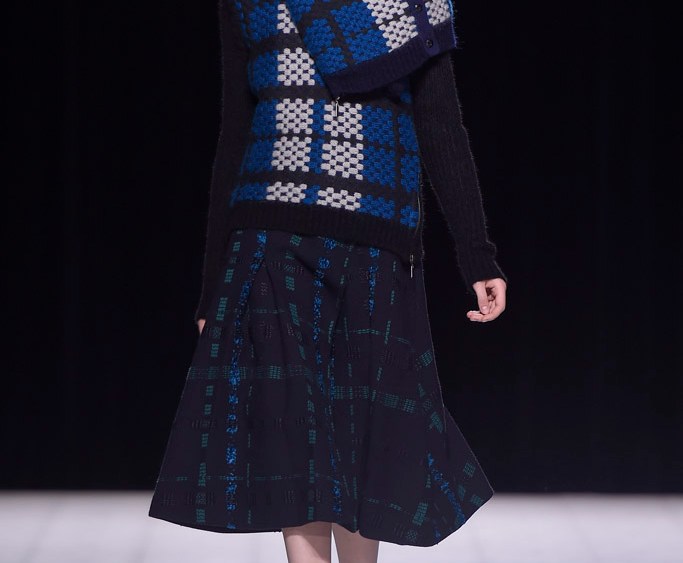
TOKYO — Japanese designers coming off of Tokyo Fashion Week are expected to benefit from the weak yen at home and abroad with collections that drew plaudits from domestic and international buyers.
Showcasing a variety of looks including statement coats, elaborate knitwear, tweed items and tailored pantsuits, designers showing during the six days of Tokyo Fashion Week offered up plenty of commercially viable merchandise, buyers said. The weak yen gives the country’s designers an added boost as it makes their goods cheaper for foreign buyers, while the currency impact also stands to give them an edge at home with Japanese retailers since it makes imported goods from Europe and the United States that much more expensive.
Related Articles
International buyer registrations for the Tokyo shows grew to 239, compared with 221 in October and 212 in March 2014. The three largest geographic regions were China, with 50 registrations, and the United States and Hong Kong with 38 and 27, respectively, organizers said.
You May Also Like
As is the case with every season, registrations may or may not correspond to actual attendance at the shows. This was a tricky season for some. A couple Japanese buyers lamented that Tokyo’s proximity to Paris made it a challenge to cover both cites thoroughly.
Despite the challenges of the event dates, show organizers and the government-run Japan External Trade Organization managed to lure some prominent names to Tokyo with free trips. This season’s batch of invited buyers included Colette creative director Sarah Andelman and Excelsior and Antonia women’s buying director Massimiliano Nardiello. Eric Jennings, vice president and fashion director for men’s wear, home and beauty at Saks Fifth Avenue, also came to Tokyo.
Japanese buyers, perhaps those best placed to view the evolution of local brands over time, gave positive feedback of the season.
Kazuyoshi Minamimagoe, senior creative director at Beams, said his picks for the season included Facetasm, Beautiful People and Mint Designs. Overall, he said he liked Tokyo and thought it offered a variety of different brands.
Minamimagoe said he expects Beams’ budget for Japanese brands to increase this fall. In his view, New York Fashion Week was lacking this season, so part of that budget may be shifted to local brands.
“I think sales of domestic brands have increased over the past few years. I think for the past three or four years [Japanese] consumers have been more interested in Japanese brands,” he said.
“Until about five years ago, there was a boom of international brands [in Japan] and things by young New York designers were selling very well. Then after that, brands like Carven from Paris were popular until about two years ago, but recently that has tapered off,” Minamimagoe said. “Part of it has to do with price and the weak yen, but [Japanese brands] are also seen by customers as being more ‘real.’ Until now, Tokyo Fashion Week designers have been mostly just doing things to please themselves, but now there is a strong consciousness of the market, and I think they all are trying hard to fit their own originality into that.”
Akiko Kitaya, a buyer at Sogo & Seibu Co. Ltd., found a lot of “easy-to-sell” items this season. She said she is maintaining her current budget for Tokyo brands.
“With its carefully selected natural materials and easy silhouettes, Beautiful People captured current trends very well,” she said. “Yasutoshi Ezumi’s architecture-themed collection was expressed very well in coats and other outerwear with sharp lines. I also felt that, because of the different materials he used and many different details on the backs of garments, there was a newness to the collection.”
Aya Ota, a women’s buyer for Isetan’s Shinjuku store in Tokyo, said she liked Written by Writtenafterwards and John Lawrence Sullivan. She said she is planning to visit a lot of presentations this week in Tokyo and her budget for Japanese brands has increased for fall. Ota said other brands on her radar include Akira Naka, Akane Utsunomiya, Hyke and Cleana, which makes only skirts.
Colette’s Andelman said she liked the overall quality of the shows. Her favorites included Discovered and Yoshio Kubo. She added that she liked the first part of the Dresscamp show. The store already has plans to do a window with Writtenafterwards in June or July.
“I know in Japan that for everything — food, design, clothing — it’s only good quality. I mean, even if it’s the most simple or the most weird thing, it will be well made. But I thought the shows themselves were very good [in terms of] production,” Andelman said. “I didn’t see everything, because I looked at all the Web sites before to do my selection. I looked at all the profiles, and I felt many were too simple, too commercial. So I don’t want to come to Tokyo to see a collection [that is] too commercial, I know there is a customer for them, I know there is a place for them, but I want something special.”
Nardiello, of Excelsior and Antonia, said the Japanese brands he saw on his showroom visits were impressive. His stores were not that enthusiastic about the pre-fall and fall collections coming out of New York and Europe, which to him seemed flat with few new ideas, so he came to Tokyo looking to enliven his product assortment.
Nardiello viewed about 24 brands on his visit to Tokyo and placed orders at about half of them for a total of about 100,000 euros, or $108,000 at current exchange. His favorites included Mame, Avie Yumiko Fukuda and Coohem. Although buying from Japan has its challenges, including significant import tariffs and advance payments, he said it’s worth it.
“I am willing to make this effort because it changes the whole image of my buying, it makes my buying very cool, fresh [and] international,” Nardiello said, adding that he found Japanese brands more original and less trend-driven than many others elsewhere.
That said, Nardiello was also forthcoming about a few brands he didn’t like. He said Adeam, which staged a Tokyo recap show of the fall collection it showed in New York in February, looked too similar to other things he had already seen. And he was less than enthusiastic about Matohu, which showed a Kyoto-inspired collection heavy on metallic fabrications.
“It seemed a bit like an Asian Giorgio Armani,” he said.
Saks’ Jennings said he found a “well-rounded” offering of men’s wear in Tokyo with a good balance of various influences including skate/street culture, classic Americana preppy heritage and British and Italian tailoring traditions.
“There’s really something for everybody here,” he said, adding that some of his favorite finds included Liberum Arbitrium, 03 by Knitt03, Takka and Ones Stroke. Saks has finished its buying for fall, but Jennings said he was making contacts and collecting look books to share with the retailer’s buyers in New York. But he stressed that it’s hard for small brands to compete on the floor with more established names if they don’t have New York-based showroom representation or agents to help manage the business.
“The challenge is finding interesting brands that are ready to do business with a big company like Saks,” Jennings said. “I’ve seen this happen many times. We fall in love with a unique artisanal brand and without that support and representation, they face a lot of challenges.”
Jutta Heidt-Hansel, managing director for Frankfurt boutique Fifty Eights and another guest of Tokyo Fashion Week organizers, was pleased with her findings in Tokyo. She viewed about 30 brands through appointments and placed orders for two: men’s denim brand Kuro and women’s knitwear label Il by Saori Komatsu. She is taking contacts for another eight to 10 brands back home with her. She said she liked the look of Rivora and Ones Stroke.
“The men’s is better to sell to Europe, to Germany, than the ladies’ [brands],” she said, explaining that some of the women’s brands in Tokyo skew too ladylike and girly for European women.
While sizing is often an issue when it comes to selling Japanese brands to European customers, Heidt-Hansel said this is becoming less of a problem.
“People already know about this problem and they are working on it. So they try to be flexible,” she said.