
Related Articles
NEW YORK – What do women really want?
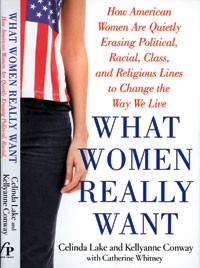
As their lives are buffeted by an increasingly diverse array of demands in a world growing ever more fragmented, there’s evidence American women nonetheless agree about most things these days. That unlikely finding is based on wide-ranging research conducted as the basis of “What Women Really Want” (Free Press: $26), which included interviews, focus groups and polls.
“It’s not a red-state/blue-state world for women, it’s purple,” said co-author/political consultant Celinda Lake, a specialist in framing issues to women voters. “Most agree on most things.”
Chief among their commonalities is a desire for control in their lives and a related sense of security, which emerged as the most strongly experienced emotions among women interviewed for the book, published in October and subtitled: “How American Women Are Quietly Erasing Political, Racial, Class and Religious Lines to Change the Way We Live.”
Today, more than 22 million women live alone, representing an 87 percent surge over the last two decades. The steep rise in single-woman households has empowered more women to make purchasing decisions – which now account for about 90 percent of all apparel transactions and about 80 percent of purchases overall, Lake said. For example, in 2003, twice as many single women as single men bought houses and 54 percent of single women owned their own homes.
“There’s far less guilt attached to luxury spending, compared with four or five years ago,” co-author/consumer researcher Kellyanne Conway contended. “As women work hard and 9/11 fades farther into the past, women are realizing they have disposable income and want to reward themselves.”
Their purchases range widely, she added, from finer apparel and more luxurious vacations, to first-time homes, spa weekends, massage therapists and personal trainers.
Women valuing control in various aspects of their lives – health, finances, time, “any area” Lake said – “is something for apparel marketers to think about as well: How to give women [a feeling of] control no matter what they’re wearing.” When asked, the first thing Lake, 52, suggested to fit the bill was customized clothing, which she thought would have the most appeal among multicultural youths, and women 60 and older.
You May Also Like
Technology is already playing that role for American women and distinguishes their purchases of various gadgets from those of men, Lake related. “Women see technology as a way to get more control,” she said; for example, they carry mobile phones to stay in touch with their children. “Men see technology as an end in itself, like buying an Xbox to play a game.”
About 51 percent of technology purchases in the U.S. economy are made by women, who spend roughly $55 billion a year on products for themselves and others, Lake and Conway have found. IPods and associated accessories, from sound ports to covers, were the runaway bestsellers in 2005, Conway said.
Concerns about beauty and wellness also fell under the influence of a longing for control, as “healthfully” was the way in which most women ages 40-64 would prefer to age, among a handful of choices. The others were sexily, gracefully and prettily. Slightly more than half, 53 percent, of women indicated they’d rather look thinner than younger. A premium was placed on “improvement instead of perfection,” Lake discovered to her surprise.
In another comparison, 79 percent of female college students, among the book’s subjects, put a premium on financial stability over shedding extra pounds, saying they’d rather be 20 pounds overweight than $20,000 in debt.
Most surprising to Lake while researching “What Women Really Want” was that the biggest wish among women was for peace in their lives. “It’s the culmination of 40 years of dramatic change, increasing stress, turmoil,” Lake said, a period in which “women have tried to have it all.”
In the years ahead, said Conway, 38, “an explosion of women who are unmarried as a choice, rather than a condition, will rock all things, from the way products are packaged to the way loans are structured and politicians put out messages.”
It’s a phenomenon, she projected, that will give rise to a sense of “solitary connectedness,” an awareness that this group is “doing the same things at the same time, but not together as a group.”