
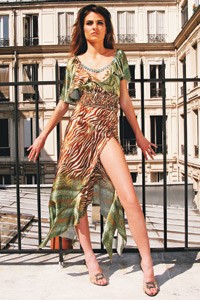
NEW YORK — The Train show arrived at its fifth season with a new offshoot, Platform 2, following in its tracks. While buyers went into the traditionally artistic, international trade show eager to snap up novel looks, they were specifically interested in spending their higher open-to-buys on dresses and black-and-white items. Polkadots and tie-dye were other hits.
Designer trade show Train started the trip, bringing with it more than 100 designers from around the world, Sept. 16 to 18 at the Terminal Stores here. Platform 2, its contemporary and bridge offshoot, followed Sept. 18 too 20 at Roseland Ballroom with about 50 exhibitors.
“Europe can bring different ideas,” said Jean-Pierre Mocho, president of Prêt à Porter Paris, the French parent show that organizes Train and Platform 2. “But we answer to the American market here.”
Moda Manhattan also entered the September trade show market for the first time, showing Sept. 17 to 19 at the Metropolitan Pavilion and Altman Building. About 2,500 buyers visited the approximately 350 exhibitors, according to Ann Caruso-Marsh, director of sales for Moda Manhattan.
“Anytime one does a launch show, there is trepidation about whether or not it will be well received, but it was nothing less than phenomenal,” Caruso-Marsh said. “The exhibitors felt the venue created a beautiful backdrop to show off the clothes nicely. September and February shows will be at the Metropolitan Pavilion going forward.”
The fifth season of Train was its biggest yet, with about 115 exhibitors, up from 95 last year and 55 when the show started in 2004. Mocho said there were 50 percent more applicants. Many designers said they landed at Platform 2 after applying for the full Train. Train filled the space to its capacity, which grew this year by shrinking lobby and restaurant space.
“We could bring many more people here, but we don’t want to move” from Terminal Stores, the former train station and warehouse in Chelsea, Mocho explained, adding Prêt à Porter is looking at expanding Train to the West Coast at some point in the near future, however.
While exhibitor numbers increased, Mocho said buyer numbers held at around 3,000 for Train and were about 1,000 for Platform 2. “We aren’t looking for thousands of people, we are looking for good buyers,” he said, adding he was surprised by the number of non-American buyers in attendance this year.
Related Articles
You May Also Like
Exhibitors at both shows reported slow traffic, but said the buyers who did attend placed significant orders.
At Train, business was “amazing” for Jamil Juma, creative director of Toronto-based contemporary label Juma. “We’ve picked up orders from nice stores all over — New York, Miami, Los Angeles, Chicago,” Juma said. “When they like the line, they are writing.”
Tie-dye pieces were bestsellers for David Maestre, who represents the Colombian dress designer Beatriz Camacho. “There’s not a big quantity of people, but the people who come are serious buyers,” Maestre said of Train.
Christophe Guillarmé, who designs embellished gowns for his eponymous Parisian label, has showed at all of the Train shows. He said new buyers from New York, San Francisco, Palm Beach, Fla., New Jersey and Puerto Rico all placed orders for his dresses, which wholesale from $150 to $300.
“There are many fewer people than usual, but more looking for someone new,” Guillarmé said. “I’ve made lots of contacts with new stores. But while there are fewer people, there are also fewer spectators.”
However, Steve Wood, of Venice, Calif.-based Marianne Kooimans, a line of hand-embroidered silk pieces, reported slow business. Wood has sold the handmade items, which wholesale for $95 to $380, at all of the Train shows. “All the people who have written are previous clients,” Wood said. “Maybe it’s because [Train] changed times or it’s diluted itself by opening another show.”
But buyers said they weren’t just browsing, and the majority reported larger open-to-buys than last year.
“Here, we write,” said Jessica Feingold, who runs detailsdirect.com, the online site for Eau Claire, Wis.-based better and contemporary specialty retailer Details. “Everyone is from Europe and this is our only chance. It’s not like they are from Chicago and we can just call them in a week.”
Because Train has developed a reputation for its artistic designer looks from around the world, buyers come to the show looking less for trends and more for unusual pieces. Details owner J. Mickey Judkins said she did not come hunting for specific trends, but rather for “avant-garde European lines.”
Nancy P. Hayner, who owns Moxie, a women’s clothing and accessories store in Greenwood Village, Colo., came to Train with the same mentality. “I always come looking for new European designers, and I want to see what they have,” Hayner said. “I am wide open to possibilities.”
Exhibitors consistently reported that dresses were top sellers, along with jackets. But most of the lines reflected the designers’ style more than current trends.
Vicki Deitz, who owns the Nashville specialty store Levy’s and has been a regular visitor to Train, was specifically interested in dresses. “The lines here are always beautiful,” Deitz said. “I come here for new resources to add spice to my store. I came looking for what is new and fresh in this market, not for trends.”
At Platform 2, buyer Hellen Preslyer said she was looking for dresses and black-and-white pieces for Forwear, a store she plans to open this year in a still undecided location in New Jersey.
Exhibitors said traffic at Platform 2 was significantly lighter the second day than the first. “The first day was good. There were lots of buyers and lots of writing,” said David Shephard, managing director of Toronto-based contemporary line Nada. “But the second day, there were a few looks. It’s empty.”
Nada landed at Platform 2 for its first trade show because Train was full. Shephard said the line did well with a vintage-inspired gray dress and its polkadot pieces, for which the wholesale prices average around $165.
Yonson Pak, designer for the Los Angeles-based Tangerine sportswear line, said her cotton black-and-white separates and her tie-dye pieces were popular. Pak chose Platform 2 as a smaller venue. “I thought I would get lost at Coterie because it is so big,” she said. “But since Coterie opened, business really slowed down. The traffic is slow, but people who come like it.”
Miami-based contemporary line Orangia reported doing well with its black-and-white tuxedo dress and its black-and-white reversible suit. Although business was good, Orangia graphic artist and designer Rodrigo Londono said he thought other shows, combined with the U.N. conference, made attracting buyers to a new show a challenge.