
Once upon a time, famous women wore their jewels. They didn’t let someone else’s jewels wear them. That is but one of many fabulous take-aways from the dazzling show “Set in Style: The Jewelry of Van Cleef & Arpels,” at the Cooper-Hewitt, National Design Museum through June 5th.
To lead with that notion is probably unfair to the show, its curator Sarah Coffin and Van Cleef, because the exhibition is about so much more than celebrity dazzle of yore. Nothing fascinates quite like high jewelry. It evokes tales both cautionary and heroic; it represents variously depth of commitment and wanton consumption. High jewelry is also a vehicle for great design. This breathtaking installation captures many of those themes in a show that, according to Coffin, was overdue; the museum last featured an all-jewelry show, Lalique, in 1998. Coffin chose Van Cleef in part because of the house’s design-centric philosophy and its deep American connections. Founded and installed on Place Vendôme in 1906 by Alfred Van Cleef and his brother in law Charles Arpels, the house opened a New York outpost in 1939, where jewelry would eventually be designed as well as sold.
Related Articles
In addition, Coffin was drawn to highlight 20th-century jewelry. “As I looked at various firms and various periods, and certainly from the design point of view, there were a lot of innovations in the Art Deco period, and I kept coming back to the Van Cleef & Arpels jewelry,” she said on a recent early-morning tour of the exhibit. Coffin notes that Van Cleef was at the front end of the Art Deco phenomenon, with designs that predated the movement’s nomenclature. She indicates several early pieces of the genre, one from 1919: “That certainly beats everybody. The exhibition that gave the style its name was in Paris in 1925.”
You May Also Like
Coffin arranged the show around six concepts: Innovation, Transformations, Nature as Inspiration, Exoticism, Fashion and Personalities. Anchoring the Innovation segment is Van Cleef’s famed Mystery Setting, patented in 1933 and on glorious display in a 1937 ruby and diamond peony brooch. Another innovation crossed over into the accessories vernacular. Louis Arpels, Charles’ brother, developed the minaudière, patented in 1934, as a tiny portable vanity fitted to hold such ladies’ essentials as lipstick, comb, cigarettes and lighter after he saw Florence Gould carrying her personal wares in a cigarette case. A stunner: a silver-toned metal case with a covered watch in yellow gold set with sapphires. In Transformations one finds elegant metamorphosis, including the Zip necklace, the idea of which was brought to Van Cleef by none other than the Duchess of Windsor around 1938. As Coffin explains, “The war intervened,” and the design proved technically complicated, delaying production until 1951, “when they went further than the Duchess’ suggestion of a necklace that zipped. Not only does the necklace zip up, but when you remove the back piece, it becomes a bracelet.” In other instances, big pieces dismantle into more sedate parts. One, a lavishly jeweled bird (that doesn’t look like a stork, but the same idea) set in yellow gold, transports one heck of a bundle of joy, a 95-carat yellow diamond that can be removed and worn as a pendant.
Piece after piece is gorgeous, and the installation itself is not without humor. Four cases each housing single pieces employ mirrors to make it look as if each stands atop the case, there for the grabbing. Especially amusing: a feisty scarecrow pin in yellow gold with diamonds and cabochon ruby feet. Nature features the obvious — flora, from gentle to gigantic; fauna, from loving birds to poodles to atmospheric wonders such as the 1948 yellow gold, platinum and diamond snowflake, and the hidden: a 1930s Art Deco-motif compact that opens to reveal a charming enamel landscape. In this group is one of the exhibit’s (quite subjectively) most beautiful pieces: a 1915 brooch of a bunch of grapes set in platinum, the leaves in diamonds and the grapes a cascade of pearls in various sizes and colors.
But we live in celebrity-obsessed times. As one loops through the grand (if difficult, for a gallery) rooms housing the exhibit, the last section is that dedicated to Personalities. It features remarkable pieces from a diverse lineup of women, among them Grace Kelly, Jacqueline Onassis, Maria Callas, Barbara Hutton, Marjorie Merriweather Post, Paulette Goddard, and, yes, legendary Violet Eyes herself, Elizabeth Taylor. During two visits to the exhibit, I found it beyond packed on a Sunday afternoon and filling up shortly after the 10 a.m. opening the following Friday; no doubt the passing of Elizabeth Taylor, who still owned her pieces in the exhibit, will increase the numbers further.
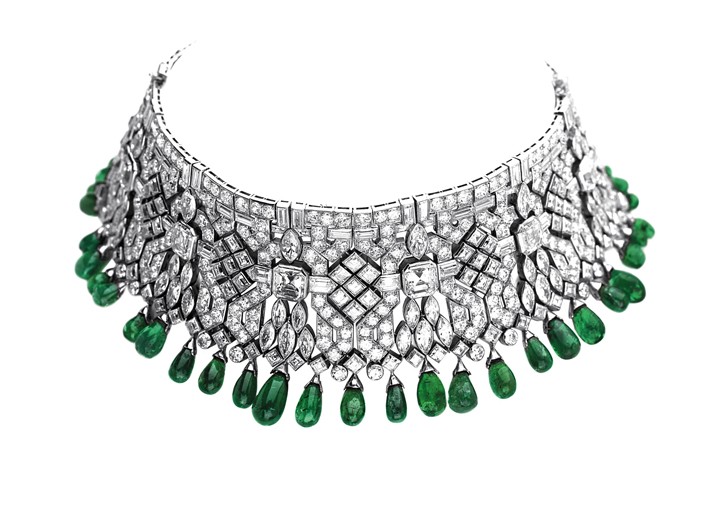
The jewels in this section say something about the women who wore them. They “showed a certain taste,” Coffin says. “I don’t mean taste in the sense of good taste, bad taste. I mean their taste. It was part of the definition of who they were, a design choice like any other design choice — what kind of architect you use, for example.” Coffin wanted to focus on women with ties to the U.S. but was hardly staunch about that; she couldn’t resist including a spectacular 1951 “Indu Necklace” and matching earrings commissioned by the Maharani of Baroda. Unlike most of the exhibit’s design-driven offerings, this was created around 13 spectacular emeralds already in her possession, total carat weight: 150.
Still, Americans were among some of Van Cleef’s most devoted clients. A remarkable ruby and diamond platinum cuff was commissioned in 1937 by Marlene Dietrich, to make use of a cache of rubies from a necklace “she didn’t care about.” The actress collaborated on the design with Louis Arpels, who then had to source matching stones to finish the piece, a demonstrative paisley of rubies encircling and outlined in diamond baguettes. According to Coffin, Dietrich wore the bracelet in Hitchcock’s 1950 film “Stage Fright.” “I guess the character in the movie was sort of odious, and she apparently really hated it,” the curator says, explaining that Dietrich never again wore the bracelet after the movie’s release. It was sold at auction after her death.
The exhibit includes a photo of Doris Duke at Shangri La house in Hawaii, “and you look at her jewelry” — bracelet, ring and earrings in floral-motif rubies and sapphires set in yellow gold — “which was called the Hawaii series by Van Cleef & Arpels.” However, it was neither designed for nor named in Duke’s honor. “I think it was just that Hawaii was a fashionable destination in the late Thirties, and then she stopped at the end of her honeymoon,” Coffin says. “Not only was the honeymoon bad, but her marriage was too. In fact, the Hawaii pieces were a present from her lover [British MP Alec Cunningham-Reid].”
In the Twenties, the elegant Daisy Fellowes purchased a pair of Indian-inspired diamond and emerald cuffs that could convert into a choker. Fellowes typically wore the lavish gems with ultrasimple gowns. Coffin calls Grace Kelly “the ultimate Franco-American connection.” Her numerous pieces on display reflect “the formal and the rather informal.” Compared to some of the other women represented, her choices seem subdued; even the grand diamond tiara Princess Grace wore to Princess Caroline’s 1978 wedding to Philippe Junot was relatively simple of design. “She liked pearls,” Coffin says. “Perhaps it was in her royal persona that there was a certain conservatism, but I think it reflected her slightly more understated, rather than flashy, elegance.”
Conversely, Taylor’s pieces, which she “kindly lent” to the museum, reflect her taste as well as that of Mike Todd and Richard Burton. “She had two husbands with great jewelry taste and herself,” Coffin says, “so there’s a real breadth in her collection.” Discretion was not part of the range. Taylor’s gems include a coral and amethyst bracelet with matching earrings Burton bought because, Coffin explains, “the amethyst matched the violet of her eyes, of course, very splashily.”
Indeed. Taylor once referred to herself as vulgar. Whether or not one accepts that cheekily harsh self-assessment, all would agree she was a woman who knew herself, reveled in her own flamboyance and adorned herself to reflect the delightfully showy reality. Jewelry proved essential to the process.
The same can be said for all of Coffin’s subjects, not that all were of La Liz-level flash, but all wore jewelry the way it was intended, as that most personal of adornments that offered intriguing clues, albeit of the toniest sort, to their personalities. Whether they bought it themselves — Coffin says a surprising number did — or had men buy it for them, they owned it literally and figuratively.
In contrast, today’s stars hit the red carpet in sparklers they’ve borrowed or have been compensated to flaunt, gems that may or may not feel in keeping with their personalities, or their fashion attire for the evening or, in the case of the starlet set, look at all age-appropriate, but gems that always, always get a hearty shout-out from Ryan Seacrest and the viewing masses. And Elizabeth Taylor thought she was vulgar.