
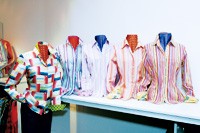
NEW YORK — Robert Graham, a fixture in the men’s wear category, is launching a spring 2005 women’s collection designed by Robert Stock that is to hit specialty boutiques and department stores such as Fred Segal, Neiman Marcus, Bloomingdale’s and Nordstrom in February.
The women’s collection, like the men’s that launched three years ago, will have its roots in well-fitted, brightly hued woven shirts, though it will encompass everything from shrunken blazers to skirts to a full denim line. The wholesale price collection will range from $40 to $72.
“We’ve found a niche,” company president Neal Kusnetz said. “Our woven shirts are European and Asian in styling, but American in fit.”
Related Articles
Kusnetz said the key to a successful women’s wear collection is to have a solid brand behind the label. “Success is built on the product and built on a base,” he said.
You May Also Like
The women’s collection will feature the same details as the men’s line. Both will have contrasting patterns on the inside lining, cuffs and collars of shirts and jackets.
“Fabric-wise, the approach is similar, but the silhouettes, of course, will change,’’ said Stock, director of design, in the company’s showroom here. “We’ll soften it up. It’s easy to transition to women’s wear because the colors we use are so vivid. We would show people the men’s shirts and they would say, ‘That could be a woman’s blouse.’” The company predicts wholesale volume for the women’s collection will range between $5 million and $7 million for 2005.
Stock is a veteran in the fashion business. His career began more than 30 years ago working for trouser designer Paul Ressler. In 1970, he founded his own sportswear company, Country Britches. He sold the company three years later to work at Polo Ralph Lauren in the design and development of Chaps. He left Polo in 1975, to start Country Roads by Robert Stock, for Creighton Industries and eventually launched his own collection, Robert Stock Designs. In 1978, he was one of the first American designers to license his name in the Asian market.
“I’ve been in the business for close to 35 years,” Stock said. “In 1974, I took my first trip to India. They didn’t even have electricity in the factories. All work was done by pedal.”
Stock said the company has design studios in Connecticut and New York and four factories in Banglor, India. “Before China was really big, they would do things in India that no other countries would do,’’ he said. “They paid great attention to hand detail.’’
Stock has witnessed the modernization of his Banglor-based production partners, Texport Garments, during their 14-year collaboration. “At first, we had 25 sewers, now we have over 200,” said Stock, who spends six to 10 weeks of the year in India.
“Robert is really on the forefront in India and Asia,” Kusnetz said. “With the fabrics he finds, he gets it right every single season.”
Kusnetz said the demand for a women’s collection had become hard to ignore. “Girlfriends, wives and daughters of the men who wear Robert Graham were always asking for their own designs,” he said. Stock agreed.
“I thought, ‘In 23 years, we’ve had such great success with men’s, why can’t we do this with women’s?’” Stock said. “We understand how women put color together. You don’t have to follow all the trends, but you have to be aware of them.”
There are a few key differences between the men’s and women’s collections. “For one,” Stock said, “the women’s collection must be able to be worn with jeans, while the men’s must be able to go with khakis.”