
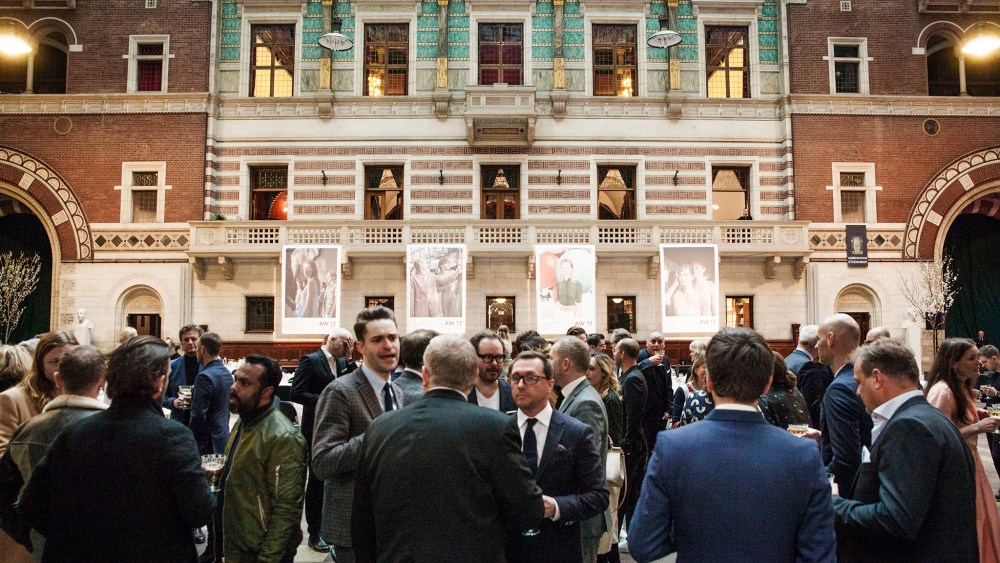
COPENHAGEN — In a context of mounting challenges to global free trade, Danish finance minister Kristian Jensen opened Copenhagen Fashion Week with a speech defending the globalized nature of the country’s apparel industry.
“Trade is unfairly being demonized,” Jensen said at an opening lunch on Tuesday that brought together designers and executives with buyers and press. “Trade barriers are what make people poorer, not globalization.”
Jensen pointed out the small-town seamstresses from his childhood had been replaced with a thriving design industry, while “globalization has given people all over the world the chance to participate.”
Related Articles
Just days after President Donald Trump’s administration removed the U.S. from the proposed Trans-Pacific Partnership and prepared to do the same with the proposed Transatlantic Trade and Investment Partnership (TTIP) with the European Union, the Nordic region’s biggest fashion week is shining a spotlight on a country and industry that has been transformed by globalization, and whose business leaders and center-right government show little interest in turning back.
You May Also Like
The country of just over 5 million people exports roughly $96 billion in goods and services each year, including almost $4 billion in fashion, according to Dansk Fashion and Textile, a trade association. In contrast with other European markets like France and Italy, which have maintained significant production facilities for high-end fashion, Denmark’s apparel manufacturing is almost completely outsourced to Asia.
While Jensen commended the Danish fashion industry for being at the cutting edge of issues of sustainability and ethics, he said there was still work to be done. “Is the industry sufficiently aware of the conditions of its workers…of its impact on the environment?” Jensen said. “We all share the responsibility of making sustainable fashion a better industry.”
This was the first season that Copenhagen Fashion Week — which is spread between two major trade shows and a calendar of 30 runway shows — had launched with an opening banquet, which was held in Copenhagen’s lofty city hall.
“We wanted to start out together as a whole business, with buyers and CEOs and the international press, to make a signal that we all stand together before we go out and do our own thing,” Copenhagen Fashion Week’s new chief executive officer Camilla Frank told WWD. Frank worked as editor-in-chief of leading Danish and Norwegian fashion magazines before assuming the role in December.
“We might not be in the top five biggest fashion weeks in the world,” said Frank in a speech during the three-course, seated lunch. “But who is to say we can’t be the most innovative, the most well-organized, and the most hygge-ly?”— referring to the Danish value of coziness and warm hospitality.
Crown princess Mary of Denmark was the guest of honor, arriving in a jewel-embellished black coat and Valentino studded heels. A longtime champion of the Danish fashion industry, she stopped to give a personal farewell to several designers and fashion executives as the crowd stood to see her off.
Won Hundred kicked off the season’s runway shows with a streetwear collection whose multicolored leather looks had a strong racing bent.
Designer Nikolaj Nielsen, who founded the brand 12 years ago, said he was referencing the costumes of Ole Olsen, a Danish speedway drive. But while his inspiration may be a national hero, Nielsen’s focus for Won Hundred is on the international.
“When you’ve got only five million people, you need to be global,” the designer said. Exports make up about 70 percent of the brand’s business, with roughly 20 percent going to the U.S.
“[Trump] is definitely something we’re thinking about right now,” said Nielsen. “I thought – and a lot of people thought – that maybe he was just saying stuff. Now he’s actually doing some stuff that we weren’t used to expecting.”
Political instability has already taken a toll on the Danish fashion industry in 2016, according Michael Hillmose, head of international relations at the Dansk Fashion & Textile trade association. The U.K. market—which had seen growth of around 20 percent in recent years — fell sharply following Brexit, as a weak pound made Danish products less attractive.
Weak currencies in neighboring Sweden and Norway have also strained revenues for Danish fashion firms, while a strong U.S. dollar raised the cost of production by Asian producers, with whom contracts are typically denominated in greenbacks.
“It’s going to be difficult for some companies to maintain their position,” said Hillmose. “They can either raise prices, or take in the costs on their own account.”
Sales by the Danish fashion industry grew just 0.9 percent in 2016 to 42.6 billion Danish kronor, or $6.30 billion at average exchange. Profits were down slightly due to the currency headwinds and the rising cost of production in China, according to Hillmose.
“China is now too expensive as a sourcing country,” he said. “Some of the big players in Denmark have moved production from China to Cambodia, Bangladesh or even Turkey. You don’t move a clothing factory for free — it’s very costly.”
At the show for Oh! by Kopenhagen Fur, contemporary dancers coated in dyed fur and leather accessories—as well as thick smears of chalky body paint—performed a series of upbeat solos. The event was livelier than your typical runway presentation, eliciting cheers from the Danish singers and TV personalities in the front row.
This is the third year in business for the fashion line by Kopenhagen Fur, which is a cooperative company owned by Danish fur breeders and the world’s leading producer of mink skins.
“The fur industry is truly global,” said the company’s ceo Jesper Uggerhøj. Kopenhagen Fur’s auctions sell only skins, which are then dressed and transformed into wearable products at plants around the world, usually in Asia. “Less than one percent of our turnover is in Denmark. So free trade is very important to us, and it’s crucial that it will continue in the future.”
Uggerhøj said fur prices were low by historical standards, but he expected to see recovery as the market rebalances in 2017.
“Russia is not really a market at the moment, so we had a surplus of supply the past few years,” he said. “But lately we see production going down and demand starting to increase in some markets. 2015 was the bottom. In 2016, prices went up a bit, and in 2017, I think we’ll see them going up even more.”
The fur industry isn’t the only part of Denmark’s fashion industry that sees better times ahead. In a survey leading up to Copenhagen Fashion Week, 64 percent of members of the Dansk Fashion and Textile association said they expected growth in the first half of 2017, while only 17 percent expect a decline.
Much of the optimism is centered on the German market, where shoppers are increasingly embracing Danish brands as tastes become less conservative, according to Hillmose. Exports to Germany by Danish brands grew 6.3 percent last year.
Danish fashion firms also report being optimistic about growth in e-commerce, which already represents around 20 percent of sales in the sector.