
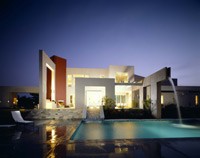
By the age of six, well before he even knew the meaning of the word “architecture,” Richard Landry was already telling people in his tiny Canadian hometown that he wanted to design buildings.
And he made good on that precocious pledge. Now 49, Landry has made a name for himself by creating gargantuan homes for Sylvester Stallone, Eddie Murphy, Wayne Gretzky, Rod Stewart, Sugar Ray Leonard and other celebrities. His projects command $400 per square foot, excluding builders’ fees and landscaping expenses, meaning they can range from $5 million to $50 million. The boyish-looking architect insists he is not an elitist, and welcomes all commissions, whether for a 5,000-square-foot home or a 100,000-square-foot mansion. But there’s no denying some of these spreads are more akin to Versailles, with their sprawling grounds and meticulous design, than a Cape Cod bungalow.
Impressive for a guy who grew up in a 5,000-person town surrounded by farms. Silos, not skyscrapers, dotted the landscape.
At 13, Landry took his first job, working for his carpenter father and earning 10 cents an hour. Not put off by the paltry salary or the fact that he sanded furniture until his fingers bled, Landry says he really enjoyed working with his hands and soon found himself “always drawing something.”
“Architecture was something I never questioned. It was the only thing I wanted to do,” Landry says.
He still sketches when bouncing around ideas with Hollywood types, ultrasuccessful Wall Street hedge-fund managers, Russia’s nouveau riche and other clients. A “big fan” of the modernist Frank Gehry–designed Walt Disney Concert Hall, Landry also admires how LeCorbusier used light for high drama in his Notre Dame du Haut chapel in Ronchamp, France, and how Santiago Calatrava makes the Turning Torso structure look so effortless. Landry’s own creations are eclectic; inspiration could come from a Tudor, a Tuscan villa or a French chateau. “I create a lot of hybrid architecture. I call it breaking the rules, but still in an appropriate way,” he says.
So who can blame him for taking on only projects that interest him, such as a house being built on a six-acre lot in the middle of a ravine outside Moscow or a 100,000-square-foot compound being developed in Riyadh, Saudi Arabia, complete with golf course, private clubhouse and indoor pools? To date, Landry Design Group, the firm he founded in 1987, has completed 200 houses, ranging in value from $3 million to $30 million. The company’s namesake is known to pepper clients with Zen-like questions such as, “How do you want to feel when you come home at night?” He also walks their land with them and checks out their current digs.
Related Articles
You May Also Like
“I always tell people, ‘The process is as important as the result. If you’re not going to have fun, I don’t want to do this project with you,'” Landry says.
His wide scope of interests hails back to his high school days, when he and his buddies put together a band in his basement. They played pop, rock and ballroom and jammed at the usual thankless places—weddings, hotel bars and school dances. Their tunes were inspired in part by Landry’s parents, who taught ballroom dancing. All those gigs as a drummer helped pay for an architecture degree at the University of Montreal, where he finished first in his class. After a few years working in Canada, he and his Honda Civic headed for Los Angeles. But his days of designing condos and theme parks lasted only so long before he ventured out on his own.
Paul Goldberger writes in the forward to the book Modern to Classic, Residential Estates by Landry Design Group (Oro Editions, November), “Richard Landry belongs to the great tradition of American eclecticism, a tradition that, at its best, has yielded masterpieces, and has also created a vastly larger quantity of decent and civilized buildings than it has been given credit for.”
Landry makes no bones about bowing out if a proposed project is not well suited for a site or does not meet his taste level, regardless of the potential payoff. Consider the client who insisted on keeping pinkish concrete columns in his partially built 40,000-square-foot manse. That was the deal-breaker for Landry, who had been called in after the original architect balked. “Unless they were prepared to take them all down, I didn’t want to us to be associated with the project. They weren’t.”
For jazz star Kenny G’s Seattle spread, Landry drew inspiration from Greystone, a Twenties Tudor mansion in Beverly Hills, and the work of early 20th-century architect Sir Edwin Lutyens. The musician dove into the design process—something Landry welcomes with all his clients—sitting on the floor with Landry as he sketched.
Eddie Murphy showed up at the job site every day when his palatial California house was being built. Like anyone whose livelihood involves taking a good long look at celebrities’ bedrooms, bathrooms and closets, Landry is savvy enough not to talk specifics. Confidentiality agreements prohibit him from describing high-profile clients’ homes or locations. But according to a published report, Murphy went with a 45,000-square-foot Italianate compound in North Beverly Park, a gated community in Beverly Hills.
Stallone is one of Landry’s repeat customers. When the Rocky star drew a design of a house during a recent meeting at Landry’s office, the architect said, “Well, you have to sign this one. This is a piece of pop art.” “Right,” Stallone told him, and did, adding, “My idea.”
“Because it was his idea,” Landry laughs. “Repeat clients are so much fun because they understand the process and they have built up confidence in you. We actually have become friends with most of our clients. It’s such an intimate process when you are dealing with clients and their bedrooms and bathrooms.”
This article appeared in WWD Scoop, a special publication to WWD available to subscribers.