
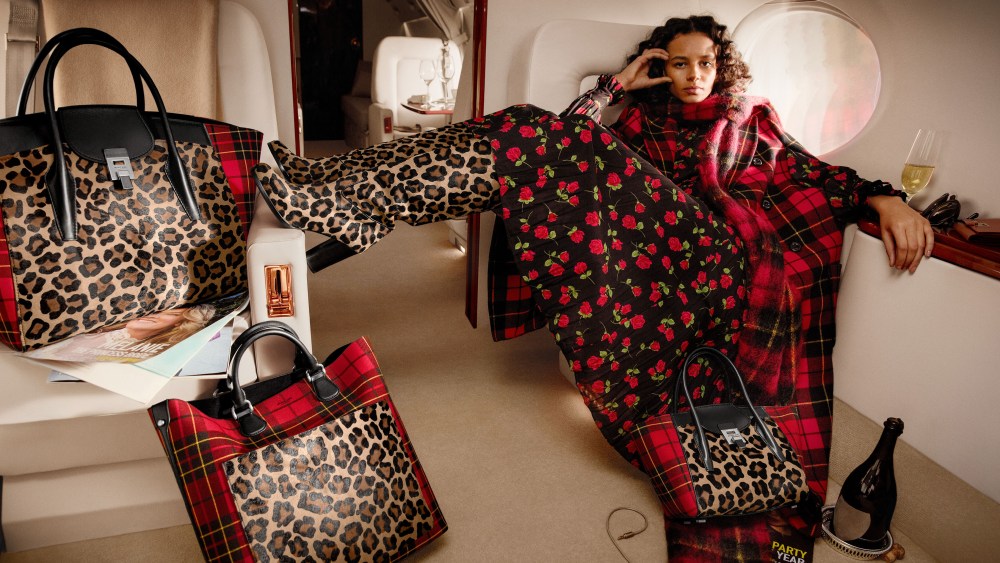
“Fashion is change. Fashion is about what’s next,” said Michael Kors during an interview Monday morning about his new fall 2018 campaigns, for which he had to embrace that mantra.
In January, The New York Times’ explosive report on allegations of sexual misconduct against Bruce Weber, Mario Testino and others brought a swift end to many of their long-term professional relationships. The day the Times story broke, Michael Kors issued a statement severing ties with Testino, who had exclusively shot the company’s campaigns for more than a decade. It forced Kors to take a beat, reflect on and tweak his creative marketing vision.
Without budging from the jet-set identity he’s forged many years over, Kors made significant behind-the-scenes adjustments, filling Testino’s shoes with not one but three photographers — Inez van Lamsweerde and Vinoodh Matadin for Michael Kors Collection and Lachlan Bailey for Michael Michael Kors. On the surface, the campaign images capture a modern, slightly less glossy, more real (for private plane-owners) version of the ultra-glam life while remaining true to Kors’ DNA. Yet on a deeper level the photos represent the designer’s willingness to react to the cultural headwinds, as he did late last year when he revealed that his company was going fur-free, after 22 years of producing a small fur collection with Pologeorgis.
Related Articles
Here, Kors discusses the anatomy of his new campaigns, and rolling with the punches after 38 years in business. “It’s up to creative people to find solutions for things that they love and believe in but are applicable in today’s world,” he said. “That’s something that either you’re up to the challenge or you’re not.”
You May Also Like
WWD: So, we’re talking about the fall campaigns, which are new on a couple of levels: Obviously, it’s a new season, new collections, but you’re also working with new photographers for the first time in a very long time.
Michael Kors: Fourteen years. It’s also the first time we’ve worked with two different photographers and photographed the two different lines separately.
WWD: Right, Inez and Vinoodh and Lachlan Bailey. How did you choose them? How did you approach the change in creative?
M.K.: I have to say, I’m not one for revolution. I’m always so concerned with evolution and, “How do we look at things from a different perspective?” In this instance, first off, we started thinking about, “What is jet set today?” Jet set today — the world is more casual. Instagram has given us the inside look in how the modern jet set actually travels and lives, and it’s certainly not quite as polished and perfect as Elizabeth Taylor and Richard Burton. We wanted to have a new lens on what it means to be jet set today. To see this woman — if you’re looking at Beyonce or you’re looking at Rihanna, quite honestly, it’s their plane. It’s not their husband’s plane. They own the plane. They make the decisions. We also wanted to reflect the runway collection, which was a very eclectic take on personal style.
Inez and Vinoodh, I have been photographed myself by them and I always admired their work in general. It was sort of a no-brainer, because they love fashion and they love to catch a moment. They also play with angles, and we also wanted to show that luxury today is not so perfect. So if she wants to eat caviar, she eats caviar. If she wants potato chips, she has potato chips. She’s not renting the plane, she owns the plane.
On the other side of the coin, when we were thinking about Michael Michael Kors and the attitude, and the men’s collection also, I immediately thought to myself that we are very much about someone who’s on the go, even if they’re not on a plane. They might be on Citibike. They might be on a moped. They might be just rushing down the street. So it was a modern take on [Ron] Galella capturing Jackie Kennedy on the street uptown, in New York in an urban situation where she doesn’t really know that someone’s taking her picture. So that was very much about the idea of working with a team who moves very swiftly and not very perfect. Looking at all the photographers out there, Lachlan Bailey has a very loose hand. His photographs are very modern in that they are captured. There’s nothing perfect about them.
WWD: When you’re working with the photographers, how does it work? Do you go to them with the idea? Do they bring something to you?
M.K.: Well, of course they have to look at what we’re thinking about shooting. What does the product look like? What was the mood of the collection? And then have a conversation about: Do we think this feels escapist? Would she go to the tropics or is it urban? What are the colors involved? Then the idea exchange starts. For instance, with the runway collection we felt that the clothes had this sort of sprawl to them; there was something about the clothes that you could just kind of collapse. Maybe she’s collapsed on the plane after she just filled a stadium. She could’ve filled a stadium with 40,000 people and getting on the plane and having her Pepsi and her chips. For Michael Michael Kors, there was a lot of movement in the fall collection. So we immediately kept thinking how we capture that kind of movement on the street in the city, even what kind of dog are we going to put in the picture. An Afghan helps capture the breeze. We didn’t go with the greyhound.
WWD: With campaigns we always hear about the photographers, the location, the models, but in terms of the clothes — you have a whole collection. How do you decide which three to five looks or whatever are going to represent?
M.K.: It’s a nightmare! It’s a nightmare. It’s equivalent of the minute a show ends — you guys don’t do this but we have journalists who for all my years say, “What’s your favorite thing in the whole show?” It’s the most horrible thing. It’s like Solomon or “Sophie’s Choice.” Which baby do you prefer? We try to pick an assortment of product that when you see the entire campaign it represents not the only way to look that season but the different key ways to look that season. Then we think about how it will photograph. Certain things are better live than in pictures. Some things are better moving than still. We want to tell the story that there’s more than one way to look each season but at the same time I don’t want it to be all over the place. For Michael Michael Kors we think about how we have many more stores than we have for collection. These photographs get used in our stores, and you know a lot of times people are running down a city street or running through a mall and we need them to get the message quickly when they walk by a store.
WWD: Did working with new photographers after such a long time make you reevaluate your creative marketing work and what you wanted out of it?
M.K.: I think the most important thing with collaborators is you want to give people room. You really want to give them room to explore, to tell the story the way they think seems fresh and modern and not crowd them. Whenever we work with people, even when we work with different people on different projects that are not a print campaign, especially when we work with new people, we want to let them run with the ball.
WWD: Going forward, is there going to be a commitment to Inez and Vinoodh and Lachlan Bailey or are you keeping it open?
M.K.: It’s fashion! Am I committing to a platform shoe for a full year? Not necessarily. But I think that working with both of them was a very pleasurable creative collaboration. Inez and Vinoodh are definitely two people that I know in the future I’ll collaborate with. I don’t know if it will be every season. We never thought in the very beginning that we would collaborate with one photographer for 14 years.
WWD: Speaking of that one photographer, most people reading this are probably familiar with the reason you ended your relationship with Mario Testino. But let’s talk about it for a minute. What was your reaction when The Times story came out?
M.K.: I have to be honest with you, the minute we learned of the allegations, these were very serious accusations and allegations. We were surprised. At the same time, there wasn’t a second moment, a moment at all. I said, “You know what? That behavior is not acceptable and we have to move on.” To me, that doesn’t diminish the fact that we had a 14-year collaboration together and I’m very proud of the work we did together. The work stood for itself and speaks for itself.
WWD: Did you ever have an inkling or hear or observe anything?
M.K.: If we had, it would’ve ended much sooner than that.
WWD: This whole thing has come out so explosively in the press and some of it is confusing. From the reports that you’ve read, what do you think? Do you think these people are getting a fair shake in the media?
M.K.: It’s hard for me. I don’t like to speak for anyone else. I think any of the people who have had allegations and accusations, I think it’s up to them to deal with those accusations and allegations themselves. I don’t know the actual situation in any of these cases. I wasn’t there. I didn’t see it. I think all of them have to deal with it themselves and decide how to handle it. If they don’t want to speak about it, that’s their right. Do they want to speak about it? Again, that’s their right. It’s hard for me to judge whether anyone is getting a fair shake. It’s up to each individual to deal with the situation and whatever allegations came up against them.
WWD: In general, has the #MeToo movement and all the news made you rethink your shows or your shoots in terms of the way you present things?
M.K.: The one thing I think is interesting is the way we think about models. I think unfortunately a lot of people in our industry don’t really think about models as people. It just sort of sometimes becomes a commodity. We hear all the time designers have models in the show and the designers don’t even know the model’s name. It doesn’t mean you have to hang out with them and be best friends, but whenever I’m working with a model, I always talk to them — How old are you? Where are you from? How long have you been doing this? — so that you have some connection to them and they have some connection to you. The minute you forget these people are individuals, I think you have a problem. I think people need to get a little bit more personal. Empathy is everything. Pretend you have children if you don’t have children. How would you want them treated? I always ask models how old they are. Jokingly, now that I’ve been doing this so long, I always ask the models how old their parents are. Because sometimes I’m like, Oh my god, how old is your mother, she’s 38?
WWD: There are a lot of changes going on in the industry. How do you see it all progressing?
M.K.: I think fashion people as a whole are people who love change and love newness. You have to be cognizant of what’s going on in general on the planet and be able to shift and adjust…The world changes daily in every way and it affects everything we do. Would we ever have thought a T-shirt, a shearling coat, flip flops and a beaded gown would all be part of the same collection? No. I mean sometimes it’s as simplistic as the fact that the weather has changed tremendously…So all of those things as a designers, as a creative person, quite frankly, it’s exhausting. But at the same time, I’m happy about these changes because if it stayed the same as it was 38 years ago I’d be bored out of my mind.
WWD: How do you negotiate the changes? You changed photographers, but also after a lifetime of loving fur and using fur, now you’re not using fur anymore. Those are two examples of being hyper-aware of the cultural moment, right?
M.K.: You have to be. You could easily say, “You know what? I don’t participate in social media so I’m not getting involved in it.” You could say, “I like tweed pantsuits and I think they’re the chicest thing in the world.” Well, unless you live on the Scottish moors, no one’s wearing a tweed pantsuit anymore. It’s really being hyper-aware of what’s going on and are there new ways to look at things. It’s not that you have to throw out everything you believe in.
WWD: Back to the campaigns for a minute. Like you said, they’re not a quantum leap from what you had done before. You didn’t throw the baby out with the bathwater. Did you think about going further afield from what you had done in terms of direction? Or did you think it was important to retain a consistency?
M.K.: I think when you see pictures and images from a designer or a runway show, you should know whose show you’re at or whose images you’re looking at. Quickly. There’s an overload of imagery in today’s world. There’s an overload of collections. It’s just the too-muchness of the world. I think it’s, how do you let people know that, yes, this is the brand, this is what we’re talking about, but, oh, it’s being looked at through a different prism…There was never any idea in my head like: Two new photographers — let’s throw it all out!
WWD: Do you think the customer picks up on the nuances between different photographers?
M.K.: I think they do. At first blush, you first have to get them to look at a photograph or an image. But once you get their attention I think they notice details…I think they’ll notice it’s different but they might not notice what’s different, and that’s fine, that’s OK. It’s kind of this strange thing when something floats in the ether and women will cut their hair just a little bit. Everyone’s cutting their hair at the same time, not that they’re going for a Mia Farrow buzzcut, but they’re going from really long to semi-long. Suddenly it percolates and everyone seems to be doing it. Unless you’re a fashion professional, I think most people appreciate and love the evolution. But they’re not interested in their friend seeing them and saying, “Wow! You decided to do your hair lime green!” That’s a specific woman who wants everyone to be shocked.
WWD: Last question: There’s so much going on in this moment and kind of a constant negativity and outrage everywhere. You’re fashion’s consummate optimist and there’s always a buoyancy to what you do. How do you maintain that?
M.K.: I am! It sounds crazy. Just last week I was in Chicago in our store on Michigan Avenue. Nothing formal — we invited about 30 clients to preview the fall collection, and I was watching women from 30 to 75. When they try the right thing on, they look at themselves differently. They just do. I don’t care what has changed and what is changing in the world, anything that boosts your morale and makes you feel more confident, that’s never going out of style… It’s really gratifying. Having a customer say, “I can’t wear a midriff — I’m 40.” And me saying, “Well, try it on with high-waisted trousers.” And suddenly you’re not talking about a Britney Spears moment, and the customer looks in the mirror and says, “Wow!” That’s amazing. If that makes me Pollyanna, so be it…I guess it probably all goes back to the fact that I remember when I was a teenager— and I never want to lose this memory — I was so fashion-obsessed that I would save up for the jean, the boot, the watch. Now, it wasn’t the meaning of life, but it did give me joy and the boost of self confidence, and I don’t think that is going anywhere any time soon.