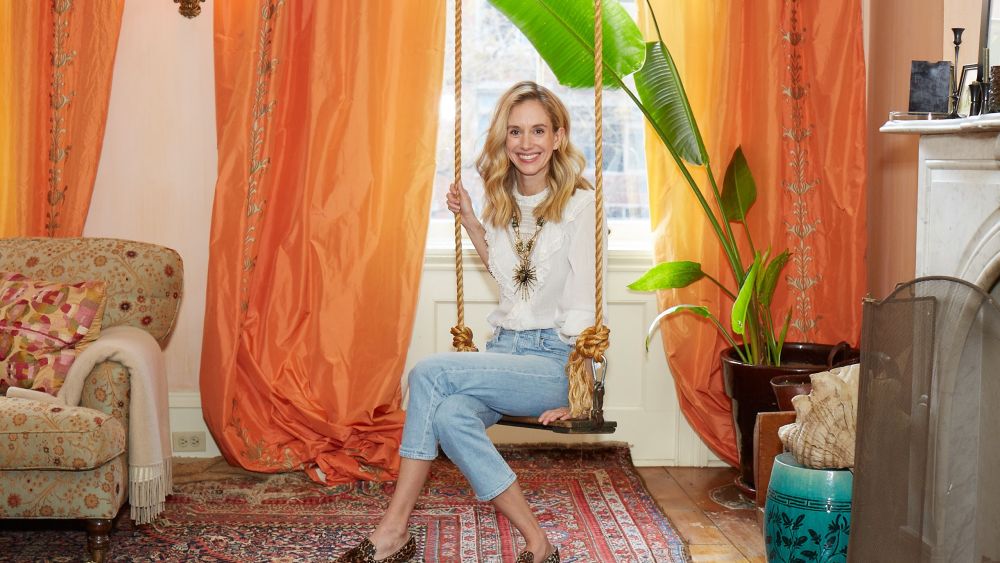
Designer Rachelle Hruska MacPherson describes her brand Lingua Franca as slow fashion with a fast tongue — a phrase coined by her husband, hotelier Sean MacPherson.
Raised in Nebraska, Hruska MacPherson’s grandmother Rita taught her how to stitch as a young girl. As an adult in New York City, she happened upon an old cashmere sweater, grabbed a needle and some thread and toyed around with what she might be able to whip up. From the onset, the designer believed that the wearable item was secondary to its message.
“Our brand was built on starting conversations. It wasn’t built on fashion,” she said. “That’s why we started with words. ‘Lingua franca’ literally means a common language.”
Related Articles

You May Also Like
Using Instagram as a launch tool for said cashmere sweaters in 2016, in the shadow of what was then the most contentious presidential election cycle in modern memory (until 2020 came along), Hruska MacPherson made it clear up front that her progressive personal politics wouldn’t be separated from her line for the sake of sales. To that end, Lingua Franca’s mission statement reads, “We’re living in uncertain — and often scary — times. We don’t have all the answers. But we try to listen and we try to learn. We’re committed to fair trade, ethical labor practices and the highest environmental standards. We’re proud to pay our embroiderers, all local women in NYC, a living wage. Oh, and we’re really into using our brand as a platform to inspire change — a portion of LF proceeds support the badass activists and organizations who are working for a better world. We care a lot.”
The brand’s hand-stitched sweaters donning phrases like “i miss barack,” “dream on dreamers” and “don’t agonize, organize” sprung up all across social media in the wake of Donald Trump’s victory. In 2017, as the world reckoned with the #MeToo movement and gender parity, Hruska MacPherson launched versions including “who run the world?” (a nod to Beyoncé’s girl power anthem) and “when there are nine” (late Supreme Court Justice Ruth Bader Ginsburg’s response when asked when there will be enough women on the Supreme Court), among others invoking pro-feminist messaging.
Celebrity clients — including Reese Witherspoon, Connie Britton and Serena Williams (even Republican scion Meghan McCain wore a “liberty” crewneck while hosting “The View”) — employed the sweaters to amplify their own social directives. Suddenly, $300 cashmere toppers were on activists everywhere.
This speed and responsiveness to current events, one of the brand’s core competencies, is not without its pratfalls. The brand’s “cuomosexual” and “cuomo for president” sweaters, released in 2020 at a time when then-New York Gov. Andrew Cuomo’s daily coronavirus briefings were making national headlines as can’t-miss television, felt starkly inappropriate in 2021 in light of the multiple sexual harassment allegations that ultimately resulted in the governor resigning from office. The brand released a statement on Instagram saying that anyone who had bought the sweaters could send them back to be unstitched and then restitched with a phrase of the owner’s choice, which they had been doing since the allegations were brought forward.
Speaking on the brand’s ability to react to the day’s news, Hruska MacPherson said “we didn’t want to become this brand that just saw every disaster as an opportunity to make money.” A Google document, which can be found on the Lingua Franca website, outlining exactly how much has been donated and to where is updated on Sundays. As of writing, LF has raised more than $1.1 million in cash and in-kind donations for various nonprofits, including the ACLU Women’s Rights Project ($59,799.77), the Movement for Black Lives ($40,563.63) and Planned Parenthood ($39,534.50).
Hruska MacPherson acknowledges that she is commenting on justice movements from an enviable perch.
“The past couple of years have really pushed me to reexamine both myself, as a privileged white woman, and pretty much everything around me. It’s a struggle that is still ongoing and one that I think should be ongoing,” she says of Lingua Franca’s direction. “As the head of a brand, this forced me to make a decision: to let my personal journey inform and alter the business I was in the process of building, or to play it safe. We were already pretty outspoken as a brand, a shift that organically happened after the 2016 election. So, it wasn’t that difficult to decide that playing it safe wasn’t for us.”
The brand has received callouts for appropriating phrases like “My Body Is Not a Political Playground,” which was originally said by Samirah Raheem, on its sweaters without crediting the originator. “We’ve definitely faltered along the way, but we’ve really tried to learn from our mistakes and from the people that have called us out for them. While it can be tempting to cower or stay silent in the face of criticism, we’ve deliberately chosen to allow ourselves to be vulnerable as a brand…and also to listen and grow when we make mistakes,” the designer said.
For example, “We’ve retired many popular phrases, namely, those rooted in hip-hop music, after coming to understand how we were participating in the appropriation of the art and ideas of marginalized people,” she continued. “It’s really important to me that the brand’s output aligns with our personal beliefs. We’re actively trying to do the best we can, and while I’m sure we’ll continue to make mistakes sometimes, my hope is that we’ll always be open-minded enough to learn from them.”
And she’s been keen to ask for help. This has taken the form of making strategic hires in the past year to create a more inclusive dialogue within the company; reaching out to friends and Instagram followers for insight and advice on wording and language, and partnering creatively with people like her friend Dr. Jodie Horton, an obstetrician in Washington, D.C., with whom she created a “Black Is beautiful” sweater benefiting UNCF after the murder of George Floyd.
Giving a tour of her workshop-slash-warehouse-slash-clubhouse in the basement of the Jane Hotel, which is owned by her husband, Hruska MacPherson flies around introducing her staff, including Diane Jaffee, an embroiderer who has been with the brand since the beginning, who was accompanied by her younger coworker Sophie Furman to receive her COVID-19 vaccine.
Jacob Faber, another member of the team who has been there from the early days, recounts having to pack up and ship the free sweaters Hruska MacPherson offered to anyone who made and sent in 100 face masks at the advent of the pandemic, when PPE was especially scarce. Their since-departed head designer, Deedee Sathianthammawit, taught face mask sewing lessons via Zoom. They ended up with thousands of masks — and a lot of work for Faber, operating alone in the Jane Street office in compliance with social distancing.
“I definitely feel so proud that our team was able to keep it going and [we were able to] keep them working and keep them employed and making money,” Hruska MacPherson said of her growing, and clearly tightly knit, staff, reflecting on a time when many in the fashion industry unexpectedly found themselves without jobs.
They kept it going to the tune of more than 300 percent growth throughout the course of the pandemic. Some of this she attributes to a consumer base that was completely homebound all of a sudden: “I do feel like engagement rose so much because people were just at home on their phones, wanting to be part of conversations….I think everything had higher engagement; I think everyone felt that way. At least for me, my husband is in hotels and restaurants and we were all in survival mode. And I think when you’re in survival mode, you want to connect even more.”
Hruska MacPherson posits that another contributing factor was likely their aforementioned turnaround time, noting that “it’s all blank until you order it, and we can get it done within one to two weeks.” This allowed the brand to remain relevant and nimble during a charged time when people were shopping almost exclusively online, but were being especially discerning with their spending. Sweaters reading “wear a mask” and “too close” were popular, and their “i heart new york” line did particularly well at a time when the city — home to many LF acolytes — was under siege.
While Lingua Franca has played around with non-sweater items in the past, including pajamas and T-shirts, it is launching its first full ready-to-wear collection for holiday. Blazers, PJs, chunky knits and relaxed pants and skirts make up the core of the offering, which maintains the cheeky and cheerful vibe that is the brand’s through line — even if the new items are slightly less phrase-focused.
Other expansions include a Lingua Franca café opening in Midtown Manhattan this fall, conceived as a “community center” for LF enthusiasts and a touch point for those new to the brand. “I’m sure it’s very hard for us to make any money selling coffee and paper flowers [another category the brand has recently rolled out] at Rockefeller [Center],” Hruska MacPherson said. “But I do think it’s a great branding exercise and a great marketing experience. Who knows where it will lead? This whole company has been about saying yes to things.”