
NEW DELHI — With “India Inc.” being the latest buzzword in just about every industry from software to pharmaceuticals, the country’s fashion industry is not about to be left behind.
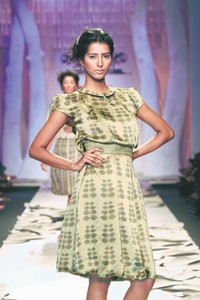
At the first spring-summer Wills Lifestyle India Fashion Week this month, Indian designers showed a renewed focus on getting down to the business of fashion.
“They are really evolving now and putting together coherent collections with wide appeal,” said Maria Luisa Poumaillou, owner of the Parisian boutique Maria Luisa. Poumaillou, known for spotting rising fashion stars, has been stocking Indian designers for several years. Two of her early discoveries were Ashish N. Soni and Sabyasachi Mukherjee, both of whom showed to positive reviews at Olympus Fashion Week in New York in September.
India Fashion Week, which is in its seventh year, has until now been an annual event with designers showing fall collections. The launch of a spring week was inevitable, said Rathi Vinay Jha, director of the Federal Design Council of India, the country’s apex body for designers.
“It was time for us to take it to the next level and be on par with the global fashion industry,” she said. “We’ve arrived for sure, now it’s a question of getting the right message out. We are serious about business.”
The Indian designer market, estimated to be worth about $50 million to $60 million, is still small by international standards, but the FDCI estimates that over the next decade, that will quadruple to about $225 million.
The buzz over Indian designers lured British style icon and fashion editor Isabella Blow to New Delhi.
Blow said she was impressed with what’s on the runways.
“This is definitely a market I want to keep a close eye on. I’m astonished by the amount of talent here,” she said, wearing a dress by Prashant Verma, a young, avant-garde Indian designer, paired with one of her signature Philip Treacey feather hats.
Most of the international buyers at fashion week came from Europe and the Middle East. “Emerging brands like ours will probably do better in the European market, which is more boutique-driven and experimental,” says Shantanu Mehra, of design team Shantanu and Nikhil. The company’s spring collection featured block-print leaf motifs and chiffon drapes, piquing the interest of Galeries Lafayette buyer Alix Morabito, who was attending India Fashion Week for the first time. Morabito said she intended to place orders.
Related Articles
You May Also Like
“The challenge is that the Indian look is not what’s trendy internationally anymore, but that does not mean we aren’t looking for something that reflects India,” she said. “This country has an amazing textile tradition. I’m looking at designers who are really translating that Indian soul into clothes with modern fit and cuts.”
Designer Namrata Joshipura, who retails at Henri Bendel, Bergdorf Goodman, Neiman Marcus and Anthropologie, said the key to success internationally for her has been to look beyond just being profiled as an Indian designer. “I don’t sell India, I sell Joshipura,” she said. “You can’t be just an Indian designer, you have to be a global designer with a global aesthetic sense.”
Buyers from Turkey, Kuwait and Paris all showed interest in her spring collection, she noted, demonstrating that global tastes are converging. “I can’t hide the fact that I’m Indian. Everything that I do is 100 percent made in India, even the fabrics. The inspiration comes from here.”
Even if designers from India want a piece of the global pie, they are also capitalizing on the retail boom at home. Shantanu and Nikhil pointed out the collection they showed on the runway was designed for an international audience, which meant using more understated prints and more emphasis on silhouette. In their stall, however, the designers offered a large selection of slightly more embellished ensembles aimed at the domestic Indian market.
“We’re one of the only countries in the world that still has its own fashion heritage, and that is not going away,” said designer Tarun Tahiliani. He was referring to the sari, India’s national dress, which is still preferred by most Indian women.
Tahiliani, the country’s couture king, said there is a lot of potential in the domestic market for designers to grow their businesses. He launched his diffusion line at India Fashion Week, aimed at the country’s burgeoning middle class of about 30 million people with considerable spending power.
The Indian design industry is forging ahead, but not without some growing pains. Many designers complained of low buyer turnout, especially from the U.S. Much of that had to do with the timing of fashion week here. “We were scheduled before New York and London,” remarked Shantanu. “Most buyers are not going to put us ahead of those shows. We aren’t that big yet.”
Organizers say they will reconsider the dates for next year’s event.
In the meantime, Indian fashion watchers have another spring fashion week to look forward to at the end of October in Mumbai, featuring a totally different group of designers. Is it too much, too soon? Maybe not, said Blow, “I just can’t get enough of it.”