In February, weeks before Iran’s missiles changed the calculus for the entire Gulf, the chief executive officers of Saudi Arabia’s most ambitious retail developers gathered in Riyadh to debate the future of the Kingdom’s market. The mood was expansive. The question on the table was not whether Saudi Arabia was growing, but how fast, and in which direction.
Then came Feb. 28.
The joint U.S.-Israeli strikes on Iran, and Tehran’s retaliatory missiles and drones across all six Gulf Cooperation Council states, sent a shock through a region that had been the luxury industry’s most compelling growth story heading into 2026. Airspace closed. Major retail operators temporarily shuttered stores across Bahrain, the UAE, Kuwait and Qatar. Oxford Economics projected inbound arrivals could fall between 11 and 27 percent year-on-year, a potential loss of between $34 billion and $56 billion in visitor spending.
The conflict has brought new clarity to the Gulf’s retail landscape, separating markets built on structural foundations from those more exposed to shifts in visitor flows. The hierarchy is being quietly redrawn.
Related Articles
Saudi Arabia: The Domestic Engine
At the February panel in Riyadh, Alison Rehill-Erguven, chief executive officer of Cenomi Centers, the Kingdom’s largest mall operator with 21 destinations across 10 cities drawing more than 109 million visitors annually, offered a data point that framed the possibilities.
You May Also Like
According to data, Riyadh offers the most leasable space for potential tenants with 3.5 million square meters, followed by Jeddah with 2.1 million square meters and Dammam with 1.2 million square meters.
And other data shows the significant potential for retail development, one of the Saudi government’s priorities. For example, Riyadh’s gross leasable area per square meter per capita currently sits at just 0.5, compared to 1.5 in Dubai and 2.2 in Abu Dhabi.
“You can already see just by using some key data and metrics that we still have runway to go,” she said. “Which is great for our business.”
The conflict has not shortened that runway. The numbers bear it out. Cenomi’s 2026 Ramadan and Eid trading outperformed 2025 by double digits in both footfall and retail sales.
“The domestic Saudi shopper has shown to be quite resilient during this difficult period,” Rehill-Erguven shared with WWD. “Cenomi Centers has actually fared well under challenging regional circumstances. Consumer confidence is holding.”
She attributes part of the uplift to travel and e-commerce logistics disruption redirecting spend into physical retail, but is clear that the structural improvements Cenomi has made to its centers are equally a factor. “As we continually improve our malls in terms of merchandise mix and experience, I am sure this has played a strong factor as well.”
Cenomi’s approach to that evolving consumer has been to stop thinking like a mall developer and start thinking like a lifestyle operator, retrofitting assets around multiple daily touchpoints.
“She comes with her family, maybe they need a health check, maybe they need a dentist appointment, and she can grocery shop, and she can grab a coffee,” Rehill-Erguven said. “It’s hitting multiple touch points.”
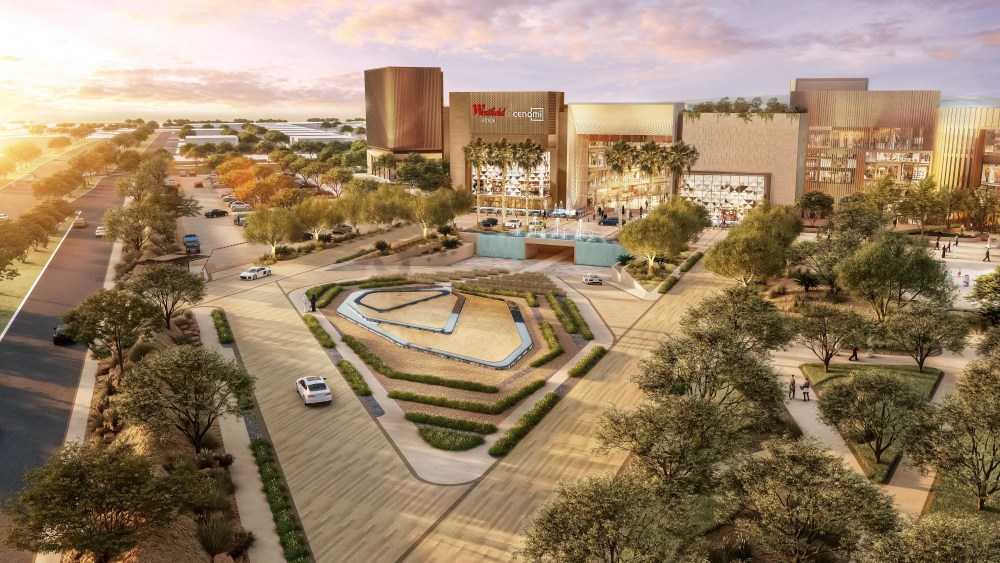
The two flagship assets coming to market this year, Westfield Jeddah and Westfield Riyadh, will each include luxury precincts of at least 215,000 square feet, formats that, Rehill-Erguven noted, “technically, at this moment in time, don’t exist in the Kingdom today.”
Neither project has been disrupted by the conflict, she shared. Major tenants have been taking handover and beginning fitout at both sites throughout the period. “We have been fortunate to not suffer any major delays or pauses at the sites and we are targeting to open both malls as planned later this year,” she said.
The Westfield branding, secured through a 10-year exclusive partnership with Unibail-Rodamco-Westfield, gives Cenomi access to a global tenant network that accelerates brand confidence.
PIF, the Kingdom’s $1 trillion sovereign wealth fund, frames its role in Saudi Arabia’s retail development in terms that go beyond financial returns. Georges Barakat, head of market and commercial strategy for retail at PIF’s local real estate investment division, noted at the February panel that currently only 4 percent of tourists visiting Saudi Arabia spend on luxury, compared to double digits in comparable markets.
“It’s not building malls, it’s building ecosystems,” Barakat said, ones designed around a simple but demanding test: “Are we designing unique, engaging and commercially viable destinations?”
Brand confidence is showing up in expansion sequencing. Ulta Beauty, having opened its first two UAE locations in January and March, is heading next to Jeddah. Primark opened at Dubai Mall the same week as Ulta’s second UAE launch, its third regional rollout in six months, with Saudi on its forward roadmap. Both openings proceeded without interruption, making their own quiet argument about the market’s underlying resilience.
Qatar: The Quiet Outperformer
At Place Vendome in Lusail, resilience is taking a different but equally instructive form. The mall, a $1.3 billion destination drawing 16 million visitors annually and ranked third in the GCC for high-end fashion, took an initial hit when the conflict erupted. Shane Eldstrom, CEO of United Developers, describes a market that absorbed the shock and recovered faster than expected.
“The first two weeks, we saw a significant impact where we were down about a third of our footfall,” Eldstrom said. “But after that, it kind of came back, and came back stronger than we could have ever expected.”
About 60 percent of Place Vendome’s footfall is the local Qatari community, which tends to stay home and spend domestically during periods of regional uncertainty. Tourism represents less than 10 percent of overall sales volume. When that cohort disappeared, the domestic base absorbed the gap. Retailers are running either on target or marginally below for the quarter. “They felt a stronger impact in other markets, particularly the UAE,” Eldstrom said.

The leasing pipeline has not paused. Place Vendome secured 43,500 square feet of new leases in the first quarter of 2026 across 10 new or upsized stores, including New Balance’s first Grey Store in the Middle East, a premium concept built around exclusive collaborations with Miu Miu and Loro Piana. Breitling, APM Monaco and LG Electronics also opened in the quarter. The mall posted 9 percent like-for-like sales growth in 2025 and 12 percent on a per-square-meter basis.
Qatar’s political neutrality has added an unexpected commercial dividend. With safe destinations at a premium, intra-GCC visitors are migrating toward Doha. “There are basically two cities in this region that are regarded as relatively safe,” Eldstrom said. “We might even see growth.”
The UAE: Structural Exposure, Strategic Response
The contrast with the UAE is sharp. The Emirates’ dominance of Gulf luxury retail, accounting for roughly 60 percent of the region’s luxury activity, is built on a model that is simultaneously its greatest commercial asset and its most significant vulnerability. Drawing shoppers from more than 180 nationalities annually, it is a market of extraordinary commercial complexity. But when international travel collapses, so does a critical portion of the revenue base.
Majid Al Futtaim, whose portfolio includes Mall of the Emirates and 29 properties across the region, is reading the moment with measured candor. “What we are seeing is not a decline in engagement, but more of a recalibration in spending priorities,” said Khalifa Bin Braik, CEO of Majid Al Futtaim Asset Management. “Consumers are still out and active, but they are becoming more deliberate, more selective and generally more cautious in how they spend.”
Where the pressure is most visible is in properties with greater tourism exposure. Entertainment is holding, with Vox Cinemas performing strongly through Eid and Easter, while beauty continues to outperform broader luxury trends.
For homegrown UAE brands, the moment is requiring a different kind of discipline. Rania Masri El Khatib, CEO of The Giving Movement, describes navigating the disruption with a sharpened rather than diminished focus. “Building a brand in times of uncertainty is not about slowing down,” she shared. “It’s about sharpening focus.”
While in-store traffic has softened, the brand’s omnichannel performance has held. “Connection and relevance do not pause in uncertain times,” she said. “Resilience is not just about navigating the moment. It’s about positioning the business to accelerate when conditions improve.”
It is in this sprit that Majid Al Futtaim is moving to support homegrown brands as well. The launch of Ma’an, a program opening the company’s full consumer ecosystem to UAE-based emerging businesses, from Mall of the Emirates to Carrefour to its SHARE loyalty network of more than 10 million members, signals where the company sees opportunity in the current moment. Launched alongside the government’s AED 1 billion economic incentive package for businesses, it reflects an institutional confidence that near-term turbulence has not shaken.
“The role of our malls has always been to bring people and communities together, and that responsibility has never been more important than it is today,” said Ahmed Galal Ismail, CEO of Majid Al Futtaim Holding.
The Longer View
The conflict has ended what observers have called the narrative of the Gulf as a permanently safe destination. What is emerging in its place is a regional retail map differentiated by structural composition rather than unified by a single growth story.
Qatar’s domestic anchor is proving its value. The UAE’s tourism-driven scale remains the region’s commercial engine but carries risk proportionate to its ambition. And Saudi Arabia, still at 0.5 square meters of retail space per capita against Dubai’s 1.5, has a growth story that is internally driven, institutionally backed and accelerating through developments that will introduce luxury retail to the Kingdom at a scale it has not seen before.
As Barakat put it in Riyadh just before the start of the conflict, “Let’s build wisely, let’s build smartly, let’s deliver on what we promised to the people.” In the Gulf’s evolving retail landscape, that discipline looks like the right bet.
Editor’s note: For more insights into the Saudi fashion and retail sectors, subscribe to fashionfutures.com and follow it on Instagram at ksa_fashionfutures.