
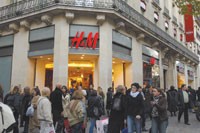
PARIS — With Louis Vuitton, Chanel and Hermès handbags dangling at their elbows, crowds of chic Parisian women eyed velvet blazers and tweed trousers on a December evening.
But they weren’t shopping on tony Avenue Montaigne; they were picking through the racks at the Hennes & Mauritz and Zara stores on busy Boulevard Hausmann.
This scene, and what surveys suggest is a strong consumer appetite for value, bode well for Europe’s fast-fashion chains, which appear poised to reap more profits during the crucial holiday selling race.
“This whole basket is full of gifts,” said Yara Aword, who is in her early 20s and was carrying a Louis Vuitton bag and shopping at H&M. Her picks from the store included earrings for 4.90 euros, or $5.74 at current exchange, and hairpins for 2.90 euros, or $3.40. “They’re inexpensive and fun. I buy H&M for fun, to have a good time. Then I throw it away. It’s not the same thing when you buy Vuitton.”
With Christmas near, analysts remained upbeat on fast-fashion’s prospects, saying they stand to profit from cost-conscious European shoppers. Both Inditex, parent of Zara, and H&M have built steam over the last couple of months in a challenging retail environment. The rise of the dollar might crimp their profits since both pay for sourcing in Asia in dollars, which means they will spend more euros. Inditex last week reported a 26 percent gain in third-quarter net income on sales that gained 20 percent. H&M reported an 11 percent gain in November sales.
“Zara offers [the] right trends and has adapted to climate [changes], this is good for sell-through,” wrote Morgan Stanley’s Claire A. Kent in a report last month that upgraded the bank’s outlook on the Spanish firm.
“Our higher confidence [on Zara’s like-for-like sales performance] stems from the fact that we believe Zara has offered the right trends this season — for women, that’s men’s military, black and short trousers,” she added.
Lehman Brothers said H&M is well placed to resist factors that may adversely effect consumer spending in Europe, including the European Central Bank’s decision to lift interest rates by a quarter point to 2.25 percent.
Related Articles
You May Also Like
“We believe H&M’s low-price positioning will enable it to withstand the potential squeeze on disposable income and may help the company benefit from customers trading down,” Lehman Brothers said.
Shares of Inditex have gained more than 15 percent since January, while H&M’s shares have jumped some 13 percent over the same period.
With value topping shoppers’ agendas this season, according to a survey by consulting firm Deloitte, the fast-fashion outlets look well positioned.
A walk-through of H&M and Zara revealed plenty of sharp pricing and gift ideas.
Jewelry designed by Londoner Solange Azagury-Partridge at H&M retails from 14.90 euros, or $17.45, for a ring to 19.90 euros, or $23.30, for a necklace.
“They make perfect gift items,” said a spokeswoman for the chain, who also noted the more “luxurious” packaging and gift boxes as underscoring H&M’s attempt to resonate with its customer base.
Apparel for end-of-the-year fetes — 79 euro, or $92.53, black dresses at Zara and 79.90 euro, or $93.59, fake-fur coats at H&M — fills both chains’ windows.
Across the board, shoppers gave the chains high marks on value and astute merchandising, diverging mildly on which chain was better positioned in the weeks before Christmas.
“You don’t always want to spend a fortune on what you wear,” said Jacqueline Mahulot, a fiftysomething woman with a Louis Vuitton handbag who was shopping in Zara. “My daughter prefers H&M over Zara. They have more fashionable clothes.”
At H&M, a woman in her early 30s and carrying a Vuitton, who declined to be identified, said she found Zara “more qualitative” than H&M.
“You go to H&M for really cheap, trendy clothes. Zara’s quality is better,” she said.
Michelle Bourg, a shopper in her 20s, concurred: “H&M is great for really cheap things. They are ahead of Zara sometimes on the trends. But, in general, the quality of Zara is better than H&M. It’s also more expensive.”
Though the stores are top holiday shopping destinations, both face challenges, women said. Few in Europe expect apparel to be a standout seller this holiday season, with retailers facing tough prospects after weak business in the fall, the second-warmest autumn on record. In France alone, sales of women’s ready-to-wear declined 13 percent in October, according to the Institut Français de la Mode.
To complicate matters, most shoppers across Europe said they would probably spend less at the holidays than last year, according to Deloitte.
“Circumstances are difficult now,” said a woman in her mid-40s shopping at Zara. “One must make judicious choices.”
Paradoxically, though, luxury in Europe also is accelerating, with leading European luxury houses reporting gains across the continent after several seasons of tepid sales.
As the market continues to polarize between the high and the low — with the middle squeezed — among the most interesting retail phenomena is customers’ increasing readiness to mix luxury with disposable chic.
Michelle Sibert, a Parisian in her mid-40s with impeccable chestnut hair and an alligator Birkin slung over a Lanvin coat, was an example. Carrying shopping bags from Jean Paul Gaultier, Yves Saint Laurent and Lanvin, she stopped to talk as she examined a table of 9.90 euro, or $11.60, sweaters at Zara.
“I’m Christmas shopping,” she said. “But mostly I’m finding things for myself. I don’t mind spending, but the price must reflect the value and the style.”
Sibert said she was looking for her daughters, too, but not with real urgency. “I do most of [my holiday shopping] later,” she said. “I wait to compare, to find the best deal. I’m waiting for sales.”