
The Swiss watch guard is passing the baton to the next generation, which is intent on infusing Geneva with a dose of edginess coupled with its famed exquisite craftsmanship.
Alexandre Peraldi, design director of Baume & Mercier
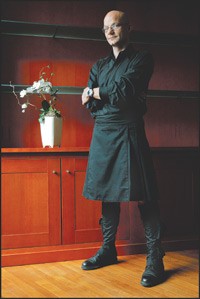
Alexandre Peraldi wears a dark knee-length or floor-length skirt every day. He believes its pure Japanese architectural look will help clear mental clutter in order to design linear, ergonomic and elegant watches for the 176-year-old Geneva-based Baume & Mercier.
“I don’t have a precise style, but I have a tendency for things that are quite simple, not the froufrou,” said Peraldi, 39, during a visit to New York last month to launch the firm’s fall watches.
Peraldi, born in Vetraz, France, became design director of Baume & Mercier in 2001, after working in accessories for Cartier and Yves Saint Laurent. Like many a designer at fashion and accessories houses with rich histories, he has dipped into the company archives, called Studio Design, reviving vintage styles and taking inspiration from the timepieces of the past.
Pieces that are provoking him include a watch with a domed case and the crown on top and an Art Deco-inspired women’s bracelet watch with a slanted case and tin diamond-studded bangle.
“We’ve been making important changes over the past five years,” he said. “We’re trying to create a liaison between the creation [the watch] and the wearer. We don’t want to be too extravagant nor old-fashioned. There needs to be an equilibrium.”
As such, the company launched Diamant, a geometric women’s watch with a diamond-laced bezel that is fashionable and comfortable for everyday wear. When designing pieces, Peraldi said he never has a preconceived notion and that inspiration finds him just about anywhere.
“I don’t get my inspiration from one moment or one thing,” he said. “Like the old Japanese proverb states: If you want to paint a bamboo, you have to observe it first and become a bamboo yourself. Only then can you paint it.”
Michael Wunderman, president of Corum
Michael Wunderman lives in Geneva, but the Los Angeles native has a strong connection to his hometown. This comes through in the newest styles from Corum. They include the Golden Bridge watch that was the company’s 50th anniversary watch in 2005, for which the functions are visible through a double-sided skeleton case. There is also the sporty Admiral’s Cup Competition 48 watch, featuring a 12-sided domed sapphire crystal and an oversize 48-millimeter case made of titanium that launched at the Baselworld Watch & Jewelry Show in April.
Related Articles
You May Also Like
“We have so many products that are strong and have a life on their own,” said Wunderman, 31, who began working at the Swiss firm his father, Severin Wunderman, acquired in 2000 after having built the Gucci timepiece business. He became president in 2003.
“I was fortunate to be a fly on the wall in the Gucci days. I am a product of my father, but he and I have very strong, passionate ideas that are different,” said Wunderman, who will eventually take on the almost $80 million Corum business and is shaking up Corum with youthful, edgy designs.
At next year’s fair in Basel, Corum will unveil its redesigned collection, keeping only 20 percent of the tried-and-true classics, like its gold-coin watches and looks with enamel detailing.
“It’s going to be much more modern, classy and reliable,’’ Wunderman said. “We’re mixing titanium and rose gold with galvanized rubber. We’re looking at things in a different way. I know the watch business, but I also know the marketing side of things. I push the engineers outside the box. Technically, we’re taking it to another level with the movements.”
Wunderman said it’s a fruitful and competitive time for the watch industry. The firm is at work on a new tourbillion, a built-in chronograph and an Admiral’s Cup watch with a gong that functions like the bell on a ship.
“All the barriers are torn down,” he said. “A guy can wear a million dollars on his wrist, and women can wear tourbillions. It’s the renaissance period of watches.”
Thierry Stern, vice president and member of the management committee of Patek Philippe
As the watch world seems to be in a race to make the world’s largest, most tricked-out watch case, Patek Philippe prides itself on going smaller — the tinier, the better.
In order to create women’s watches with chronograph and other complications, the company is creating the smallest movements to fit within women’s smaller-sized cases.
“You don’t want a fashion watch that’s in and out in six months,” said Stern, 36, who took on the role of vice president and member of the management committee of the firm in 2003. “Some brands are getting too big. I think 42 millimeters is too big.”
Stern, like any fourth-generation watchmaker, is also saddened by the fascination by small and new companies with complications like minute repeaters and tourbillions that only a few watch companies have mastered.
“Tourbillion is a fashion victim,” he said. “It’s difficult to make, and [many brands] are making them now. But the sound of the gong has to be perfect [on a minute repeater], and the tourbillions these companies are making are not accurate. They are destroying the aura.”
Stern is focusing on what his company knows and does best: handcrafted watches and ageless styling.
This year, the firm launched the Gondolo Gemma for women, an elongated rectangular case with a faceted sapphire crystal.
“I’m always amazed that people think that Patek Philippe watches are fragile,” he said. “When you’re at this level, you can’t be fragile.”
The company has also ventured into uncharted territory.
“There was never a plan to go into the jewelry business, but our customers asked for it,” he said, regarding the introduction of jewelry to complement its 24 watches.
Stern clearly isn’t concerned with the profusion of new watch brands, even at its decidedly slow-paced production rate: The 167-year-old firm produces about 38,000 watches per year, even as many of its big-name competitors typically produce as many as 800,000 watches in the same period.
“When business is going well, new brands come in,” he said. “When it’s bad, they disappear.”