
Books have long been a delicate subject in China, and perhaps that’s why they make such compelling artistic material in the forthcoming exhibition “Shu: Reinventing Books in Contemporary Chinese Art.”
All things “shu,” the Chinese word for books, will be displayed at the China Institute Gallery in New York, starting Sept. 28. This will be the first major show to explore how artists are reexamining traditional Chinese books in light of the country’s social transformation. It will also be the Upper East Side gallery’s first major exhibition of contemporary Chinese artists, featuring such standouts as Cai Guo-Qiang, Zhang Xiaogang and Xu Bing.
University of Chicago scholar Wu Hung is curating the exhibition, as well as this year’s Gwangju Biennale in South Korea.
Bing’s “A Book From the Sky” is the most ambitious piece, by far. From 1987 to 1991, he created a vocabulary of 4,000 characters that appear to be Chinese but are nonsense symbols. He carved the characters in reverse into pear wood to make movable type, which was then used to print “A Book From the Sky.” In addition to that woodblock and four volumes of his books, an enlarged photograph of the artist’s 1988 large-scale installation featuring 400 of his nonsensical books on display at the National Gallery of Art in Beijing will be shown at the China Institute Gallery.
Bing noted, “By the time of the Cultural Revolution, I could read, but there weren’t any books available. The entire country read one book — Mao’s ‘Little Red Book.’ We read and memorized that book all day. At the end of the Cultural Revolution…I was starving for culture….I read so many different types of books. But after reading so much, I didn’t feel so well. It was like being overstuffed. It was at that time that I made ‘A Book From the Sky.'”
He once said, “You can’t help but think that this book must have some sort of deep meaning; why else would someone conduct this [project] with such seriousness? In reality, it does not have any content to tell you. But I believe that this work needs to be carried out very seriously; the greater the seriousness of the work, the stronger its artistic power.”
Related Articles
You May Also Like
China Institute Gallery director Willow Chang said, “It is not only something shocking, but it makes people think.”
This seemingly endless stream of information is something many can relate to, she said. “We are all flooded with information.”
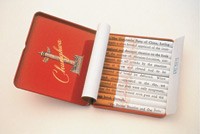
More concise is Bing’s “Tobacco Project: Red Books, 2000,” cigarettes printed with quotations from Chairman Mao and arranged in a tin imprinted with Tiananmen Square’s landmark statue. China has more smokers than any other country, and cigarettes are shared freely as a way of making friends, Chang said. With this work, Bing has combined a political message with an everyday item.
Yue Minjun’s “Recycle Bin” is a sculptured piece that should give visitors pause. Six male figures squat on wooden boards, encircling a pile of books and looking as though they are talking.
Regardless of their intended messages, contemporary Chinese artists are benefiting from the world’s increasing interest in China. Chang chalked that up to the country’s economic might and to the fact that younger artists tend to embrace avant-garde mediums like installation art and performance art, which are more understandable to the Western world.
“Chinese avant-garde art usually touches upon a number of sensitive issues which enter the world and people pay attention to — including, ‘Are all these books useful for us, not just for China?'”