
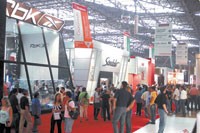
RIO DE JANEIRO — In 2007, Brazilian trade show organizers plan to maintain the popular format changes made at their last editions and contend that recently increased for-export prices will not dissuade foreign buyers, who tend to agree.
Brazilian clothing and textile fair exhibitors were not able to keep dollar-based for-export prices from rising at their 2006 shows, though they say prices should remain stable through the first half of 2007. That’s because although the dollar has lost 35 percent against the Brazilian real since 2004, the exchange rate has stabilized since mid-2006. Fortunately, show organizers said that prices have stabilized at a level that is not so high as to discourage foreign buyers willing to pay top dollar for quality fabric, workmanship and stylistic innovation.
The twice-yearly São Paulo Fashion Week, Latin America’s biggest fashion showcase, will feature 50 stylists at its Jan. 24 to 30 edition, up from 43 at the January 2006 event. Key exhibitors at the event in the 258,000-square-foot Bienal Cultural Center in São Paulo’s Ibirapuera Park will include Alexandre Herchcovitch, Reinaldo Lourenço, Fause Haten, Lino Villaventura, Forum, Tufi’s Duek’s signature line and Patachou’s Tereza Santos export line. Some 100,000 visitors and two-dozen foreign buyers are expected.
SPFW will again maintain a business salon on the venue’s fourth floor with more than 70 designer showrooms, a format change inaugurated at the June 2006 event. The salon generated $400 million worth of business in June 2006, mostly from domestic buyers who took advantage of the one-stop shopping it provided, said Graca Cabral, an organizer of SPFW.
“We expect foreign business to continue to be brisk at the January and June 2007 SPFWs, even though for-export prices have gone up,” said Cabral. “Stylists are sensitive to this and are increasingly trying to create the right balance of quality, design and price to satisfy foreign buyers, as well as domestic ones.”
Eve Kohlman, owner of upscale Boston boutique Fanny and Delphine, came to SPFW for the first time last June and said that higher-than-expected designer prices won’t dissuade her from returning to the January 2007 edition. “I wasn’t expecting prices to be so high, but I also wasn’t expecting the fashion to be so innovative and well-made,” said Kohlman. “And as my customers are less price-conscious and more design- and quality-oriented, I believe they’ll pay the price.”
Related Articles
You May Also Like
Sandra Moleirinho, who runs Babulaque, a London-based foreign distributor for European and Asian retailers, also plans to come back to SPFW in January and June 2007. “Some of our buyers were a bit taken aback [by the price increases], but still placed orders and will continue to do so because Brazilian fashion remains very innovative,” said Moleirinho.
While SPFW features high-end established brands, Fashion Rio showcases low-end underdog designers with a strong emphasis on casualwear. The next edition of Fashion Rio, to be held Jan. 15 to 21 at the Gloria Marina in Rio de Janeiro, is expected to attract some 75 foreign buyers, three times as many as are expected at the next SPFW. Most are small boutiques and distributors, not the large chain boutiques and internationally known stores that attend SPFW.
Fashion Rio’s low-end designers haven’t increased for-export prices as much as SPFW’s high-end labels, and event organizers are expecting brisk sales, based on the June 2006 show.
“Buyers all over the world are more and more questioning prices,” said Eloysa Simão, a Fashion Rio organizer. “But increased sales at the June 2006 Fashion Rio lead us to believe that the same should happen at our January and June 2007 events.”
The June 1 to 9 edition of Fashion Rio is expected to draw 70,000 visitors to the Gloria Marina and will feature runway shows for 35 designers, up from 31 at the January 2006 edition. Key houses at Fashion Rio will be Maria Bonita Extra, Colcci, Santa Ephigenia, Mara Mac, TNG and Walter Rodrigues.
In June, Fashion Rio will add an extra tent for runway shows, mainly to include bikini makers who don’t attend in January when winter collections are presented.
The Couromoda, Latin America’s biggest footwear show, will take place at São Paulo’s Anhembi Park Jan. 15 to 18, with 1,300 exhibitors occupying the entire 904,000 square feet of pavilion space, as well as two 64,000-square-foot tents and an additional 240 rooms at an adjacent Holiday Inn.
Couromoda president Francisco Santos expects some 60,000 visitors and some 4,500 foreign attendees at the next show, the same number who came to the January 2006 edition.
Santos said Brazilian footwear makers are adjusting to increases in for-export footwear prices by selling higher-value-added footwear, which can absorb the price increases more easily than lower-end shoes. “At the next Couromoda, foreign sales should remain steady and maybe even increase because we’ll be selling [fewer pairs] but at higher prices,” he said.
Fenatec, Latin America’s largest textile fair, will also take place at Anhembi Feb. 27 to March 2. Forty-seven textile exhibitors are expected to occupy 120,000 square feet and draw some 14,000 visitors, including 600 foreign buyers.
Brazil’s third major apparel trade fair, Fenit, is set for June 26 to 29 in Anhembi Park and will feature casualwear, beachwear, athleticwear, underwear, socks and accessories. Fenit will take up 658,000 square feet of the pavilion, with around 60 percent set aside for the more than 500 exhibitors, and the remaining space allotted to Fenit Inspiration, an after-hours entertainment area inaugurated at the last edition of Fenit. It features restaurants, music and dance shows and discos, as well as areas where exhibitors can stage swimwear shows, give away samples of their wares and set up retail shops for buyers.
The June edition of Fenit is expected to attract 28,000 visitors, including 1,100 foreign buyers from the Americas, Europe, Asia and Africa.
Fenit organizer Roberta Dias said she expects “Fenit sales to be at a level similar to last year, even among foreign buyers, [who are] attracted to the uniqueness of Brazilian fashion.”
Fernando Pimentel, the head of the Association of Brazilian Textile and Apparel Industries, was not
overly optimistic about business at the SPFW, Fashion Rio and Fenit fairs in 2007 because, although the economy grew 3.5 percent in 2006, he said it did not benefit textile or clothing makers. The devalued dollar hurt dollar-based exports and made dollar-based textile and clothing imports more price-competitive, especially those from China.
“If the dollar-real exchange rate remains the same in 2007, as I suspect it will, even if the economy grows by 4 [percent] to 4.5 percent, the greatly devalued dollar will continue to hurt exports and make imports more price-competitive, negatively impacting our clothing and textile sectors,” Pimentel said.