
True Religion Takes Off
With his latest business venture, Jeff Lubell believes he’s found the path to salvation.
Sales at his company, True Religion Apparel Inc., surged by a factor of 10 last year — its first full year in business — as the high-end jeans line also pulled into profitability. Now Lubell is predicting sales will almost triple next year as the brand continues an international rollout.
The Los Angeles-based firm in the fourth quarter of 2004 reported net income of $2.5 million, or 12 cents a share, compared with $156,122, or a penny a share, a year ago. That came on sales of $13.6 million, up from $1.3 million.
For the year, income came to $4.2 million, or 20 cents a share, compared with a $10,782 loss a year ago. Sales were $27.7 million, up from $2.4 million.
A former fabric salesman, Lubell launched two hot jeans lines — Bella Dahl and Hippie Jeans — between 1998 and 2002, but lost control of both of them to his partners. When he unveiled plans for True Religion in late 2002, he vowed to retain command.
In the summer of 2003, he merged the firm into the shell of a publicly traded company called Gusana Explorations that had been founded to search for valuable minerals, but had never succeeded in finding any. The deal put Lubell at the helm of a public company that initially had only three employees — himself; his wife, Kymberly, and an assistant — and a stock that traded for less than a dollar a share.
A lot has changed in the past 18 months. On Wednesday, True Religion shares closed at $11.85, off 13 cents. The stock’s 52-week low was 65 cents and its high was $14.85.
According to filings with the Securities and Exchange Commission, Lubell in December sold 1 million of his shares for $4.25 a share. That left him with a 42.8 percent stake in the company. He said he continues to be the largest single shareholder.
In an interview early this month, Lubell, who serves as chairman of the company, insisted that he hadn’t altered much about the brand’s approach since founding the company, though he has scaled up to have 40 employees.
Related Articles
You May Also Like
“We didn’t change anything, but we made sure that we had the right production people in place. It’s all about being on time and getting the production,” he said. “Otherwise, we would have never made those numbers.”
The brand makes superpremium jeans that wholesale for $100 to $200 and command retail prices up to $465.
In a conference call with financial analysts the day the company released fourth-quarter numbers, Lubell said the bulk of the line’s sales last year came from its base of 300 specialty store accounts that represented 76.5 percent of sales, with the balance of revenue coming from department stores. This year, he predicted, department stores would grow to represent a larger chunk of his business.
He also noted that sales outside the U.S. now represent 46 percent of volume. The brand’s top markets abroad last year were Japan, Germany, Canada and the U.K., and it’s now lined up additional distribution in Europe, Africa, Asia and South America.
In July, the company plans to open its first signature store, a 900-square-foot unit in Manhattan Beach, Calif. Lubell said he chose the location because it wouldn’t conflict with the company’s current customers. It also happens to be where he lives.
If the first unit does well, Lubell said he’d like to roll out additional stores in a handful of cities in the U.S. and abroad.
Lubell said True Religion plans to continue to push the envelope on jeans pricing.
“Today’s customer is about the product,” he said. “It’s not about the price point. If you want to buy a price point, you go to Wal-Mart and Target.”— Scott Malone
DIFFA Raises $600K
Decorated denim might be trendy right now, but it’s always been the height of style for the Dallas Collection — the annual black-tie auction benefiting the Design Industries Foundation Fighting AIDS.
By invitation, more than 100 designers accepted the challenge this year to restyle a Levi Strauss denim jacket so gloriously that people would be willing to shell out thousands of dollars for it. With underwriting and other fund-raising efforts, the 20th annual jacket auction, held March 5, grossed well over $600,000 to help people living with AIDS in North Texas.
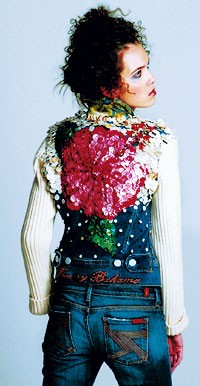
The theme, “A Dream as Big as Texas,” inspired jackets dolled up with peacock feathers, corn husks and hair rollers, in addition to the customary crystals, fur, feathers, sequins and hand-painting. Topping the charts was Tommy Bahama’s shell-encrusted fitted jacket with cream knit sleeves that was bundled with a trip to Belize and netted a record $35,000.
“This is the second year that Tommy Bahama’s design team in Seattle has had the highest price jacket,” said Gretchen Kelly, Dallas chapter administrator for DIFFA. “They create these phenomenal jackets and then they start a campaign throughout the company to raise money to bring the jacket home. So they bought it back. They are totally committed to what they are doing.”
Show producer John Ahrends, a local dress and costume designer, transformed the event’s longstanding format to freshen it up. He switched the venue from Dallas’ International Apparel Mart to the massive Trinity Ballroom at the Wyndham Anatole Hotel to accommodate 1,500 guests. Instead of a long runway, models wended their way along the five points of a star-shaped stage.
Ahrends also dispensed with the exotic headdresses and costumes of years past, pairing the jackets simply with jeans or various bottoms that had been supplied by the jacket designers.
The event also featured a performance of “Cowboy Songs” by the Bruce Wood Dance Company of Fort Worth.
Denim decorators included celebrities, home furnishings manufacturers, stylists, TV shows and a film production company, as well as fashion firms such as Cosabella, David Meister, Hanro, Kenneth Cole, Le Mystere, Michael Simon, Missoni, Sean John, Seven For All Mankind and Victor Costa.
Emcee Rene Syler of CBS’ “The Early Show” told the crowd she had seven DIFFA jackets in her collection and hoped to add three more at the auction.
“Wild horses could not keep me away from tonight,” she said.— Holly Haber
Haroche Goes West
Ary Haroche is going back to the roots of jeans marketing with his new line, Western Denim.
Denim has long been associated with the Old West and jeans first took off as a fashion item during the post-World War II dude ranch boom. The association has remained strong and even today lines such as Wrangler Western Wear link themselves closely to the rodeo set.
Haroche is looking to walk a fine line with his new venture, offering jeans that use studding, embroidery and appliqués to evoke the Old West without calling to mind bandannas and 10-gallon hats.
“It’s got the Western flavor without being goofy,” said Fred Levine, co-owner of M. Fredric, a 19-unit chain in the Los Angeles area that will be carrying the line when it ships next month. “The customer is ready for anything in jeans that has a subtle twist.”
Haroche knows his denim. The Moroccan native began Freeway jeans in the Eighties in New York, sold the line to the now-defunct Kenar and then worked in design at Jag and Esprit in California. After consulting for Tarrant Apparel Group’s private label business in Hong Kong and working with others to launch their projects, he climbed back into his own saddle.
The Western Denim line is a full collection, mirroring the way Haroche thinks his consumer will shop. Jeans in the line are cut from Japanese and Taiwanese fabrics, such as a 12.5-oz. ringspun textured wash; a 13-oz. cut that holds the colorful embroidered touches, such as palm trees and rose designs on back pockets, and the distressing in the form of tears and back-knee creasing.
Western shirts feature looks in denim and big plaid patterns with logo and rose embroidery. The brand also offers camouflage military-styled shirts, bomber jackets with knit trims and embroidered cargo capris.
Wholesale prices for the shirts run $38 to $59; for the jeans, $69 to $89, and the knits, $49 to $59. Haroche said first-year sales can top out at $5 million.
Much of his sales are coming from abroad, where he has secured distribution in Holland, Belgium, Luxembourg, the U.K. and Japan.
“Distributors are hungry for American product,” he said.
Haroche was able to get such an extensive collection off the ground because of the financial backing from Henri Levy, who also owns Sharagano, Spy and Tokyo Denim Bank, known for its silk and satin bomber jackets. That label now focuses on private label jeans geared to juniors’.— Nola Sarkisian-Miller