
NEW YORK — Visitors to the Geoffrey Beene collection on display at Sotheby’s here are greeted with an oversized black-and-white photograph of the bespectacled designer leaning behind one of his creations on a form. Whether intentional or accidental, the image personifies how Beene stood for design — pure and simple — even though his clothes were anything but.
Perhaps his own words, as repeated by a panelist during Monday’s “A Celebration of an American Icon” presentation at the Upper East Side auction house, best captured that sentiment. As Beene said once, “The more you learn about clothing, the more you learn what must be taken away. Simplification becomes a very complicated process.”
A gray jersey gown with rhinestones, a blue tapestry coat decorated with a few human forms, a yellow dalmatian-print bolero with a black dress and a red-and-white polkadot chiffon vest and skirt are among Beene’s designs on display at Sotheby’s. While the clothing is merely part of a fashion retrospective and is not for sale, the many pieces of art, sculpture and furniture in the adjoining rooms will be auctioned Sept. 23 and are expected to generate between $1.5 million and $2 million in sales.
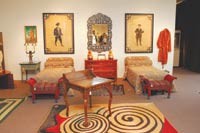
The designer’s modernist eye also can be seen in the hundreds of items from his New York City apartment and Long Island home that will be sold, including furniture and design by Jean Prouvé, Ferdinand Parpan, Leon Jallot, Jan and Joël Martel and Jean Lambert-Rucki, as well as paintings and works on paper by such modernists as Jean Arp, Alexander Archipenko, Salvador Dali, Man Ray, Keith Vaughan and the Russian artist Pavel Tchelitchew.
During a far-reaching discussion that tracked the crux of his career from the Sixties up until his death last year, fashion insiders Grace Mirabella, Jade Hobson Charnin and Kim Hastreiter remembered the exacting designer whose clothes Bill Cunningham once described as having “the bravado of an orange peeled in one movement.”
After seeing the work of the Paris-based designer Elsa Schiaparelli, especially the wit infused in her pieces, Beene became a big fan and started adding witty touches to his work, Mirabella said. She also noted how, in 1971, he became one of the first American designers to launch a secondary collection, Beene Bag. A few years later, a critical New Yorker review prompted him to replace his of-the-moment structured clothing with more lightweight and free-flowing pieces.
Related Articles
You May Also Like
“He would take a dress and crumple it in the palm of his hand and say, ‘This is modern dressing,'” Charnin said.
When an image of a Beene-clad model holding a vicious dog on a leash flashed on the screen during the visual presentation, Charnin recounted how Vera Wang, who worked at Vogue before she started her bridal business, had a mishap during that shoot. “She called me and said, ‘Jade, the doberman ate the dress.'”
“Actually, it was a pajama, but they got the picture first,” Mirabella interjected.
Charnin continued, “I told her, ‘OK, I’ll tell Grace if you tell Henry Ginsberg, the businessman behind Beene.'”
Another image during the visual presentation depicted his sketch of Linda Byrd Johnson’s wedding dress with the header “That Wedding Dress.” But, Mirabella said, “he wasn’t interested in doing what we now call celebrity dressing.”
Later, during a panel discussion, the choreographer Martha Clarke noted that, when her dance troupe needed funding to take “Vienna: Lusthaus” on the road, Beene overnighted a check. In the Nineties, Beene moved away from traditional runway shows, preferring to work with dancers. Hastreiter said of Beene, a former premed student: “To him, a body without movement was a statue.”
One of Beene’s longtime friends, Helen O’Hagan, described how he trekked to Canal Street — long before it was fashionable to do so — searching for plastic piping for a jacket or combing through farmer’s markets in different cities for sweet peas. “At flea markets, church bazaars or tag sales, he always found something to buy. I never saw someone who could zero in on something that was the best in the collection. His eye got it and he got it.”