
ST. GALLEN, Switzerland — They built this city on embroidery — and it’s ready for its close-up.
On Friday, four major museums here will unveil exhibits devoted to fashion and St. Gallen’s rich textile history, showcasing everything from a gown composed of delicate layers of organza to a leather-clad performance artist chained to a chair — a real slave to fashion.
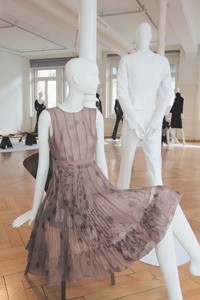
The centerpiece is a sprawling exhibition at the Textilmuseum mounted by Akris, the fast-growing firm that helped put this picturesque Swiss city on the international fashion map with its cashmere double-face jackets and luxurious and modern sportswear. A group of international editors, retailers and VIPs will be invited to tour the citywide cultural event, titled “Schnittpunkt” — the German word for “crossroads” — on Sept. 30 between the Milan and Paris fashion weeks. Organizers hope to welcome more than 50,000 visitors over the next four months.
“Everybody now goes to India for embroidery, but this is a tradition we also have in Europe,” said Akris designer Albert Kriemler, a walking encyclopedia of his hometown’s textile lore and a passionate guardian and cheerleader of its savoir faire. “I’m proud that we still have an industry here that does something that’s the best in the world.”
It’s all there for the public to reach out and grab at the Akris exhibition, which Kriemler hopes will “explain how we work and who we are.” Visitors accustomed to seeing dresses behind glass will encounter no such barriers here. Kriemler put Akris designs from the Eighties through to the current fall season in stairwells and hallways, even installing racks of double-face and leather jackets from sizes 2 to 12 for people to try on. And don’t miss what the designer calls his “cashmere feel room,” where bolts of the luscious stuff beg to be stroked. “It’s really about feeling this exhibition, not only looking at it,” he stressed.
While even industry folk associate St. Gallen with couture fabrics, Kriemler hopes the exhibition will prove “there is also an industry behind it….I use St. Gallen embroidery for everyday clothes.”
Indeed, one of the garments from Kriemler’s current fall-winter collection most in demand from editors is a coat that reprises a vintage St. Gallen embroidery design from 1963. And one of Akris’ best-selling blouses of all time, a stretch silk chiffon number from his fall 2002 collection, was trimmed with lily of the valley embroidery, circa 1953.
Related Articles
You May Also Like
Although the fashion house was founded in 1922 by Kriemler’s grandmother, who started out crafting aprons on a single sewing machine, the exhibition is not a retrospective, partly because the company did not archive its fashions until the early Eighties. Spread over three floors, the show documents Kriemler’s evolution as a designer and highlights the house’s obsession with divinely rich fabrics and sophisticated embellishments.
It’s also a hands-on introduction to broderie Anglais, guipure and sequins, three St. Gallen mainstays turned out by such mythic St. Gallen fabric houses as Jakob Schlaepfer, Forster Rohner and Bischoff. Rolls of the stuff undulate toward visitors, awaiting inspection.
But “Schnittpunkt” — which focuses on art as much as fashion — also gave these mills a chance to experiment, realizing fabrics dreamed up by six contemporary artists. These are on show at the Neue Kunst Halle.
“Have you seen these? They’re hand-embroidered spiders,” Tobias Forste of Forster Rohner said to Kriemler, showing a handful of the lifelike fabric tarantulas to Kriemler. “The ladies in the company dared not to touch them.”
Schlaepfer, meanwhile, churned out terry cloth dresses with Italian film stills burned onto them by lasers for German artist Rosemarie Trockel, and bolts of dense text etched into glossy, high-tech polyester for British artist Liam Gillick.
The Kunstmuseum and Historiches Museum also delve deeply into the links between art and fashion in surprising and amusing ways.
Roland Wäspe, director of the Kunstmuseum, noted that its impressive collection of Old Master paintings was bestowed by the Sturzenegger family, which built its fortune on textiles and tablecloths. These are mixed with thought-provoking works — including early Nan Goldin snapshots of her transvestite friends in Boston — for an exhibition titled “Lifestyle.”
“Fashion is more than surface. It has to do with identity,” Wäspe said, pointing, for example, to a tiny sculpture of Karl Lagerfeld by Berlin artist Karin Sander, crafted layer by layer by a computer after a 3-D body scan, a technology now employed for fashion.
Meanwhile, “Dresscodes” at the Historiches Museum demonstrates how dresses, in the hands of artists such as Yoko Ono, Lucy Orta or Beverly Semmes, are talking points for such complex issues as celebrity, homelessness and isolation.
For his part, Kriemler is confident the exhibition will enlarge St. Gallen’s renown for its textile industry, which employs an estimated 6,500 people, almost one-tenth of the population. “St. Gallen embroidery has always been important to us,” he said. “This makes the whole exhibition credible for me. I would have never done this in another city.”