
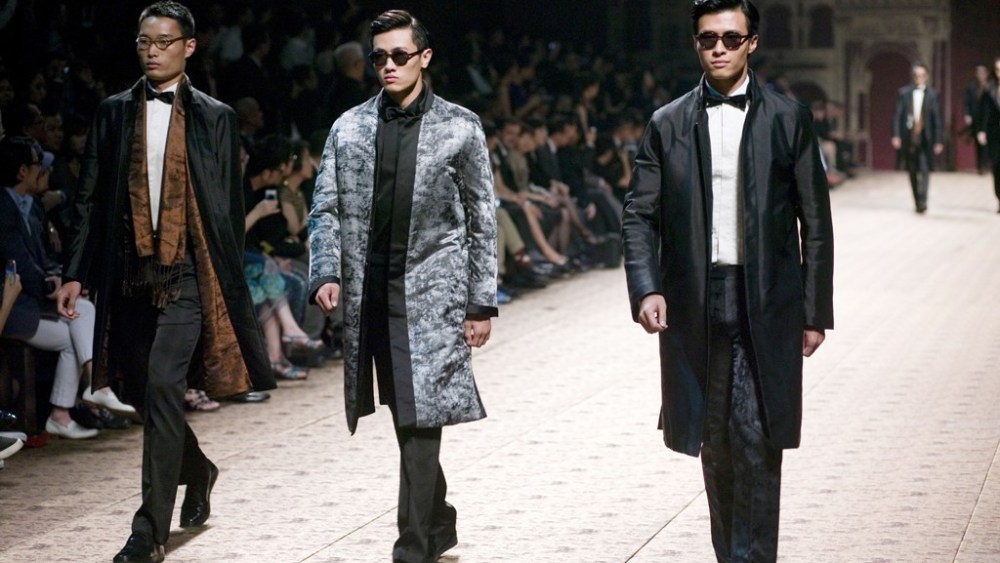
BEIJING — Selling luxury goods in China has never been simple, but in 20 years the fashion house Ermenegildo Zegna has discovered that a long view and patience are key to winning customers.
Now that China is closing in on Japan as the world’s top market for luxury goods, everyone wants a piece of the pie. But Zegna executives believe the company is uniquely positioned to remain a market leader.
Celebrating Zegna’s two decades in China, executives on Thursday discussed the challenges and opportunities this market presents, and focused mainly on the positive. They have reason for their optimism, as one of the top five luxury brands in China, which is now the company’s number one market in the world after passing the United States last year.
Related Articles
You May Also Like
“Considering that we’re only menswear, I think it’s quite an accomplishment,” Zegna chief executive Gildo Zegna said at a press conference ahead of the brand’s anniversary fashion show and party at a modern art museum on Thursday night. “The secret is in the DNA of the company…pioneering spirit and ambition.”
Zegna’s China presence started with one store in 1991. The company now has 75 stores in 32 cities and plans to increase that to about 80 by the end of the year, the ceo said. He said executives are even exploring the possibility of reaching into fourth-tier cities, smaller urban areas where luxury consumers are only just beginning to emerge.
Of course along with being a top luxury brand comes increased competition from other menswear lines seeking to capitalize on China’s emergent wealth and taste for luxury goods.
The executive said he’s confident of the company’s position, but he doesn’t plan to rest on past laurels. Instead, Zegna is unrolling new global brand stores, along with collectible items like limited-edition watches to lure style-conscious men.
Zegna is even more optimistic about China than many analysts, who see the luxury scene here gradually outpacing other countries.
“China is competing with Japan to be the number two luxury market in the world,” he said, adding that he thinks that could happen by next year.
Last year, Ermenegildo Zegna’s net profit reached 60 million euros, or $79.2 million, compared with 17.3 million euros, or $24 million, in 2009. Revenues surged 21 percent to 963 million euros, or $1.27 billion.
Asia accounted for 46 percent of Zegna’s revenue, led by China, which grew over 30 percent. In China, the company opened four new stores designed by Peter Marino, including a flagship in Shanghai, its largest store to date. Zegna is also looking at launching an online store in China at the end of this year or early next year.
“It’s the importance of being an insider,” Zegna said of the brand’s growth in China. To that end, the executive said the company is heavily focused on understanding individual local markets in China and building sales staff and product offerings to meet demand.
As evidence: Zegna’s fall/winter 2011 collection, “In the Mood for China,” first unveiled in Milan in January and shown again in Beijing Thursday night at the house’s anniversary party. The collection, which was dedicated to China, features suits the house says were inspired by the Chinese Revolution of the last century, and mixed of other details paying homage to Forties style.
Beyond particular products, executives said well-trained employees are key to Zegna’s growth in China, where male customers tend to be far more reliant on the advice of sales associates than in Europe or the United States.
“Here, they value highly the recommendations of the sales associates,” said Zegna.
Some other notable difference in Zegna’s China customer base: Chinese men shop in groups, as a leisure activity, and visit stores 7-10 times per year. In other words, shopping is fun. That’s compared with traditional markets, where customers visit once or twice a year. And unlike in other markets, Chinese men are strong consumers of luxury items.
“China has historically been more of a men’s market for luxury than women’s,” said Zegna.