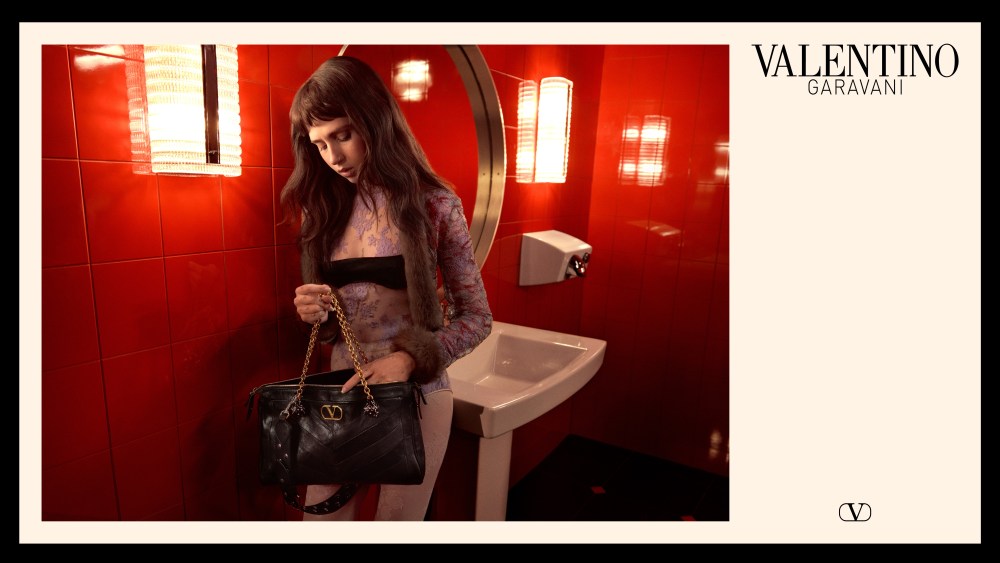
MILAN — Alessandro Michele does not want speed to be part of his vocabulary.
Valentino‘s creative director turned once again to his longtime collaborator Glen Luchford to photograph the brand’s fall 2025 campaign, unveiled exclusively with WWD, and penned a letter to say that “nowadays fashion is more and more an expression of a hypertrophic and accelerated world, stubbornly pursuing the promise of novelty: new forms, new traces, new stories.”
Michele is aiming to go in a different direction, as he did with his pre-fall campaign for Valentino urging a return to a more long-lasting gaze.
You May Also Like
Related Articles
“In such a whirlwind, I chose to dwell in a different gesture: not running, but lingering,” Michele continued in his letter. “Not opening a new chapter, rather delving into a theme already unfolding. I chose not to consume the latest thing. Rather, I decided to let the images and the interrogations sediment and grow within a vertical excavation.”
He referenced the topics of the fall show, dubbed “Le Méta Théâtre Des Intimités” and held in Paris in March, “to continue questioning the close relationship between identity and robing practices. Here comes the public bathroom again: a counter-place where private and relational dimension mingle, where the visible challenges the invisible, where decency collides with guilty pleasure and exposure flirts with occultation. It’s a liminal space that, in this campaign, becomes enriched with new bodies, gazes and encounters, becoming an unfailing scene of possibilities.”
The campaign is fronted by American singer-songwriter Clairo, who is also a Valentino brand ambassador; American interdisciplinary artist and rock musician Kembra Pfahler; Aimée Byrne; Isabella Pascucci; Shane Stevens; Hana Janata; Sanique Dill; Weiyi Fang; Bukwop Kir; Paul Scally, and Giuseppe Cirillo.

The talents are seen posing in a public bathroom with red and black tiles, reproducing the set of Michele’s sophomore Valentino ready-to-wear show, staged in a giant public toilet bathed in red light. In his show notes at the time, the designer described the space as “dystopian, disturbing, Lynchian.”
Conceiving the campaign, Michele argued that “it was like imagining a life after the show: How many other existences could that uncanny and choral space host? How many other unspoken desires could take shape there? And which different intimacies would be reflected in its corridors?”
Indeed, in March the designer told WWD the show was about exploring the performative nature of intimacy, and the way we construct our identity through clothes.
“We know, fashion has always been a language of appearance, a device that stages bodies and exposes them to the gaze. Even in our most intimate dimension we can’t escape such exhibiting nature,” Michele continued in the letter.
He believes the late historian and philosopher Hannah Arendt “had it perfectly clear: being and appearing coincide, it’s what frames our very existence in the world. Accordingly, clothes certify their status of second skin, the means through which we decide to show ourselves on the stage of life.”
The designer concluded that “it may be just this, fashion’s most valuable legacy: depth showing itself as an interweaving of surfaces and intimacy revealing its political and poetic strength. Not at all motionless essence, but endless motion. Not a private shelter, but a shared scene.”