“It’s just been a dream come true.”
For Hannah Rose Dalton and Steven Raj Bhaskaran, best known as the creative entity Matières Fécales, the past year has been a watershed moment, albeit one they built toward over the course of a decade.
What began as an artistic exploration of identity and otherness for the Canadian couple, who trained as patternmakers at Montreal’s Collège LaSalle and are content creators, performance artists and DJs, solidified as a label that is part of the brand development division of Dover Street Market Paris.
Related Articles
Since then, Matières Fécales has enjoyed a remarkable debut show last March with the likes of Chappell Roan in the front row followed by a well-received sophomore show in a gilded salon on Place Vendôme, with pieces spotted on the likes of Daphne Guinness, Tilda Swinton, FKA Twigs, Lady Gaga, Playboi Carti and Rosalía.
You May Also Like
Meanwhile, the brand also garnered a raft of 38 retailers around the world.
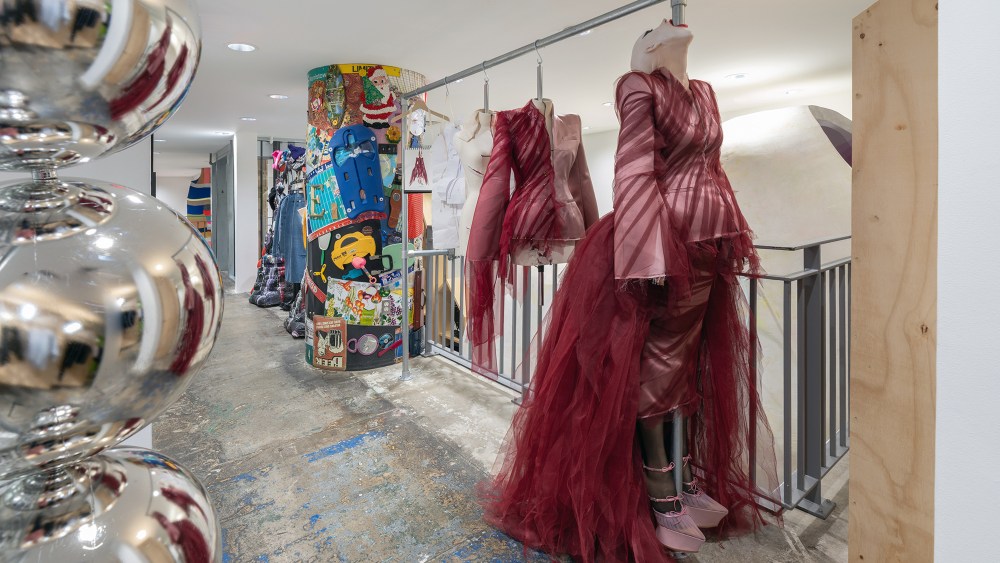
Better yet, the duo has started to carve out their own retail presence, with shop-in-shop outposts in Dover Street Market New York, London and come late March, Ginza in Tokyo.
“It’s just been very much a learning experience, which has been super cool,” said Bhaskaran, during a showroom appointment in the run up to their fall 2026 show on Tuesday.

“To start a year ago with just an idea — we built the first collection in a year and a half — just us doing our thing and then launching it,” he continued. “To now see people wearing the pieces, that’s just so new for us, it’s been very exciting.”
All in all, “it feels great to be a brand called Matières Fécales that is able to have such a great reception, not just esthetically and online” but also commercially, the pair said.
But Dalton and Bhaskaran are not letting the heady pace get to them. From the onset, they have had their first four collections mapped out, as much a creative decision as a strategy to build brand signatures and cement recognition.
Taking 18 months to bring to life the first collection was about “building the foundation of a house that hopefully we can live in for a very long time and hopefully, other people can live in, enjoy and participate in,” Bhaskaran said.
The pair are intent on forging ahead “because we think we have something to say in both as designers, but also as a brand,” he continued. “And it’s exciting to be able to articulate our vision through a brand that is our own, not [as] the creative directors of something else, so we have the freedom to build the foundation of what we want to say, and we’ve been able to do that so far.”
That said, they named the biggest challenge they faced as “transitioning from being a designer to being a brand, which is a whole different ballgame,” he added.
In this early stage of their label, the pair are focusing on consistency, parlaying recurring technical details such as the sharply turned out shoulder introduced in their first collection, which along with a tell-tale cross-shaped back seam have become shorthand for their aesthetic.
“As a luxury consumer, if I’m going to a brand, I want to know what to expect. Take Rick Owens, you know what a Rick Owens blazer looks like. I love that continuity and going into our own brand I would want the same thing,” said Dalton. “To me, Chanel is so successful because I can [readily] think of five products already. If I’m looking for that, I know Chanel will [offer that] to me.”
Following this approach is what account for the vitality of the brand, which added 14 doors for spring 2026, up from 24 doors for its inaugural fall 2025 collection.
For its first season, sell-through was 70 to 80 percent in a number of stores, according to the brand, with several retailers reordering items that sold out straight away. Dalton pointed out that remaining pieces weren’t included in end-of-season markdowns.
Tailored garments, which account for 30 percent of its wholesale revenue, proved as popular as more accessible jersey and denim categories. Meanwhile, couture and custom special orders have continued to come in.
“[Stores] told us that people just got it immediately because they already got us immediately because of the decade of work that we’ve done and put out there, so they already understood the vibe,” said Bhaskaran. “It’s easy to understand and it’s easy to also make the association [with] Matières Fécales.”
Matières Fécales’ broad price range, which starts around $150 for a T-shirt and goes north of $3,500 for, say, a sharp-shouldered blazer in exquisitely hand-tooled tweed, has been a success factor.
Dalton said that on a recent visit to Japan, one of Matières Fécales’ main markets, products had flown off the shelf in equal measures from retailers who had purchased at either end of the spectrum.
“Having both extremes doing really well has been super amazing for us because I would never want to be in just one or the other,” she added. “I think that’s helping because it’s not just focusing on one type of store. Many types of stores can buy with Matières Fécales.”
Despite this early wholesale success, the duo isn’t about to put pedal to the metal to grow their wholesale accounts, prefering to focus on deepening existing relationships.
“What we do is very specific, and we want it to be specific,” Bhaskaran said. “We’re being very picky in terms of the stores we want to be part of [because] not everyone gets it and there’s no point sending stuff [and] it doesn’t sell, and then it’s part of that whole cycle we don’t want to be part of as much as possible.”
For the Canadian creative couple, the next frontier in growing their brand is adding their own retail to the mix. There are plans for e-commerce in the short terms but they want to get physical soon, too.
This would see them build footholds in their main markets of the U.S., Japan as well as Paris and London. Not that they’d just drop their wares in a traditional luxury retail framework.
“When you go to a lot of luxury spaces, it’s actually very cold — marble, beautiful architecture and the person is super perfect,” said Bhaskaran. “For us, it was important to have a homey experience [showing] our journey of developing the collection.”
Matières Fécales being who they are, that means life-size realistic sculptures of, say, Dalton swallowing a clothing rack pole or the duo and their cat during a fitting — installations respectively in New York and London’s DSM spaces.
“It’s a bit of what a designer sometimes has to go through to work and sell,” he quipped.
Striking up these kinds of conversations is what the pair are going for. For Bhaskaran, “in marketing, in business, why can’t we also promote critical thinking? Why can’t we also present these very interesting concepts?
“Depth in the luxury space is what [consumers] want from us and we’re going to give them that,” he continued. “So it’s really a match made in heaven, where we have the audience, we have the clients, we have the interest and the connection of people that crave this dialog that we’re creating with them.”
Whether this results in a purchase isn’t the immediate goal, either. “I still think the consumer takes away with something, even if it’s not a product and that’s important, too,” said Dalton. “It’s not all about money at the end of the day, right?”