
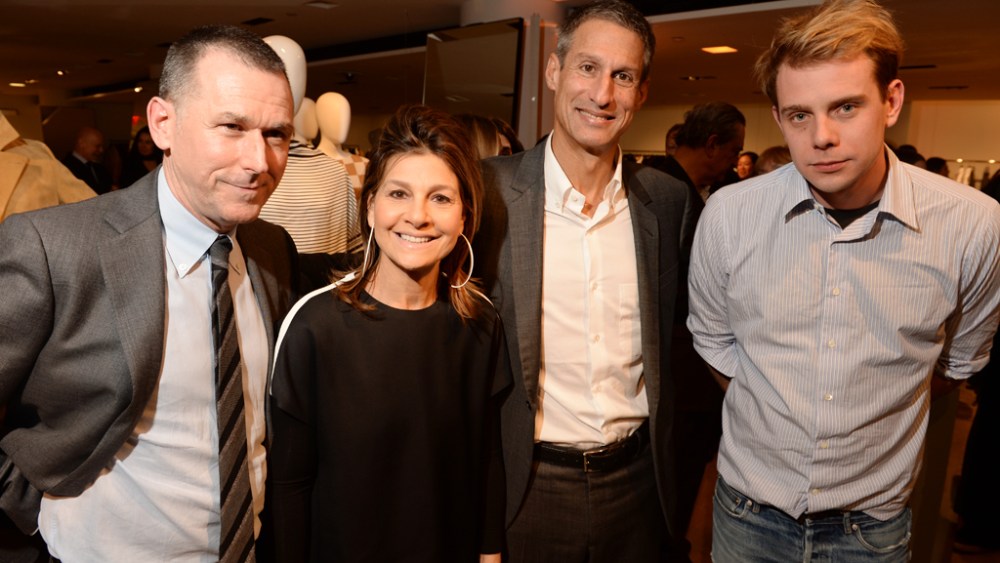
Three days after the completion of Paris Fashion Week, where Jonathan Anderson showed his second women’s Loewe collection, the Spanish luxury brand put him on a plane to America. The ultimate destination was Miami to officially open Loewe’s first North American flagship in the Design District. It’s an important store for the brand — and for Anderson, his first hard wrought, retail creative design concept, which involved importing an 18th-century granary from pastoral Spain and erecting it within the store’s white box motif.
Anderson had never been to Miami and his visit happened to coincide with the American collegiate rite of spring break. “I have no idea what to expect,” he said. “Everyone says it’s like Jennifer Lopez’s ‘Love Don’t Cost a Thing’ video.”
Related Articles
Before he could see it for himself, there were obligations to fulfill in Manhattan, mainly to Barneys New York, which hosted a cocktail party and dinner at Betony on Monday night to celebrate the arrival of the complete range of the Loewe collection in its Madison Avenue store — a coup, as Barneys is the only American retailer to carry the full line. The U.S. is a small market for the brand, which is only beginning to approach now with one store and a few specialty retailers, who are likely queueing up. “At the moment we have 12 doors in the U.S. It’s a tiny business for us,” said Lisa Montague, chief executive officer of Loewe, who intends to keep distribution small.
You May Also Like
“He’s revitalized such an extraordinary brand and he’s done it very quickly,” Tory Burch said of Anderson at Betony. She should know — “I used to do [Loewe’s] PR in the U.S. Isn’t that funny?” Burch attended the dinner with Pierre-Yves Roussel, the LVMH Möet Hennessy Louis Vuitton executive who oversees Loewe, along with Vanessa and Victoria Traina, Barneys ceo Mark Lee, editors and Montague.
Anderson’s mini U.S. tour fell at the point on the fashion calendar when almost everyone involved in the monthlong feeding frenzy is completely burnt out, yet as he put it, “fashion is very hard to turn off. You feel like you’re still in the cycle.” It’s always ongoing, as he knows. Once he’s done with Miami, the designer has to complete the men’s advertising campaign and videos, then finish resort for J.W. Anderson and Loewe.
“It’s just like, where are the ideas going to come from?” he asked rhetorically, sitting at the Bowery Hotel on Monday morning.
Anderson does not lack for intellectual thoughts on how to approach a collection. His own fall lineup for J.W. Anderson, for example, sent editors, stylists and retailers into a tizzy with its overtly Eighties inspiration, which he came upon by way of an overarching chronological strategy. “Over the last couple of seasons I’ve been looking at this idea of nostalgia, where fashion kind of consumes itself,” Anderson explained, unpacking his philosophical position as he twirled his unkempt blond hair. “I wanted to go through an expelling process to consume the decades to move forward.”
By the time he finished exorcising the Sixties and Seventies in his men’s collections, he was bored with the eras. The Eighties offered something more substantial. “I fell in love with that moment,” he said. “We have such a really odd relationship with the Eighties, because it was this moment when we became so excessive. But in fashion, as much as we have stigmas to it, there was a lot of groundbreaking, like Comme des Garçons looking at things in a very different way. The cuts and the shapes are extremely interesting.” Challenging is another word that comes to mind, one that Anderson clearly appreciates.
He shivered at the concept of the “wardrobe,” the fashion lingo of the moment for the “real” clothes emanating from the House of Louis Vuitton. “Fashion has shafted itself into this awful position,” he said. “We work bottom line, but we don’t realize to get to bottom line we need to have ideas. I think we have forgotten how to excite each other; we need competition with each other, we need things that are wrong.”
In the arc of fashion history, perhaps nothing is considered more wrong than the Eighties.
As for the competition, Anderson keeps up with his peers, though he has a rule to not look at other designers’ collections until the season is over. He had yet to fully review fall 2015 aside from what he picked up on Instagram. He liked what he saw at Marc Jacobs. “At least it’s a commitment to something,” Anderson said.
As Burch said, at Loewe, Anderson has abruptly resuscitated a very sleepy brand in two seasons by unapologetically committing to bold fashion. The fall collection was a scientific Eighties exploit with colorful leather lab coats, goggle-esque sunglasses and mutlicolored Puzzle bags, his influential contribution to the current notion of “It.” Making Loewe relevant has been simplified a bit without a real ready-to-wear legacy to live up to, though the 170-year-old leather history looms. “I love that Loewe has a museum. I love to revere it and dream about the time that you were on a boat and you were extremely wealthy and you have a full-length gown and an umbrella and a small dog,” said Anderson of his thoughts on the archive. “It’s great, but my sister gets on an easyJet flight and she needs a bag that she can cram into it so she doesn’t have to pay extra. She needs it to fit a weekend’s amount of clothing. I feel that was my initial response to the brand. How does it operate right now?”
As part of that, Anderson rejects the popular definition of luxury. “I don’t believe in this idea of luxury anymore,” he said. “That weird notion of luxury for me is like shopping in an airport.”
A Loewe Puzzle bag retails for about $2,690. A one-way ticket from London to Madrid, where Loewe is based, costs as little as $120.