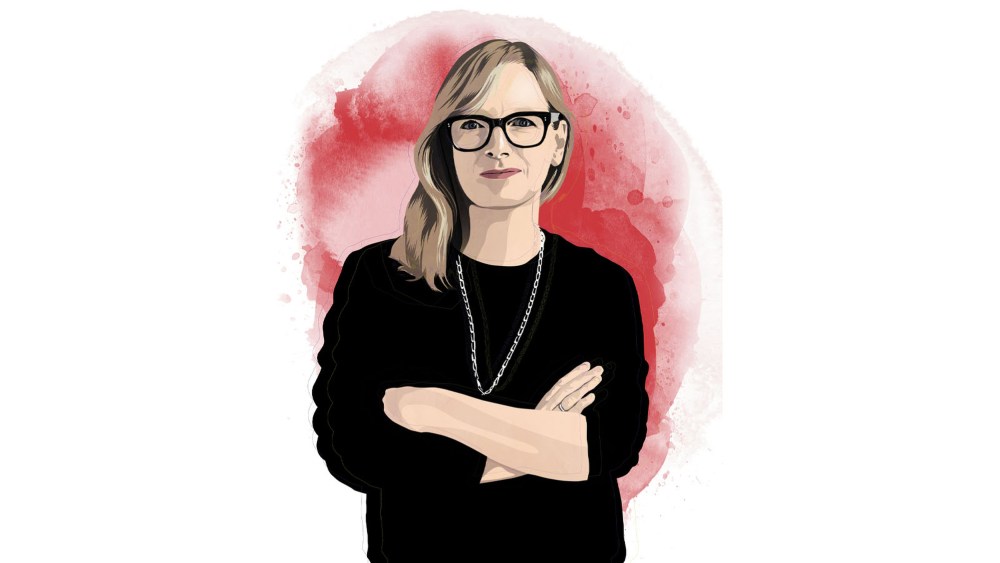
Lee Alexander McQueen had been the head designer at Givenchy for roughly a year when he hired Sarah Burton straight after her graduation in 1997 from London’s Central Saint Martins College of Art and Design.
As womenswear designer for the incendiary British talent’s signature label, those were her first brushes with the storied French couture house.
Accustomed to McQueen’s higgledy-piggledy studio in London — a warren of chilly rooms stacked with plastic tubs full of patterns, trims and whatnot — Burton recalled the gust of glamor she felt when she stepped into Givenchy’s sunny, grandiose headquarters on the Avenue George V.
Related Articles
It was also her first exposure to an in-house atelier, cementing her and her boss’ devotion to the art and craft of making clothes.
You May Also Like
“I remember how much Lee appreciated the ateliers, how much he learned from them, and how much that brought couture into what he was doing at McQueen,” she recalled. “It was definitely a turning point for how he made clothes. I think they really respected him, and he really respected them.”
Although she did not spend as much time in Givenchy’s ateliers as McQueen, the proficiency of the ateliers struck her also.
“We were working in London, going to Brick Lane for fabrics, and it was so creative. You really had to think out of the box because there wasn’t the money to do things,” she said. “But when we came to Givenchy, it taught all of us skills.

“Everything was made onsite over there, so that was amazing,” she added. “You had a constant conversation with the ateliers and you realized how important are the hands that make the clothes.
“It was very glamorous, much more than the [McQueen] London studio,” she said with a burst of laughter. “It had a beauty to it. And I remember it always being light in the room.”
More than that, it had a big impact on their working methods.
“It taught Lee, and then me, how to do a collection almost like a couture collection,” Burton said. “When I design a collection, it’s not 1,000 rails of clothes and then you put looks together. It starts with the silhouette, and it becomes like characters…each one is an individual. So when you get to putting the collection together, it’s quite clear who those women are.”
That said, she appreciated straddling gritty London and refined Paris.
“We’d use those plastic tubs quite often. One day, a tub might have beads in it, and the next day you’d be tea-dyeing lace in it to make sure we got the right color,” she said. “It was quite nice, that juxtaposition of not being too precious, because I think sometimes if you’re too precious about things, you don’t experiment.”
Born in Cheshire in the north of England, one of five children of an accountant father and a music teacher mother, Burton was fascinated with clothes from an early age.
She studied print fashion at the Central Saint Martins and landed an internship at McQueen after one of her instructors, Simon Ungless, introduced her to the designer in 1996. Her design responsibilities there grew organically, ultimately extending to menswear, accessories, footwear and other categories.
Burton spent most of her career — 26 years — at McQueen, ultimately taking the creative helm of the house, somewhat reluctantly, in the wake of the designer’s suicide in 2010.
A fastidious fashion technician prized for dramatic tailoring and intricate, yet empowering dresses, Burton added a feminine touch to McQueen’s hard-edged aesthetic. She would remain true to the brand’s pin-sharp tailoring and darkly glamorous aesthetic for another dozen years, presenting her final collection for the spring 2024 season.
She would not remain idle for long, though, appointed to the helm of Givenchy in September 2024, becoming Givenchy’s eighth designer — and only its second female couturier.
Founded in 1952 and owned by LVMH Moët Hennessy Louis Vuitton since 1988, the house has seen a number of designers come and go since founder Hubert de Givenchy retired in 1995. (Matthew M. Williams, Clare Waight Keller, Riccardo Tisci and Julien Macdonald came before Burton, in addition to McQueen and John Galliano, de Givenchy’s first successor.)
How is Burton finding the adjustment to a new house?
“I love it. It’s like a breath of fresh air,” she said with another gust of laughter. “It’s great to have a clean, white page. But also Lee was here, so I feel like I know it.
“One of the first things I did was get all of his pieces, John’s and Hubert de Givenchy’s pieces out of the archive to look at them. So it feels like he was present. A lot of the codes he used are still relevant — the tailoring, the dresses, the silhouette.”
Burton said she’s enchanted to work with Givenchy’s “amazing” menswear and womenswear ateliers, which she’s been enhancing and growing.
Her joy shows.
Burton nailed her debut Givenchy show for fall 2025, an exhilarating display of new silhouettes, including dramatic hourglass coats and jackets, geometric baby-doll dresses and austere gowns. The clothes were superb, peerlessly realized and immediately desirable; sometimes young and zesty, but most often the pinnacle of adult sophistication.
“Here was a show where you could sense how proud the models were to wear [the clothes], and the entire cast of diverse sizes and ages looked gorgeous,” WWD opined at the time.
During her initial excavation into the archives, Burton was struck by de Givenchy’s “relationship with women, his friendships with women, and his wanting to make women feel at their very best — understanding the moments in their lives when they wanted to feel a certain way,” she said during a conversation before her debut last March.
When Burton worked with director Jonathan Glazer on a film a few years back, she experienced a heightened version of this.
“We did quite a lot of casting, and when the characters would come in the room, and if they put on something I’d made and they didn’t feel comfortable, I would completely change it,” she recalled. “It’s the same with models, or anybody. You know immediately when somebody feels themselves in an outfit. Because clothes shouldn’t overpower you. They should make you feel a certain way, and give you a strength but still make you still feel yourself.”
Burton’s sophomore show for Givenchy earlier this month was equally beguiling. It saw her bring more of a sexual pulse to the expert tailoring and dressmaking via sheer fabrics, peeling and stand-away necklines, short hems, slit skirts and bra tops galore.
She pulled it all off with remarkable restraint and finesse, earning her strong reviews — and the 2025 WWD Honor for Womenswear Designer of the Year.
Retailers say they are very encouraged by what Burton is bringing to the French house.
“A clarity of design is clearly emerging at Givenchy,” said Bosse Myhr, director of womenswear and menswear at Selfridges in London. “For many years we had a very loyal customer base for Burton’s McQueen. Now at the helm at Givenchy, we are confident that this same customer will continue to engage with Burton’s design and also be excited about a new, considered approach for the maison.”
With her debut fall 2025 collection just arriving on the store floor, Myhr said early signs are “encouraging,” especially on dresses and tailored suiting.
“The lines are very refined and elegant,” he noted. “There is also a day element to the new Givenchy which is clearly recognizable as Sarah Burton-designed — wearable and desirable.”
Rickie De Sole, vice president and fashion director at Nordstrom, said Burton’s initial Givenchy collections confirm the power of simplicity.
“The perfect trench, the crisp white shirt — but nothing is as simple as it seems,” she said. “Her approach tells a woman’s story — a woman designing for women and the power that comes with that.”
De Sole said when Cate Blanchett wore Givenchy’s new Cocoon bomber jacket at the New York City premiere of “Black Bag,” it had an immediate impact at the store level.
“It is our top-selling piece,” she said. “Leather jackets are extremely popular, followed by dresses. What’s great about Sarah’s Givenchy is its timeless appeal that women of all ages can embrace. We do quite well with jackets, followed by dresses and knitwear.
“Her work explores the impact of shape, showing how a curve can reshape the way we dress,” she said. “The bold shoulder and nipped waist strike a balance between masculine structure and feminine softness.”